



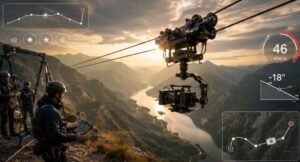
A broadcast camera can cross a football field without wheels, rails, rotors, or a crane. It does it by changing the length of several tensioned cables by tiny, coordinated amounts.
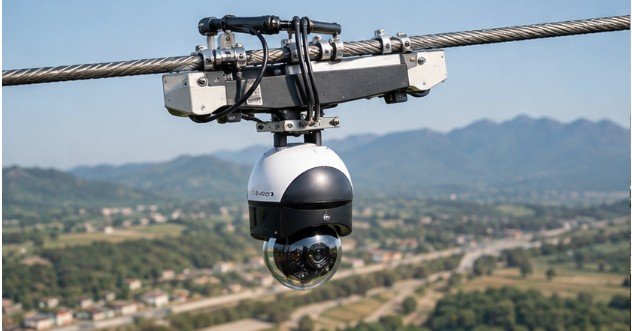
That is the basic answer to how overhead cable cameras work. Systems such as SkyCam and spidercam suspend a stabilized camera platform from multiple high-strength lines connected to motorized winches. Software converts a pilot’s joystick input into synchronized cable movement, while a second operator controls the lens and framing.
SkyCam says its systems support more than 600 marquee events annually and that it has nearly 40 deployable systems across the United States.
The Camera Is Really a Cable-Driven Robot
The camera looks as if it is flying, but there is no lift from propellers. The platform is positioned by cable tension.
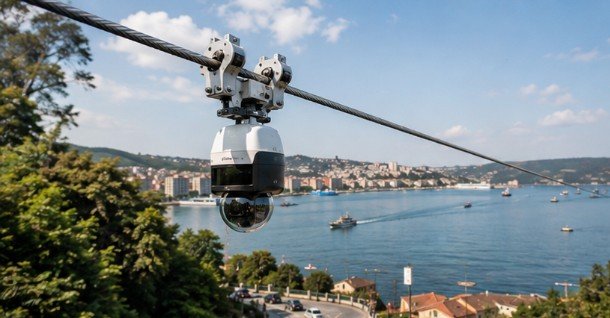
In a typical four-point system, winches sit at high corners or engineered anchor locations. Each winch pays cable out or pulls it in. If all four lines change length in the correct proportion, the platform can move forward, backward, sideways, upward, downward, or diagonally.
No single cable “steers” the camera. Position comes from the relationship among all cable lengths at the same moment.
Yaskawa, which supplies servo technology used by SkyCam, describes its servo motors and SERVOPACK amplifiers as the motion hardware behind the system. Servo control matters because broadcast moves need both speed and precise acceleration.
From Joystick Input to a Flying Shot
Understanding the sequence makes the technology much easier to visualize.
1. The Pilot Requests a Direction
A trained pilot moves a joystick rather than controlling individual winches. The computer interprets that request as movement through X, Y, and Z space.
2. Software Calculates Cable Changes
The control system determines how much each line must shorten or lengthen to reach the new position while maintaining usable tension.
This happens continuously. A smooth diagonal move, for example, may require all four cables to change length at different rates at exactly the same time.
3. The Winches Move Together
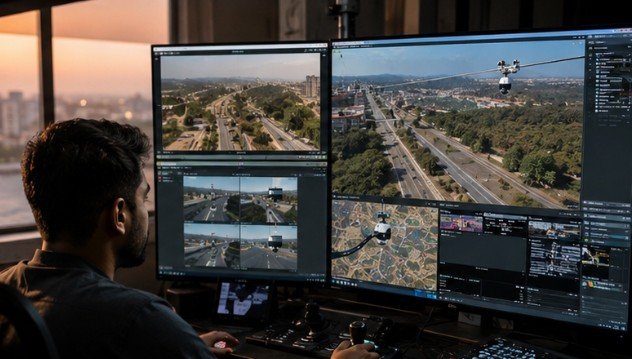
Servo-driven winches accelerate and decelerate in synchronization. Beckhoff’s technical description of spidercam says four motor-operated winches coordinate their winding and unwinding to create the flight path. The system it documented can reach 9 meters per second, or roughly 20 mph.
That speed explains why these cameras can follow football players, sweep through arenas, or transition quickly from a wide establishing view to a dramatic low-angle tracking shot.
4. A Stabilized Head Controls the Picture
Platform movement and camera framing are separate jobs.
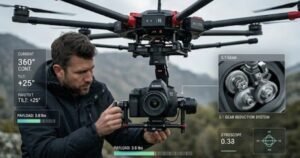
A motorized gimbal or remote head keeps the image steady and allows pan, tilt, zoom, focus, and sometimes roll to be adjusted independently. Ross Video says spidercam combines passive and active stabilization with modern gimbals, including setups designed for augmented-reality production.
This separation is important. The pilot can concentrate on safely positioning the moving platform while the camera operator concentrates on composition.
5. Fiber Carries Video and Control Data
These rigs also need high-bandwidth communication.
Ross says spidercam carries camera, lens, microphone, tally, and control signals through fiber-optic connections, including 4K UHD workflows. Beckhoff describes specially manufactured spidercam lines with fiber incorporated into them for image transmission.
Not every overhead camera system uses identical cable construction. Therefore, the often-repeated description of “Kevlar cable with fiber inside” should not be treated as a universal specification. The broader principle is that suspension, motion control, video, and data transmission are engineered as one coordinated system.
The Four Parts That Make the Shot Possible
| Component | Main job | What viewers notice |
| Winches and servos | Change cable length precisely | Smooth travel |
| Cables and anchors | Suspend and position the platform | Large flying area |
| Stabilized head | Aim and steady the lens | Level footage |
| Control software | Coordinate movement and limits | Repeatable paths |
Venue geometry matters just as much as camera choice. Ceiling structures, scoreboards, lighting grids, anchor positions, audience areas, and cable clearance determine the actual flying envelope.
An indoor arena cable camera setup guide is useful because a coordinate that is mathematically reachable may still be unsafe, obstructed, or visually unsuitable.
Why Use Cables Instead of a Drone?
Cable cameras and drones can both create aerial-looking shots, but they solve different production problems.
Cable-based systems can support larger professional camera packages, operate with very low noise near the camera platform, provide precise positional information for graphics, and stay aloft during long broadcasts without repeatedly landing for flight-battery changes. Drones, meanwhile, are faster to deploy and can cover much larger outdoor areas.
The main disadvantage of a cable system is infrastructure. It needs suitable suspension points, installation time, calibrated equipment, carefully defined operating zones, and trained crews.
That makes cable cameras particularly effective for controlled stadiums, arenas, studios, concerts, and repeat live-event environments rather than rapidly changing locations.
Safety Is More Than Strong Cable
One of the biggest misconceptions about how overhead cable cameras work is that safety mainly depends on using extremely strong lines.
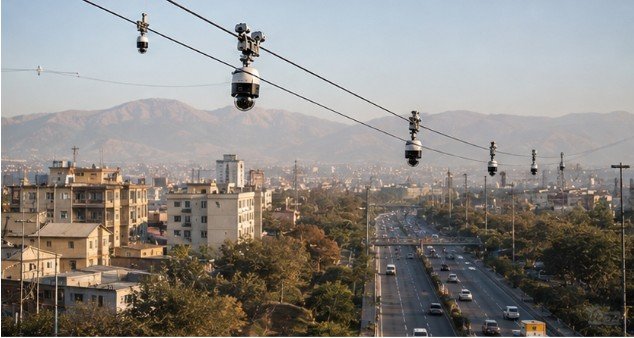
Cable strength is only one layer.
Modern systems also rely on software boundaries, operating zones, system diagnostics, inspections, communication procedures, trained operators, and engineered motion limits.
Ross Video’s 2026 Bell Centre installation describes visual cable inspections, communication checks with the winches, system diagnostics, geofencing, defined operating zones, and pre-event procedures before the camera is cleared for operation.
Cable routing deserves similar discipline. Good camera cable concealment and rigging practices reinforce a basic production principle: cable paths should be planned, protected, inspectable, and serviceable rather than improvised.
Crews who also work with fixed surveillance systems can review how to wire a CCTV camera system to understand signal, power, routing, and termination before dealing with more complex motion-control infrastructure.
A Five-Question Pre-Flight Check
Before a cable camera moves above a live production area, the crew should confirm:
- Are the anchors, lines, winches, brakes, and connections inspected?
- Is the software calibrated to the venue’s actual geometry?
- Are floor, ceiling, wall, and restricted-zone limits defined?
- Do the pilot, camera operator, technician, director, and venue team have a clear communication plan?
- Has the intended camera move been tested safely before full-speed operation?
A rig powering on successfully does not automatically mean it is ready to fly.
Frequently Asked Questions
1. How does an overhead camera work?
Motorized winches change several cable lengths simultaneously. Software coordinates those changes so the suspended camera moves through 3D space while a stabilized remote head controls framing.
2. What are the downsides of using wired CCTV cameras?
Wired CCTV requires physical cable installation and may need separate signal and power paths. This can make installation, relocation, and expansion more labor-intensive than wireless alternatives.
3. How do coax cameras get power?
Standard analog cameras normally need a separate power supply. Power-over-Coax systems can carry video and power through one coaxial cable, but both the camera and DVR must support PoC.
4. What are the disadvantages of dome cameras?
Dirt, water, scratches, and infrared reflections on a dome can reduce image quality. Dome surfaces therefore need careful installation and periodic cleaning, particularly for cameras using built-in IR illumination.
The Shot Looks Weightless Because the Engineering Is Not
The best explanation of how overhead cable cameras work is not simply “four cables and a camera.”
It is synchronized robotics: motors, cable geometry, stabilization, fiber communication, software limits, trained operators, and disciplined rigging working fast enough to disappear from the viewer’s attention.
That invisibility is the real engineering achievement. When the system is working properly, the audience notices the touchdown, performance, entrance, or dramatic reveal—not the machinery carrying the lens above it.