



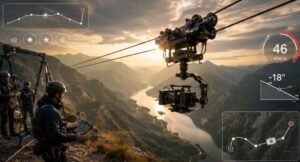
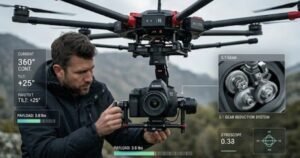

Two camera moves can send a viewer’s attention upward or downward and still create very different results. When I compare tilt shot vs pedestal shot, I use one simple rule: a tilt changes the camera’s angle, while a pedestal changes the camera’s physical height.
A tilt rotates the camera vertically on a fixed axis, much like nodding your head. A pedestal shot, also called pedding, physically moves the entire camera up or down while the lens can remain level.
What Actually Changes Between These Two Camera Moves?
The difference is angular movement versus spatial movement. During a tilt, the camera base stays in roughly the same place while the head pivots up or down. During a pedestal move, the whole camera rises or falls.
This distinction becomes even clearer when you compare static shot vs moving camera shot, because a tilt can redirect the viewer’s gaze without physically relocating the camera, while a pedestal changes the camera’s position in space.
Think of a tilt as looking up while standing still and a pedestal as riding an elevator while looking straight ahead. One changes the viewing angle; the other changes the physical point of view.
What Is a Tilt Shot in Filmmaking?
A tilt shot is a vertical camera movement created by rotating the camera up or down around a fixed axis. A tripod with a fluid head is the standard setup for a controlled tilt.
A tilt up may travel from a character’s shoes to the face for a dramatic reveal or from street level to the top of a skyscraper to emphasize scale. A tilt down can reveal an object, clue, or important detail.
This makes camera tilts particularly useful for establishing shots, character introductions, visual storytelling, and scenes where the audience needs to discover information gradually.
Does a Tilt Shot Cause Keystoning or Perspective Distortion?
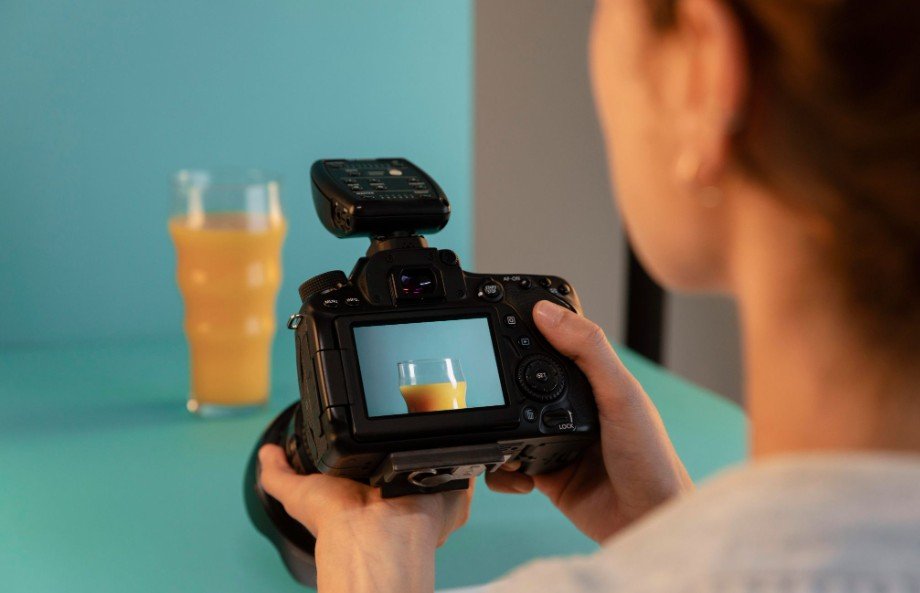
A strong camera tilt can create perspective convergence, especially with architecture. Vertical lines may seem to lean inward, an effect associated with keystoning, while steep angles can exaggerate foreshortening.
Not every tilt creates heavy distortion. Focal length, camera height, subject distance, and lens angle all matter. Still, pointing a camera sharply upward usually changes geometric relationships more noticeably than physically raising a level camera.
That distinction is especially useful when shooting buildings, interiors, or other scenes where you want vertical lines and proportions to appear more natural.
What Is a Pedestal Shot?
A pedestal shot is a spatial movement in which the entire camera physically ascends or descends. Filmmakers may call these moves pedestal up and pedestal down.
Traditional studio pedestals create smooth height changes, while a jib, crane, vertical slider, or stabilized gimbal can produce similar vertical camera movement. The defining feature is changing camera height.
If an actor stands up from a chair, for example, the camera can pedestal upward to maintain framing. A pedestal down can reveal information on a lower level of a set, such as an object behind a counter or a hidden area below the original composition.
How Does a Pedestal Shot Change Perspective?
A pedestal changes where the audience observes the scene from. Imagine filming someone behind a kitchen counter. Tilting downward changes where the lens points, while raising the whole camera can let the audience see farther over the counter while keeping the horizon more level.
Because the camera moves through space, foreground and background relationships can shift, making pedestal movement useful when sightlines and physical vantage point matter.
This is why a pedestal can sometimes resemble vertical tracking. Instead of changing only the camera angle, you are physically repositioning the viewer within the three-dimensional space of the scene.
When Should You Use a Tilt Instead of a Pedestal?
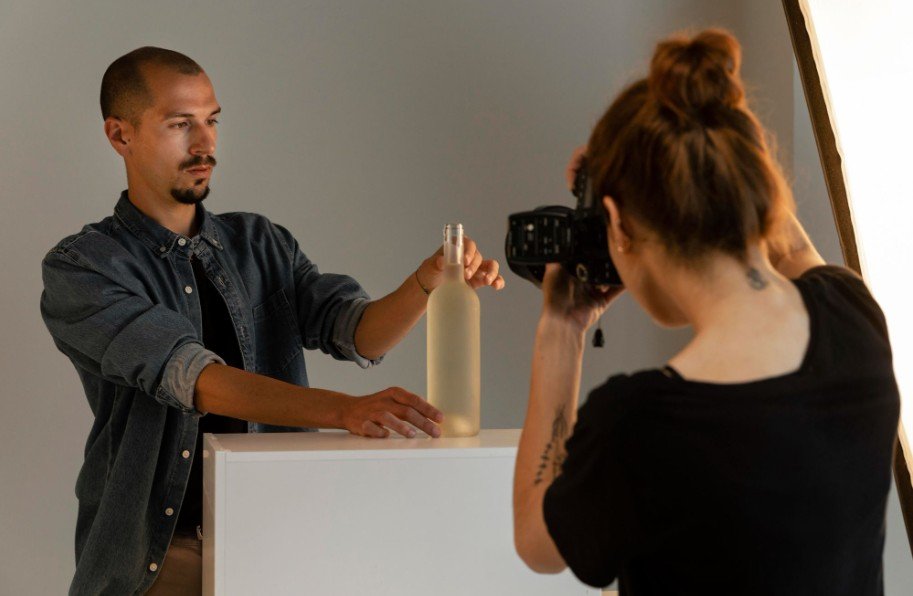
I choose a tilt when I want to redirect attention vertically without changing the camera’s location. It works well for tall subjects, establishing shots, dramatic introductions, character reveals, and vertical action.
In faster sequences, vertical movement can also support impact and momentum. Studying camera movement for action scenes can help you decide when a tilt should follow a jump, fall, strike, or rapid change in height without making the shot feel unnecessarily complicated.
I choose a pedestal when camera height improves the composition. It can follow someone standing or sitting, clear an obstruction, reveal another level of a location, or move the audience to a higher or lower viewpoint.
The easiest way to make the tilt shot vs pedestal shot decision is to ask whether the viewer should look from a different angle or see from a different height.
What Camera Gear Works Best for Each Shot?
For a tilt, a sturdy tripod with a smooth fluid head gives precise control. A quality fluid head helps the camera operator create consistent tilt up and tilt down movements without distracting jumps.
Pedestal moves require vertical travel, so studio pedestals, jibs, cranes, vertical sliders, and gimbals are more useful. A boom-style camera system can also achieve larger vertical movements when the shot requires greater height.
Whatever gear I use, I rehearse the move. Smooth acceleration, consistent speed, accurate framing, and a clean stop matter more than expensive gear.
Can You Combine a Tilt and Pedestal Movement?
Yes. A camera can rise while tilting downward to keep a character framed, or descend while tilting upward. Jib and crane shots often combine vertical travel with tracking, panning, and tilting.
These combinations become especially effective in dramatic moments where the movement needs to reflect a character’s internal state. Understanding camera movement for emotional scenes can help you decide whether a gradual rise, fall, or tilt should create intimacy, vulnerability, tension, or emotional distance.
Understanding each movement separately makes complex camera choreography easier. It also helps cinematographers create motivated movement instead of simply moving the camera because the equipment allows it.
What Mistakes Make These Camera Movements Look Amateur?
The biggest mistake is moving the camera without a storytelling reason. A smooth move can still feel unnecessary if it does not reveal information, follow action, establish scale, strengthen emotion, or improve composition.
Another mistake is assuming every vertical frame movement is a tilt. If the camera stays at the same height and rotates, it is a tilt; if the whole camera rises or falls, it is a pedestal. Jerky starts and abrupt stops can also weaken the shot.
I prefer to plan where the movement begins, what motivates it, and where it should end before I start recording.
Frequently Asked Questions
1. Is a pedestal shot the same as a tilt?
No. A tilt rotates the camera vertically from a mostly fixed position, while a pedestal physically raises or lowers the camera through space.
2. Does the lens stay level during a pedestal shot?
It can. A pure pedestal move can keep the lens level, although filmmakers can intentionally combine the movement with a camera tilt.
3. What is pedestal up in cinematography?
Pedestal up means physically raising the entire camera during a shot rather than simply changing the lens angle. It can help maintain framing as a subject rises or reveal a higher vantage point.
4. Can a gimbal create a pedestal-style shot?
Yes. An operator can raise or lower a stabilized gimbal to create vertical travel, though maintaining a smooth and consistent path requires practice.
5. What is the easiest way to remember the difference?
A tilt is like nodding your head. A pedestal is like moving your whole body up or down while continuing to look forward.
Which Camera Movement Should You Choose?
Neither technique is automatically more cinematic. Use a tilt when changing the camera angle creates the reveal or follows the action. Use a pedestal when changing camera height creates a stronger vantage point, cleaner geometry, or better spatial relationship.
Once I think in terms of angle versus height instead of simply “up versus down,” choosing the right movement becomes much easier.