




I become far more conservative with rigging the moment performers or crew enter the load area. Safe rigging practices around actors and crew are not simply about choosing strong hardware. They depend on controlling where people stand, how loads move, who gives commands, and what happens if one component fails.
A rig can meet its calculated capacity and still create an unsafe set. I therefore evaluate the rig and the people around it as one system.
Why Rigging Around People Requires Different Planning
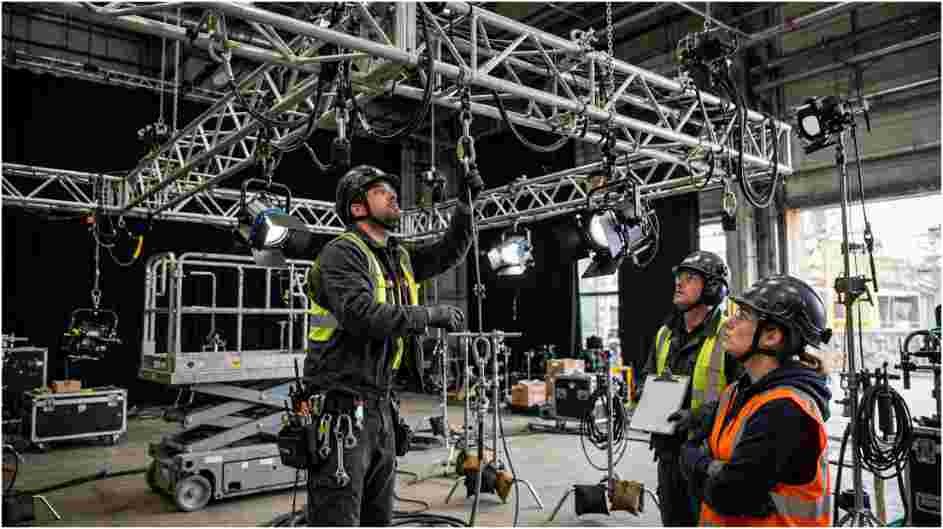
Production rigs often place lighting, cameras, scenic pieces, truss, motors, and accessories above active workspaces. A failure does not need to involve the main support to cause an injury. A loose pin, tool, clamp, cable, or accessory can become a dropped-object hazard.
OSHA requires rigging equipment covered by its construction standard to be inspected before use each day. Damaged or defective slings must be removed from service immediately.
For me, that establishes the starting point for safe rigging practices around actors and crew: prevention must happen before anyone occupies the exposure zone.
I never assume that a higher safety factor alone makes working beneath a rig acceptable. Design factors depend on the equipment, application, applicable standards, manufacturer instructions, and engineering requirements. ESTA also publishes ANSI entertainment standards covering statically suspended systems and powered hoist systems used in entertainment environments.
Start With the Human Footprint, Not Just the Load
Map the Drop Zone and Swing Zone
Before equipment moves, I identify more than the point directly beneath it.
I consider:
- the vertical drop zone;
- possible pendulum or swing movement;
- sling and cable paths;
- tensioned-line danger areas;
- equipment travel;
- nearby escape routes.
OSHA’s sling guidance tells personnel not to stand beneath suspended loads or beside sling legs under tension.
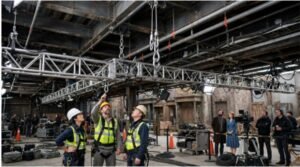
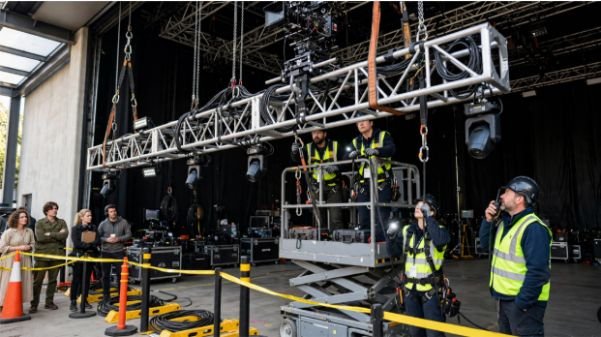
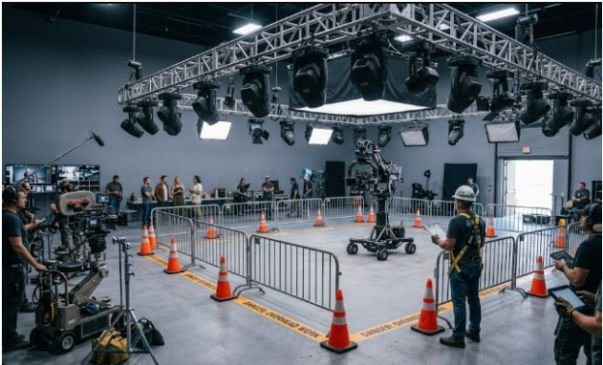
On a film set, I expand that principle into a practical exclusion zone. Tape, cones, barriers, spotters, or controlled access can make the boundary visible.
Anyone reviewing how to identify unsafe rigging setups on set should therefore look beyond the hardware. A technically sound rig with performers standing inside its active movement zone still demands attention.
Separate Rigging Work From Performance Work
One mistake I avoid is allowing rehearsal, lighting adjustments, camera repositioning, and active rigging to happen simultaneously beneath the same system.
I divide the work into stages.
Rigging teams install and inspect first. The system gets tested next. Actors and nonessential crew enter only after the supervisor releases the area.
That simple sequencing removes unnecessary exposure without slowing the creative process significantly.
Rigging Hardware Inspection and Load Control
Inspect Before Work Starts
My inspection starts with identification.
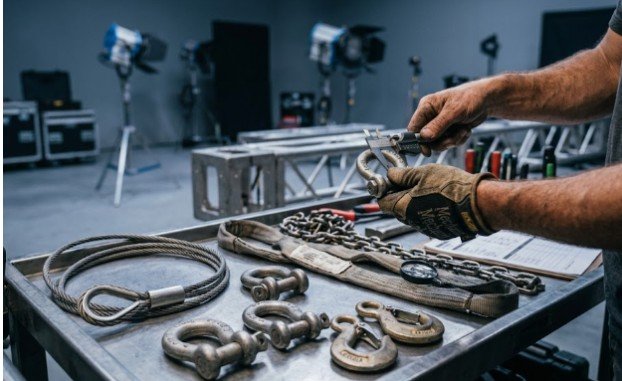
I verify that slings and relevant components have readable capacity or manufacturer information where required. I then inspect for distortion, cracking, damaged stitching, severe abrasion, wire damage, unusual wear, damaged hooks, and missing components.
OSHA requires daily pre-use inspection of slings and attachments covered by 29 CFR 1926.251. Defective equipment must be removed from service rather than left available for accidental reuse.
I prefer a physical quarantine area for rejected hardware. A damaged sling sitting beside usable equipment can easily return to the rig during a rushed reset.
That inspection should also feed directly into the production’s rigging risk assessment for film production, rather than exist as an isolated checklist.
Treat Sling Angles as a Load Multiplier
Sling geometry is one of the easiest hazards to underestimate.
Consider a simplified symmetrical two-leg sling supporting a 1,000-pound load.
| Sling angle from horizontal | Approx. tension per leg |
| 90° | 500 lb |
| 60° | 577 lb |
| 45° | 707 lb |
| 30° | 1,000 lb |
The load has not changed. The geometry has.
At 30 degrees, each sling leg carries roughly the entire 1,000-pound load in this simplified example. OSHA guidance generally advises against horizontal sling angles below 30 degrees unless recommended by the manufacturer or calculated by a qualified person.
That is why safe rigging practices around actors and crew must account for sling angles, hitch configuration, component ratings, dynamic effects, and actual load paths.
The table is an illustration, not a substitute for a qualified rigging calculation.
Safe Overhead Rigging and Secondary Protection
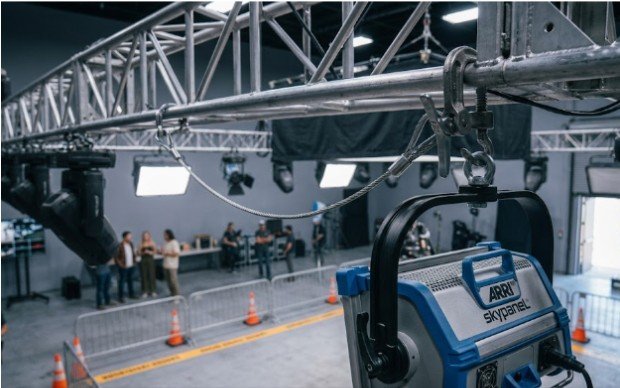
Control Dropped Objects
A heavy suspended fixture may get most of the attention, but I also inspect everything attached to it.
Pins, tools, adapters, barn doors, monitors, small cameras, fasteners, and accessories deserve their own retention strategy.
Catwalks and grids should remain orderly. Loose equipment above performers creates a hazard even when the primary rigging system remains intact.
Good safe rigging practices around actors and crew therefore treat housekeeping as part of rigging engineering rather than general tidiness.
Do Not Treat a Safety Cable as Decoration
Where secondary retention is required, I check its actual load path.
A secondary system should attach to suitable points, have enough capacity for its intended function, and avoid excessive slack that could create a severe shock load after primary failure.
I also avoid using secondary retention to justify questionable primary rigging. Redundancy supports a properly designed system; it does not repair a bad one.
These details belong in a thorough film production rigging hazard assessment, especially when equipment remains suspended above occupied areas.
Communication During Film Set Rigging Operations
Give Movement Commands One Clear Route
Crowded sets generate conflicting voices.
For critical load movement, I want one defined command structure. The operator must know whose instruction authorizes movement, who can call a stop, and what signals will be used.
OSHA’s overhead-crane rules provide a useful principle: when multiple cranes handle a load, one qualified responsible person must control the operation and instruct involved personnel.
Film rigging benefits from the same clarity.
My pre-movement call normally confirms that the path is clear, the exclusion zone is active, the load is ready, and communication is functioning.
Stop When Communication Breaks Down
If the operator cannot hear the designated signal person, I stop movement.
I do not replace a lost radio connection with shouting across a stage.
Safe rigging practices around actors and crew depend on predictable commands. Ambiguous communication can turn a mechanically safe lift into an operationally unsafe one.
Trial Lifts Before Actors Enter the Area
Before a significant load travels into its working position, I prefer a controlled test with nonessential personnel outside the exposure area.
A small initial lift can reveal unexpected rotation, poor balance, shifting rigging, snagged cables, or unusual equipment behavior before the load reaches people.
I check four things during that test:
| Check | What I want to see |
| Balance | Load remains in expected orientation |
| Rigging | No slipping, deformation, or abnormal movement |
| Clearance | Load and lines clear surrounding structures |
| Control | Motion stops exactly when commanded |
Testing is especially valuable after configuration changes. Moving a fixture, changing a sling length, or adding camera equipment can alter the system enough to justify another review.
Quick Reference Table for Crew-Safe Rigging
| Hazard | Practical control |
| Suspended load | Keep unnecessary personnel outside exposure zone |
| Damaged sling | Remove and quarantine immediately |
| Shallow sling angle | Recalculate load or change configuration |
| Loose overhead items | Secure or remove them |
| Moving rig | Establish visible exclusion zone |
| Conflicting commands | Use one defined command structure |
| Communication failure | Stop movement |
| Changed configuration | Inspect and test again |
OSHA also specifically advises keeping personnel away from suspended loads and tensioned sling legs.
The pattern behind safe rigging practices around actors and crew is simple: reduce exposure before relying on equipment strength to control risk.
Frequently Asked Questions
1. What is the safest way to rig equipment above actors?
Use properly engineered and rated equipment, inspect it before use, control dropped objects, provide required secondary retention, and minimize occupied time beneath suspended equipment.
2. How do safe rigging practices around actors and crew reduce accidents?
They combine load control, inspections, exclusion zones, clear commands, secondary protection, and restricted personnel access around active rigs.
3. Should actors stand beneath a load during a rigging test?
No. Testing should occur with nonessential personnel outside the load’s potential drop and movement zones.
4. Why are low sling angles dangerous on film sets?
Lower sling angles increase leg tension, which can overload slings, anchors, shackles, or supporting structures even when the suspended load stays unchanged.
No Shot Is Worth Standing Under a Question Mark
After working through a rig, I use one final test: if I cannot explain the load path, ratings, inspection status, exclusion zone, secondary protection, and command structure clearly, the system is not ready for people.
That mindset makes safe rigging practices around actors and crew practical rather than theoretical.
Before the next rehearsal, inspect the full system from the anchor point to the smallest overhead accessory. Then inspect the space beneath it. The strongest rig is still only part of the safety plan.