





A rig can look clean, organized, and professional while still hiding a serious failure point. When I think about how to identify unsafe rigging setups on set, I do not judge one sling or shackle in isolation. I follow the entire load path and then look at who could be exposed if something fails.
My basic rule is simple: if I cannot verify the load, connection, rating, anchor, or intended use, I do not consider the rig ready.
Start With a Load-Path Scan
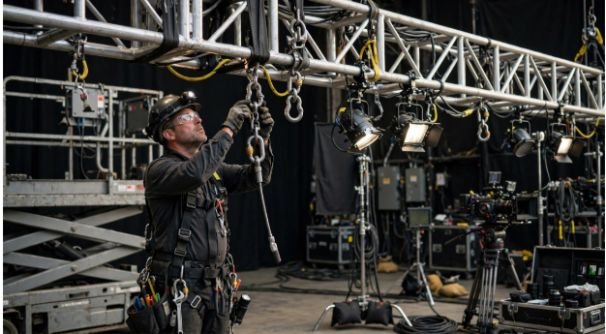
My quickest method for identifying dangerous film rigging is to trace force from the suspended equipment back to the supporting structure.
I check the fixture, attachment point, sling, connector, hoist, anchor, structure, and finally the area underneath.
This matters because individually rated components do not automatically create a safe system. A strong shackle cannot compensate for an overloaded anchor. A new sling cannot correct poor load distribution.
OSHA requires covered rigging equipment to be inspected before use on each shift. Defective equipment must be removed from service. Required manufacturer identification and safe-working-load markings must also remain legible.
| Check | Red flag | Response |
| Load | Weight unknown | Calculate first |
| Hardware | Bent or altered | Remove it |
| Sling | Cut, burned, kinked | Quarantine it |
| Anchor | Capacity unknown | Do not load |
| Geometry | Severe angular loading | Reconfigure |
| Fall zone | Crew underneath | Clear area |
I combine this scan with a film rigging safety checklist for production crews. The checklist finds individual defects. The load-path method finds dangerous combinations.
Check Rigging Hardware for Damage and Missing Ratings
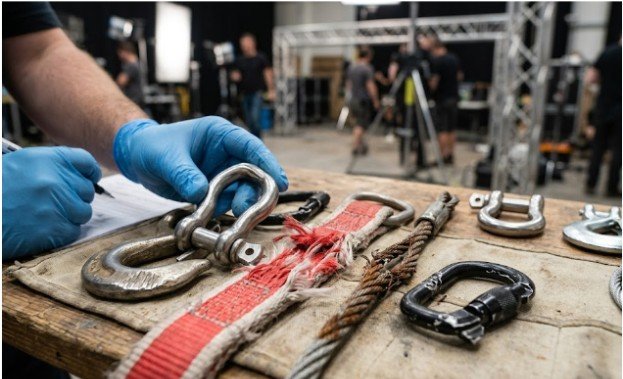
Knowing how to identify unsafe rigging setups on set starts with recognizing hardware that should never reach the lifting stage.
Shackles, Hooks, Pins, and Connectors
I look for bent shackle bodies, damaged threads, distorted bows, stretched hooks, missing components, cracks, and obvious unauthorized modifications.
Missing identification also stops my inspection.
OSHA’s construction rule requires covered rigging equipment to carry permanent, legible manufacturer identification showing its recommended safe working load. Custom lifting accessories are subject to additional marking and proof-testing requirements.
A standard bolt should never become a convenient replacement for the correct shackle pin simply because it fits.
The same caution applies to side loading. OSHA notes that an eyebolt’s strength can fall substantially when force acts at an angle instead of along its intended axis.
Wire Rope and Synthetic Slings
Wire rope needs a different visual check. I watch for broken wires, severe abrasion, crushing, corrosion, kinks, and birdcaging.
OSHA provides specific removal criteria for wire-rope slings. These include defined limits for broken wires and excessive wear.
Synthetic web slings should be checked for cuts, tears, burned fibers, melting, worn stitching, chemical damage, and distorted fittings. OSHA states that slings showing these forms of damaging deterioration must be removed from service.
That inspection approach connects directly with the safe use of slings in film production rigging: material condition, fittings, edge protection, hitch configuration, ratings, and angles all matter together.
Spot Improper and Makeshift Rigging
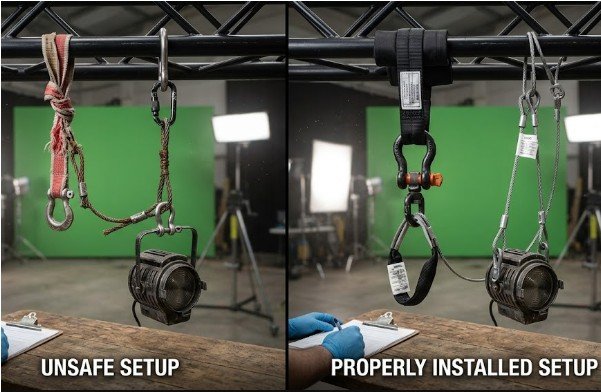
Sometimes the biggest warning sign is not damaged hardware. It is improvisation.
When checking how to identify unsafe rigging setups on set, I become cautious when I see homemade connectors, undocumented welding, ordinary bolts replacing rated hardware, or suspension from building features with no verified capacity.
Water pipes, HVAC equipment, ceiling grids, handrails, and decorative structures should never be assumed to be acceptable rigging points.
Wire-rope clips are another useful clue. OSHA’s safe-use guidance says their number, spacing, and torque should follow manufacturer or qualified-person recommendations. For U-bolt clips, the U-bolt goes over the dead end while the live rope sits in the saddle.
If somebody has assembled clips by appearance alone, I want the connection verified before loading it.
Read Sling Angles and Load Distribution Before the Lift
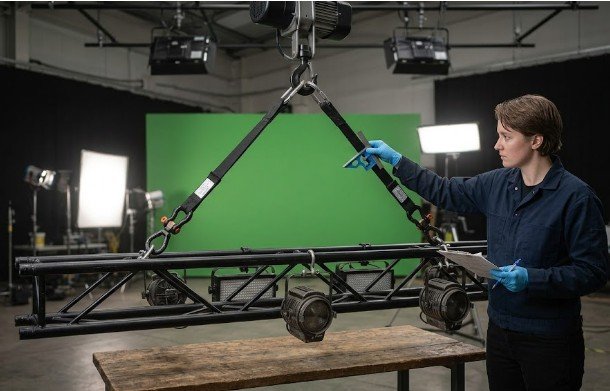
Load geometry is one of the easiest hazards to underestimate.
As two sling legs become flatter, tension in each leg increases. This means a sling does not always carry half of a two-point load.
Consider a balanced 1,000-pound load.
| Sling angle from horizontal | Approx. tension per leg |
| 60° | 577 lb |
| 45° | 707 lb |
| 30° | 1,000 lb |
At 60 degrees, each leg sees about 577 pounds. Drop the angle to 30 degrees and each leg reaches roughly 1,000 pounds.
The suspended weight never changed.
This is why rigging load distribution for film sets deserves attention before the lift begins. OSHA’s wire-rope sling guidance advises against horizontal sling angles below 30 degrees unless the configuration is recommended by the manufacturer or a qualified person.
When learning how to identify unsafe rigging setups on set, I therefore look at geometry as closely as hardware ratings.
Look Up for Overhead Rigging Red Flags
My inspection does not stop at the primary hanging connection.
I look for loose accessories, sharp edges contacting cables or slings, unstable truss supports, incomplete outriggers, questionable ballast, and missing secondary retention where the equipment design, venue policy, manufacturer, or production procedure requires it.
A safety cable also needs a meaningful attachment. Looping secondary retention around another weak component does not create useful redundancy.
Entertainment rigging has specialized standards of its own. ESTA’s Technical Standards Program publishes ANSI standards covering areas such as statically suspended rigging, manual hoist systems, counterweight systems, and aluminum trusses.
That is a good reminder that overhead film equipment should not be treated as casual hardware assembly.
Check the Ground Below the Rig
One of the most overlooked parts of how to identify unsafe rigging setups on set is looking down rather than up.
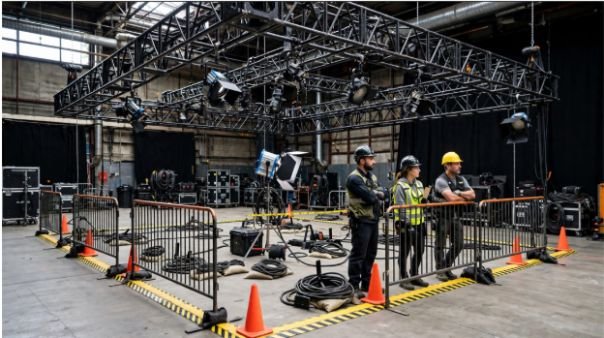
A technically sound lift can still create an unsafe workplace if unnecessary crew members stand inside the fall zone.
For crane operations covered by its construction standard, OSHA requires available hoisting routes that minimize employee exposure. It also limits who may remain within the fall zone and requires qualified rigging in specified situations.
On a production, practical warning signs include people walking beneath suspended equipment, uncontrolled access, unclear commands, and no defined exclusion area.
I prefer that boundary established before the equipment leaves its resting position.
What to Do When You Find an Unsafe Setup
Recognizing how to identify unsafe rigging setups on set only helps if the next action is disciplined.
I would stop the affected operation, keep people away from the hazard, and bring the issue to the qualified person responsible for the rig.
I would not straighten a bent connector, improvise another pin, retie a damaged sling, or apply a small load just to see what happens.
OSHA requires defective covered rigging equipment to be removed from service.
The safer response is verification.
Confirm the total load, working load limits, sling configuration, anchor capacity, manufacturer instructions, inspection status, and intended use. If any critical part remains unknown, the setup should remain unloaded until it is resolved.
FAQ
1. What are the first signs of unsafe rigging on a film set?
Missing ratings, damaged components, improvised anchors, poor sling geometry, and uncontrolled fall zones are immediate warning signs.
2. How can I tell whether a rigging sling is unsafe?
Check for cuts, burns, broken wires, abrasion, deformation, damaged fittings, chemical attack, and missing required identification.
3. Can undamaged rigging equipment still create an unsafe setup?
Yes. Wrong angles, overloads, side loading, weak anchors, and incompatible components can make intact equipment dangerous.
4. Who should inspect questionable overhead film rigging?
A qualified or properly designated rigging professional should evaluate the system using applicable requirements, manufacturer instructions, and production procedures.
If the Rig Looks Questionable, the Camera Can Wait
The best way I approach how to identify unsafe rigging setups on set is to stop judging individual pieces and start judging the whole load path.
I want every pound accounted for. I want every connector used correctly. I want the anchor verified and the space below controlled.
Before the next lift, trace the rig from the equipment to the final supporting structure. If you reach one component whose capacity, condition, or purpose cannot be explained, stop there.
A delayed shot costs time. A questionable overhead rig can cost far more.