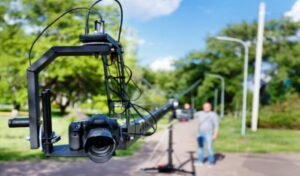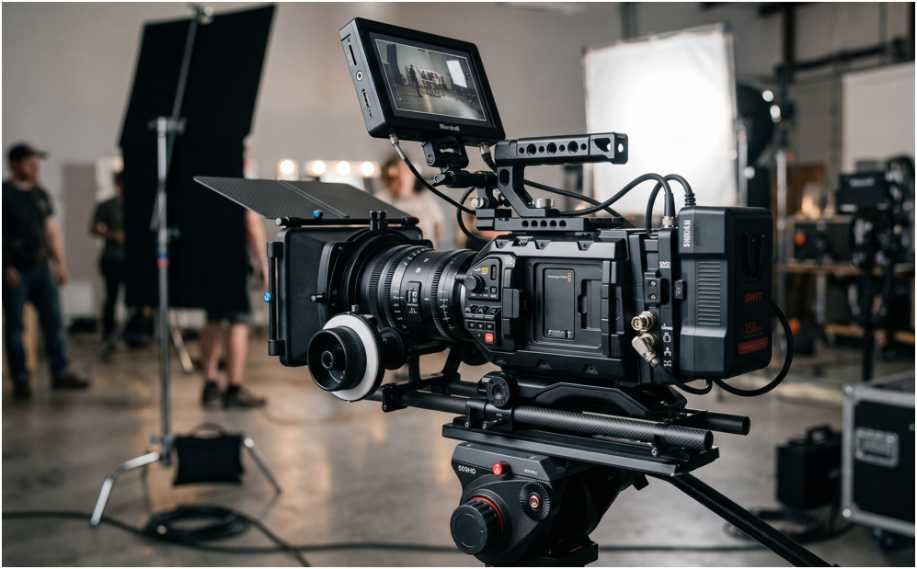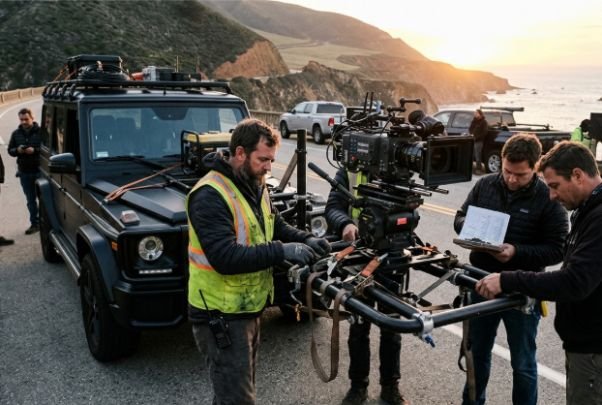






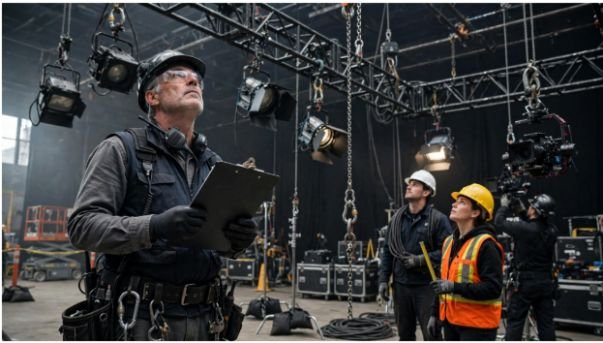
A rushed overhead setup can turn an ordinary camera or lighting move into a serious hazard. My film rigging safety checklist for production crews begins before anything leaves the ground. I check the load, support path, hardware condition, access control, secondary retention, and communication plan.
I treat this checklist as a stop-work tool rather than paperwork. If nobody can confirm a rating or attachment capacity, I do not treat the rig as ready.
Start With the Complete Rigging Load Path
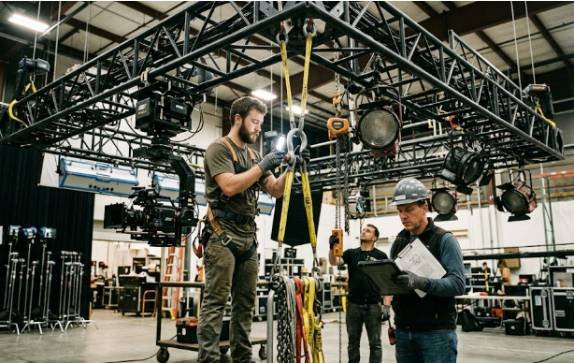
The biggest mistake I try to avoid is inspecting individual components while ignoring the complete system. A reliable film rigging safety checklist for production crews should trace the load from the supporting structure through every sling, shackle, hoist, bracket, and attachment.
A perfectly rated shackle cannot compensate for an unknown support point. Likewise, an oversized motor cannot correct an overloaded bridle.
Calculate the Real Suspended Load
I calculate every item that will hang below the support point. That may include the camera body, lens, gimbal, batteries, transmitter, mounting plates, lighting fixtures, truss, cables, motors, and lifting accessories.
OSHA directs general-industry sling operations to 29 CFR 1910.184 and construction operations to 29 CFR 1926.251. Both frameworks emphasize rated capacity, inspections, and removing unsafe equipment from use.
That makes rated capacity one of the first items on my film rigging safety checklist for production crews.
| Quick Check | What I Verify |
| Total load | Everything suspended below the support |
| Hardware rating | Capacity of each component |
| Weakest component | Lowest-rated part controls the system |
| Support point | Approved capacity and condition |
| Dynamic forces | Starts, stops, movement, wind, or shock |
Check Sling Angles Before the Lift
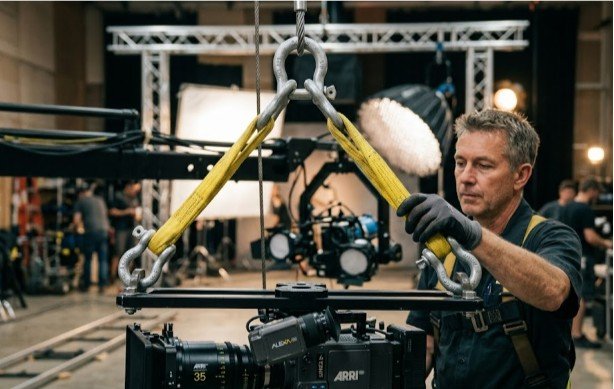
Load weight alone does not tell me the force inside a bridle.
Consider a simple 400-pound load on a two-leg bridle. With each sling at 60 degrees from horizontal, each leg carries about 231 pounds under an ideal static calculation. Reduce that angle to 30 degrees and each leg carries roughly 400 pounds.
The load did not become heavier. The geometry changed.
That is why I check hitch type, angle, manufacturer data, and component capacity instead of relying on the suspended weight alone.
Inspect Film Rigging Hardware Before Use
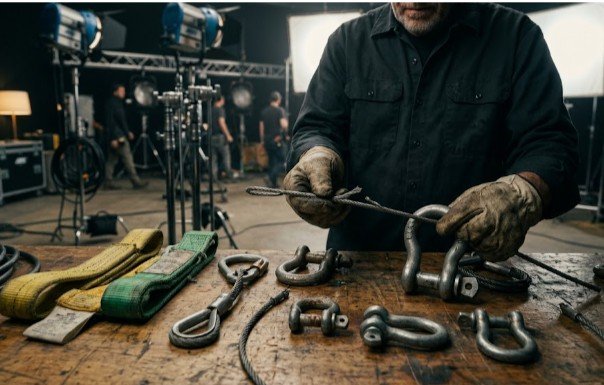
Hardware inspection is the next part of my film rigging safety checklist for production crews. Anything difficult to inspect on the ground becomes even harder to evaluate after it goes overhead.
For crews building a repeatable inspection routine, how to inspect rigging hardware before filming is worth treating as a separate pre-lift procedure.
OSHA’s construction rigging rule requires covered equipment to be inspected before use on each shift and requires defective equipment to be removed from service. Its general-industry sling provisions also set inspection and removal-from-service requirements.
Check Slings, Shackles, Hooks, and Wire Rope
I start with identification. When required ratings or tags cannot be read, I do not guess the capacity.
Wire rope needs attention for broken wires, kinking, corrosion, crushing, or other deformation. Synthetic slings need checks for cuts, burns, punctures, damaged stitching, or distorted fittings.
For shackles and hooks, I look for bending, spreading, cracks, thread damage, and unauthorized modification. I install pins and retention hardware according to manufacturer instructions rather than relying on a crew-made rule.
| Component | Stop-Use Warning Signs |
| Wire rope | Broken wires, kinks, corrosion, crushing |
| Synthetic sling | Cuts, burns, damaged stitching |
| Shackle | Deformation, damaged pin, missing identification |
| Hook | Cracks, spreading, damaged retention hardware |
| Hoist | Chain damage, abnormal operation, control fault |
Defective equipment goes into quarantine. I mark it clearly so another crew member cannot unknowingly return it to service.
Establish a Rigging Exclusion Zone
Good film set rigging exclusion zone safety begins before motors move or anyone pulls tension into a system.
I define the lifting area, identify authorized personnel, and establish how the boundary will be maintained. Cases, carts, loose cables, and unnecessary crew should leave the lift path before the operation starts.
A film rigging safety checklist for production crews also needs one clear stop command. The operator, signal person, rigging supervisor, and nearby crew should understand it.
The goal is not merely drawing tape around a drop zone. The goal is controlling exposure while loads are being raised, positioned, adjusted, or lowered.
Protect Overhead Cameras, Lights, and Equipment
For overhead equipment safety for film production, I treat secondary retention as an independent protection layer.
A secondary safety should use suitable equipment and attachment points. It must be routed so it can retain the suspended item without contacting sharp edges, hot fixtures, moving assemblies, or other hazards.
I also inspect cable management. Video, power, control, and data cables need suitable support and strain relief. They should never become accidental lifting components.
This part of the film rigging safety checklist for production crews matters most with complex camera packages. Small accessories can be overlooked even when the main camera mount is secure.
Test Hoists, Controls, and Crew Communication
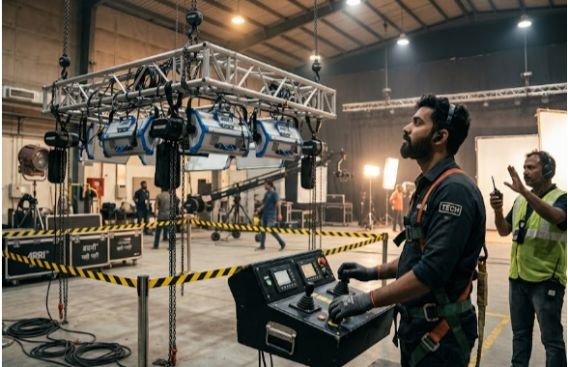
Powered systems introduce additional failure points. ESTA publishes entertainment-industry rigging standards, including the ANSI E1.6 series covering powered hoists and related inspection, maintenance, selection, and control considerations.
Before full movement, I check operating direction, emergency-stop functions, travel path, chain or rope condition, and applicable limits. I also confirm who gives movement commands.
ESTA’s rigging standards and inspection work specifically address entertainment systems used to suspend equipment in environments that include film and video production.
Perform a Controlled Trial Lift
A short trial movement can reveal poor balance, unexpected rotation, clearance problems, or incorrectly seated rigging before the equipment reaches working height.
I include this step in my film rigging safety checklist for production crews, but I do not use a made-up universal height.
The exact procedure should follow the equipment manufacturer, qualified rigging plan, and applicable standard. OSHA has specific trial-lift procedures for personnel hoisting, but those rules should not be copied blindly onto ordinary equipment lifts.
I stop immediately if the load shifts unexpectedly, hardware rotates into a poor position, controls behave incorrectly, or the exclusion zone is breached.
My Final Pre-Roll Rigging Check
Before cameras roll, I run the film rigging safety checklist for production crews one more time.
I want five clear answers:
- Is the actual suspended load known?
- Is every load-path component suitable and inspected?
- Is the exclusion zone controlled?
- Are primary and secondary retention systems correct?
- Can any designated person stop the operation immediately?
One uncertain answer means the rig needs another look.
For unusual setups, I also document attachment points, equipment identification, load information, and responsible personnel. Photos can help during shift changes or when a setup must be recreated later.
Frequently Asked Questions
1. What should a film rigging safety checklist for production crews include?
It should cover load calculations, rated hardware, attachment points, inspections, exclusion zones, secondary retention, hoist controls, communication, and stop-work procedures.
2. How often should film rigging hardware be inspected?
Inspect equipment before use and follow additional inspection intervals required by applicable regulations, manufacturers, employers, and operating conditions.
3. Who should approve an overhead camera or lighting rig?
The production should use a competent or qualified person appropriate to the equipment, operation, safety plan, and applicable regulations.
4. Do overhead film lights always need secondary safety cables?
Requirements depend on the equipment, mounting method, manufacturer, venue, and jurisdiction, so the specific installation must be evaluated rather than relying on a universal rule.
Rig It Right or Don’t Roll
My rule is simple: a complicated shot does not make uncertain rigging acceptable. A strong film rigging safety checklist for production crews makes the team prove the load path, hardware condition, exclusion zone, secondary protection, and operating plan before production pressure builds.
Print the checklist before call time, assign clear rigging responsibility, and make the stop command the easiest instruction on set to obey.