





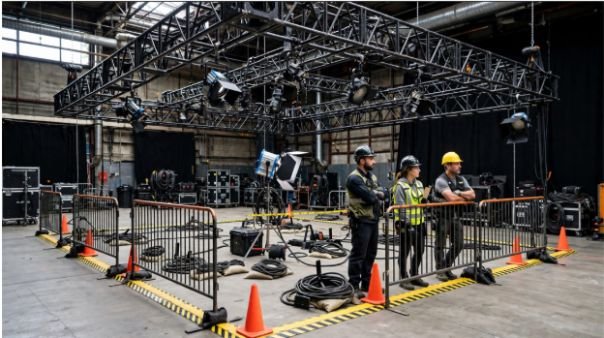
A light, truss, motor, cable, or tool overhead can turn a normal set into a struck-by hazard in seconds. Film set rigging exclusion zone safety is not just tape on the floor. The boundary must match the real hazard, control access, and change when the rigging task changes.
On U.S. productions, I treat the exclusion zone as a live control measure, not a fixed circle. OSHA crane rules restrict access to fall zones during covered lifts. OSHA also requires head protection where falling-object hazards exist. CSATF guidance stresses hazard assessment, communication, safety meetings, and defined exclusion zones.
Quick Understanding: What the Zone Must Control
| Hazard area | What it covers | Practical control |
| Drop or fall zone | Where a load, tool, fixture, or component could fall | Barricade it; keep nonessential crew out |
| Swing or movement zone | Where a load, boom, truss, or cable could travel | Cover the full movement envelope |
| Crush or pinch zone | Space near bases, counterweights, moving gear, or structures | Keep bodies out of trapping points |
| Controlled access | Space riggers need to attach, guide, land, or inspect loads | Assign clear entry control |
OSHA restricts worker presence in fall zones during covered crane operations, while current entertainment-industry guidance supports clearly defined and controlled exclusion areas.
That is the core of film set rigging exclusion zone safety: the floor boundary should represent the hazard above it, not a convenient number.
Overhead Rigging Drop Zones Are Not a Universal 10-Foot Circle
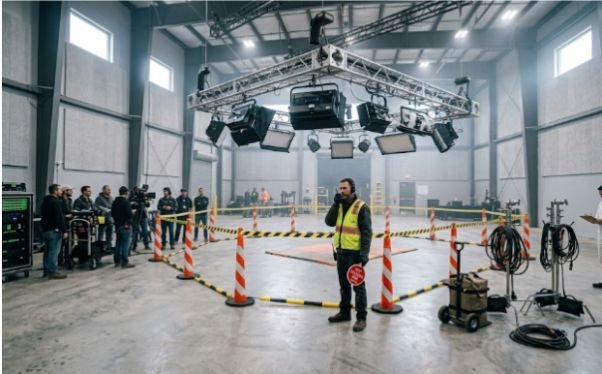
A “10-foot minimum” appears in some online film-rigging advice. I would not present it as a universal U.S. film-set requirement. OSHA’s crane fall-zone requirements focus on the area where a load could fall. Current CSATF guidance also describes exclusion zones as boundaries determined by a responsible person and reconsidered when conditions change.
Geometry shows why a fixed radius can mislead. Imagine a 12-foot truss being flown overhead. It already reaches six feet from its center before fixtures, cables, or possible swing are considered. A neat circle can therefore leave part of the actual hazard outside the barricade.
For film set rigging exclusion zone safety, I use a three-envelope check. First, mark the projected drop footprint. Next, add the possible swing or movement envelope. Finally, add enough controlled-access space to stop unauthorized crew from entering the hazard area.
This is a practical planning method, not a regulatory formula.
Exterior rigs add another variable. Pair the exclusion-zone plan with wind limits for overhead rigs on film sets before hoisting equipment or leaving large surfaces exposed.
How to Establish and Enforce the Exclusion Zone
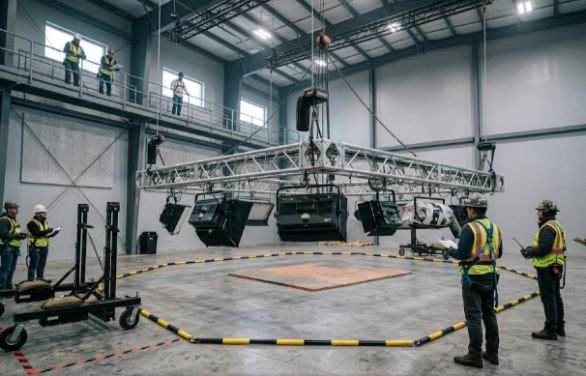
A boundary has to be visible before it can control anyone.
Current CSATF guidance identifies caution tape, barricades, signage, light signals, and call-sheet notifications as possible ways to communicate an exclusion zone. It also says access should be limited to authorized people when the responsible person determines conditions are safe.
A film set rigging exclusion zone safety plan also needs clear ownership. Assign one person authority to control entry during active overhead work. Depending on the production, that responsibility may fall to a designated spotter, department lead, safety representative, or another qualified crew member.
Use a Toolbox Talk Before the Lift
CSATF Safety Bulletin #5 recommends safety meetings when significant hazards or plans change. It also calls for systems that identify hazards, communicate them to cast and crew, and correct unsafe conditions.
Before the lift, cover the load path, exclusion boundary, authorized entrants, communication signals, stop-work procedure, and conditions that trigger a reassessment. Good film set rigging exclusion zone safety depends on everyone understanding those limits.
Temporary structures deserve a separate check. Link this procedure to temporary truss rigging safety for film production, including support conditions, connection points, hoists, bracing, and the intended load path.
Suspended Loads, PPE, and Hardware Checks
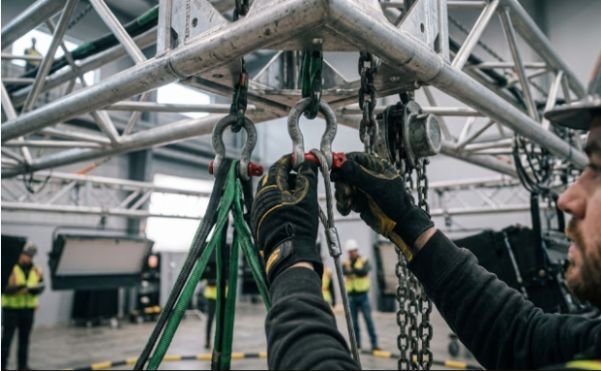
OSHA’s rules for covered crane operations generally keep workers outside the fall zone while a load is suspended. Exceptions are limited to workers needed for specific tasks such as hooking, unhooking, guiding, landing, or initially connecting a load. OSHA also requires covered hoisting routes to minimize worker exposure where possible.
For film set rigging exclusion zone safety, the practical rule is simple: never route a suspended load over people merely because the stage is busy or production is under time pressure.
PPE Is a Backup, Not the Boundary
OSHA requires protective helmets when workers face possible head injuries from falling objects. OSHA has also specifically confirmed that this requirement can apply around crane and hoist operations where an overhead falling-object hazard exists.
A hard hat may reduce injury risk. It does not make standing underneath a suspended load acceptable.
Other PPE should follow the production’s hazard assessment and the work involved. Exclusion and exposure controls should remain the first line of defense.
Inspect and Verify Load Ratings
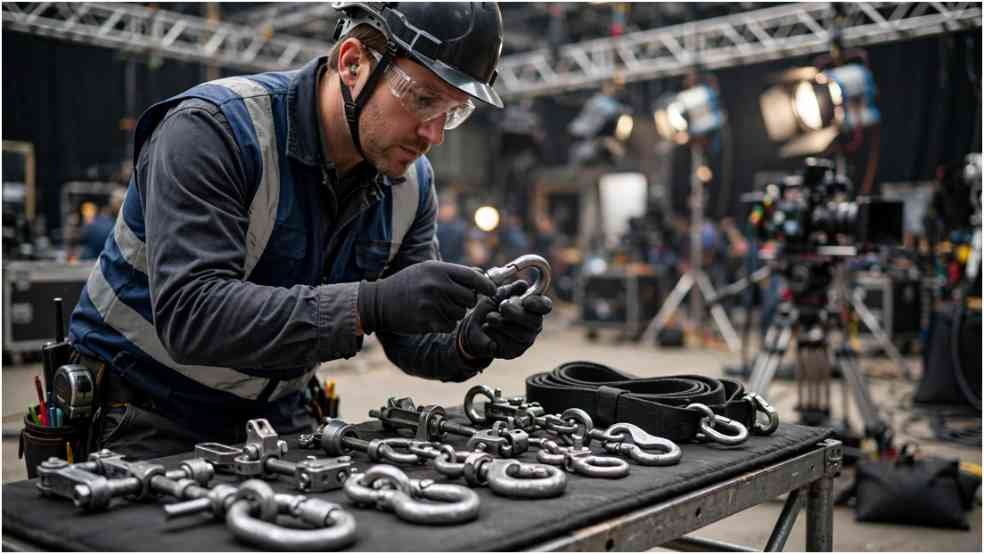
For covered construction rigging, OSHA requires rigging equipment to be inspected before use on each shift. Equipment must also carry legible identification showing its recommended safe working load, and defective equipment must be removed from service.
That makes film rigging hardware load ratings a core companion topic. Shackles, slings, hoists, connectors, truss, attachment points, and supporting structures must function as one load path.
Film set rigging exclusion zone safety cannot compensate for damaged hardware or a load that exceeds the capacity of part of the system.
When the Exclusion Zone Should Change
Film set rigging exclusion zone safety should be reassessed whenever the hazard changes.
That can include a different load, longer truss, altered hoist path, repositioned crane, added fixtures, moving scenery, changed counterweights, changing weather, or a camera position that moves crew into the previous hazard area.
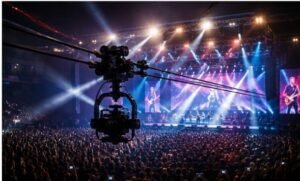
Current CSATF guidance for gimbals specifically calls for re-examining an exclusion zone during construction and pre-rigging and communicating changes to cast and crew. It also requires checking that unauthorized people are clear before operation.
I apply the same risk logic to overhead work. A boundary that works during assembly may be wrong during lifting, focusing, rehearsal, filming, or strike.
A Five-Question Pre-Lift Check
Before overhead work starts, I ask five questions:
What can fall?
Where can it move?
Who actually needs to enter?
What could change the hazard?
Who has authority to stop the work?
If any answer is vague, the film set rigging exclusion zone safety plan is not ready. Resolve that uncertainty before the load leaves its support.
Reference Table for U.S. Safety Planning
| Reference | Why it matters |
| OSHA 29 CFR 1926.1425 | Addresses keeping workers clear of fall zones during covered crane operations |
| OSHA 29 CFR 1926.251 | Covers inspections and safe-working-load identification for covered rigging equipment |
| OSHA 29 CFR 1910.135 | Requires head protection where falling-object hazards threaten workers |
| CSATF Safety Bulletin #5 | Addresses hazard identification, communication, correction, and safety meetings |
| CSATF Safety Bulletin #41 | Provides current entertainment guidance on defining and revising exclusion zones |
| CSATF R, R2, and V6 training | Covers entertainment rigging, overhead lifting, hardware inspection, and equipment capacity |
CSATF Safety Bulletins describe themselves as recommended industry guidance and direct productions to consult applicable regulations. Which OSHA provision applies can also depend on the equipment and type of work being performed.
Keep the Shot. Lose the Shortcut.
A strong exclusion zone makes unsafe access difficult and safe work obvious. The smartest film set rigging exclusion zone safety plan follows the actual load, movement, and crew exposure instead of borrowing a fixed distance from another set.
Before the next hoist, walk the intended load path. Mark the fall and movement hazards. Assign access control. Brief every affected department.
Film set rigging exclusion zone safety works only while the marked boundary matches the live hazard. If the rig changes, redraw the zone before anyone treats the area as safe.
FAQs
1. How large should a film rigging exclusion zone be?
Size it from the actual fall, swing, crush, and movement hazards; there is no universal 10-foot film-set radius.
2. Who can enter a drop zone under suspended rigging?
Only authorized and essential personnel should enter when the work requires it and the applicable safety procedure permits entry.
3. Should crew wear hard hats beneath overhead rigging?
OSHA requires head protection where falling-object hazards can injure workers, but PPE does not replace exposure controls.
4. When should a film set exclusion zone be reassessed?
Reassess it whenever the load, rig, movement, weather, work phase, access route, or surrounding set conditions materially change.