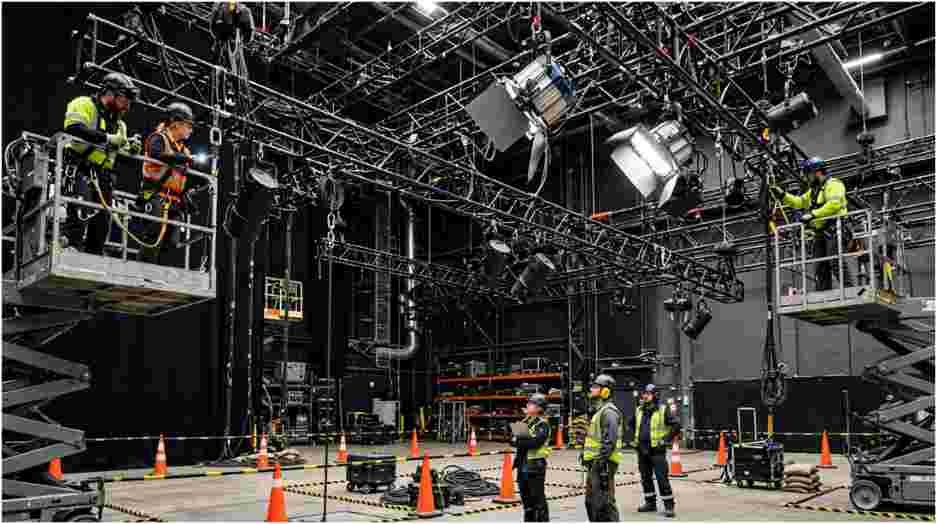






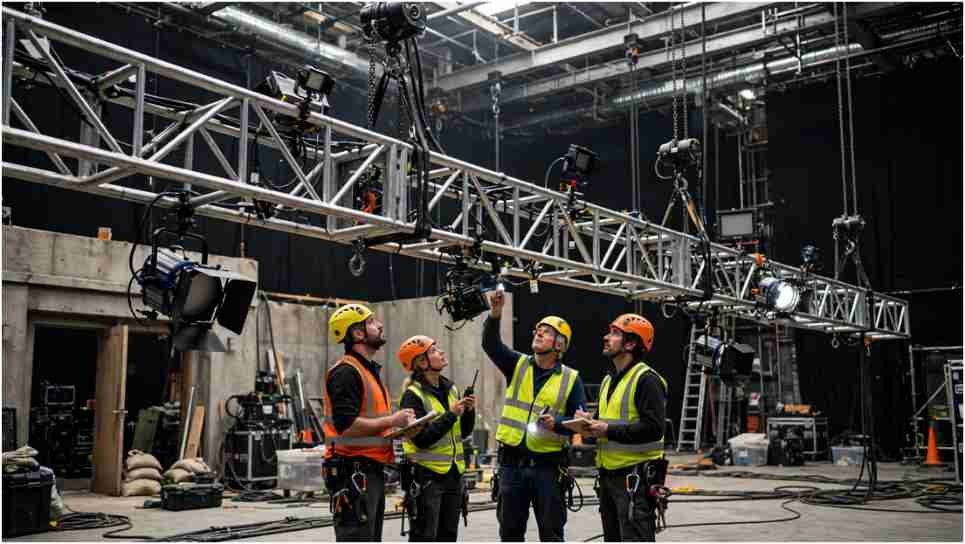
When I review a temporary overhead truss plan, I start with one question: where does every pound go after it leaves the fixture? That catches more bad assumptions than staring at a truss chart alone. Temporary truss rigging safety for film production depends on the full load path: fixture, clamp, truss, sling, hoist, support point, and structure.
On U.S. sets, the OSHA requirements that apply depend on the work and equipment involved. ANSI/ESTA standards and manufacturer instructions add entertainment-specific guidance. ESTA currently lists ANSI E1.2-2021 for the design, manufacture, and use of aluminum trusses and towers.
Use the principles below as a planning framework, not as a substitute for a qualified rigger, structural engineer, manufacturer instructions, or local authority requirements.
Start With the Load Path, Not the Truss Length
A truss can handle a large distributed load yet still become unsafe because of one badly positioned point load. I treat the lowest permitted capacity anywhere in the load path as the controlling limit.
| Term | What it means | On-set rule |
| WLL | Maximum intended working load | Use the documented WLL |
| Design factor | Margin used to establish a rating | Never substitute breaking strength |
| Point load | Concentrated force | Check span and position |
| Dynamic load | Force caused by motion | Use engineered limits |
OSHA requires material-handling rigging to be inspected before use on each shift and to carry legible safe-working-load identification. Its sling rules also prohibit shock loading. I would therefore never replace the real dynamic calculation with a blanket “add 25% or 50%” allowance.
For component-level capacity checks, see film rigging hardware load ratings. That documentation discipline is the backbone of temporary truss rigging safety for film production.
Truss Pick Points and Node-Point Rigging Matter
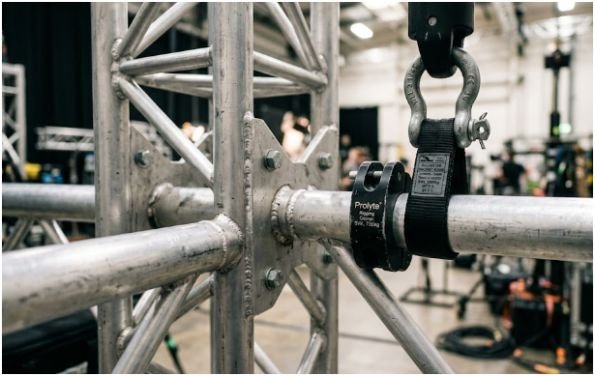
The truss itself may be correctly rated while the attachment location creates a completely different structural condition.
Load and Suspend Near Node Points
A load placed between panel points can introduce local bending into the main chord. That condition may not be covered by the published truss loading table.
Prolyte’s current truss manual recommends placing suspensions at node points or directly beside them. It warns that off-node suspension can significantly reduce load capacity and may require structural analysis. Its load-placement diagrams also direct users to locate loads at or close to node points.
That makes node placement central to temporary truss rigging safety for film production, not an assembly preference.
Use Compatible Clamps, Slings, and Connectors
Clamps need to match the actual chord diameter and remain rated for the intended loading direction. Attachments should use manufacturer-approved structural members rather than diagonal braces or convenient connectors.
Assembly hardware deserves the same discipline. Use specified pins, bolts, clips, washers, and tightening procedures. If the manufacturer does not approve an impact tool, saving a few minutes is not justification for using one.
This is where shackle and sling safety for film rigging becomes part of truss design rather than a separate inspection task.
Dynamic Loads Change the Rigging Math
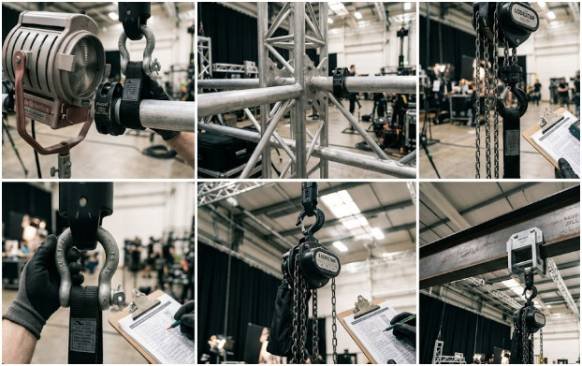
Motorized camera heads, moving scenery, repositioned lighting, and other active systems can create acceleration, deceleration, sway, and unequal reactions between hoists.
Actsafe’s overhead-rigging guidance states that static and dynamic forces should both be considered. It also recommends greater design margins where loads are suspended or moved over people.
I treat those figures as risk guidance rather than one universal U.S. legal formula. The applicable standard, engineer, manufacturer, venue, insurer, and authority having jurisdiction determine the final requirement.
OSHA’s sling rule gives crews one particularly clear boundary: shock loading is prohibited. Smooth starts, controlled stops, correct hoist alignment, and swing control therefore matter.
Temporary truss rigging safety for film production weakens the moment movement becomes an afterthought. I treat each planned movement as a new load case, not merely another cue.
Redundancy Does Not Rescue a Bad Primary Rig
A secondary safety should protect against a credible failure. It should never justify an overloaded clamp, damaged sling, unsuitable fixture attachment, or poor truss pick.
Where the fixture manufacturer, engineered plan, or production policy requires secondary retention, connect it to approved structural points. Synthetic slings also need inspection for abrasion, sharp edges, heat, and potential fire exposure.
A steel secondary may be required by a project’s engineering or safety policy, but it does not replace correct primary rigging.
For temporary truss rigging safety for film production, redundancy only helps when it is genuinely independent. The same logic applies to monitors, power supplies, camera accessories, and grip hardware. If something can detach, it belongs in dropped object prevention on film sets.
Keep People Out of the Lift Path
Excellent hardware does not protect a crew standing underneath an active lift.
OSHA states that employees should remain clear of loads about to be lifted and suspended loads under its general-industry sling rules. Entertainment guidance also stresses communication between the rigging operator and ground personnel.
I would establish the exclusion zone before the first motor moves. Use one communication chain and one unmistakable stop command.
If the operator cannot see the complete load, use a qualified spotter with an agreed signal method. That separation is essential to temporary truss rigging safety for film production.
The Pre-Rigging Check I Would Not Skip
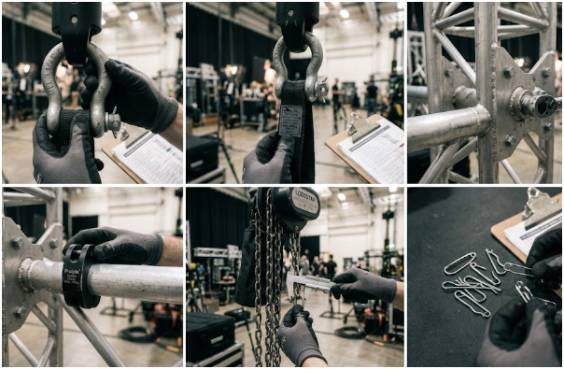
I prefer a documented load-path review over someone looking upward and saying the rig “looks fine.”
| Check | What must be confirmed |
| Truss | Model, span, orientation, load table, visible damage |
| Hardware | WLL tags, compatibility, pins, slings, clamps |
| Load positions | Approved nodes and drawing match |
| Support | Capacity at each hoist or pick |
| Lift control | Exclusion zone, commands, stop signal |
| Trial lift | Balance, brake hold, deflection, load sharing |
A low, controlled trial lift may be appropriate when the engineered lift plan and equipment instructions require it. I would not treat “exactly one foot” as a universal rule. Temporary truss rigging safety for film production depends on the approved procedure, not a borrowed rule of thumb.
Outdoor ground-support truss brings another variable: weather. Wind limits, ballast or guying, action triggers, and monitoring procedures should come from the engineered design and manufacturer documentation. ESTA’s published standards include ES1.7 for weather preparedness and E1.21 for temporary outdoor technical-production structures.
My Five-Minute Load-Path Audit
Here is the paper exercise I find most useful.
Draw one line from every suspended object upward until it reaches the building structure or ground support. Beside every item the line crosses, write its WLL, manufacturer load-table reference, or engineered capacity.
If one link has no documented answer, the line stops.
A lighting package might sit comfortably inside the truss’s distributed-load capacity and still fail this test. An off-node clamp, poor sling geometry, an underrated shackle, or an inadequate venue point can control the entire assembly.
That is the better mental model for temporary truss rigging safety for film production: the truss is only one link in the system.
Frequently Asked Questions
1. Who should approve a temporary film truss rig?
A qualified rigging professional should plan it, with structural engineering review whenever the load case, supporting structure, or manufacturer requires it.
2. Can I hang a film light anywhere on box truss?
No. Follow the manufacturer’s load data and attachment instructions, normally positioning loads at or close to approved node points.
3. What safety factor should temporary truss rigging use over people?
No single ratio replaces the applicable standard, manufacturer rating, engineered design, and local requirements for every U.S. production.
4. Is temporary truss rigging safety for film production only about weight?
No. Position, motion, sling angles, connections, retention, weather, inspections, and worker exposure all affect the final rig.
The Rig Does Not Care About Call Time
A truss can look level, quiet, and perfectly stable while one connection carries a load it was never designed to see.
I would rather delay a lift than accept an unreadable WLL tag, off-node pick, undocumented support point, or missing exclusion zone. With temporary truss rigging safety for film production, the practical next step is simple: trace every load to its final support and do not lift until every link has a documented answer.