



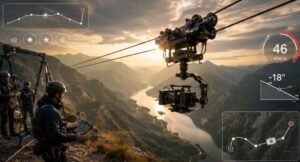
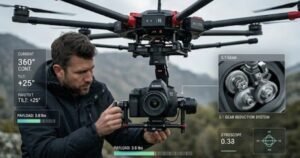
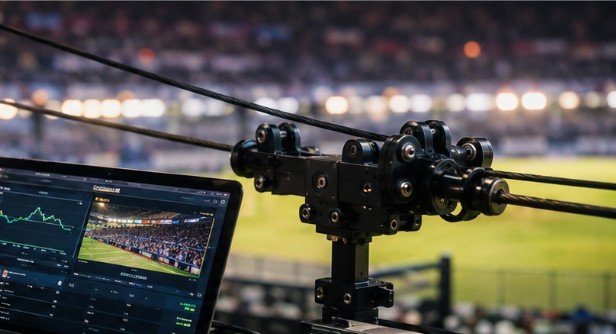
During a prime-time NFL broadcast, a suspended cable camera rig flies at 20 miles per hour just six feet above a quarterback’s helmet, carrying a 50-pound broadcast camera setup with zero risk of falling into the crowd. Try doing that with a battery-powered quadcopter, and federal regulators will shut down your live feed before kickoff.
When evaluating spidercam vs drone for live sports, the debate isn’t just about getting cool overhead shots—it comes down to load capacity, air safety, regulatory law, and raw power. Broadcasters must balance the physics of high-tensile Kevlar cables against the untethered freedom of multirotor aircraft. Both technologies have transformed modern sports coverage, but they solve fundamentally different engineering problems.
The Cable Rig Advantage: Uncompromising Power and Heavy Payloads
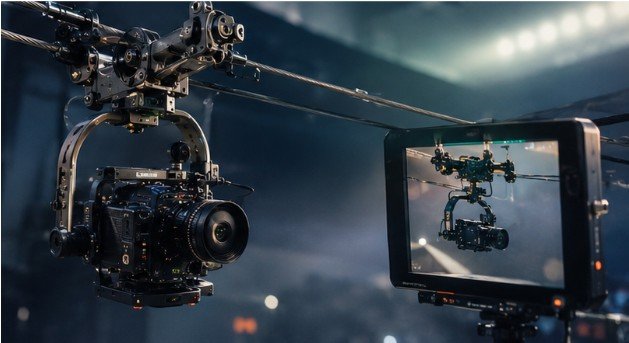
Spidercam systems—originally engineered in Austria and now operated under Ross Video—rely on four motorized winches anchored to structural stadium points. High-tensile Kevlar cables converge on a central gyro-stabilized dolly, moving the camera in three-dimensional space via synchronized software.
Because power feeds continuously through the winches, a Spidercam never needs a battery swap midway through a four-quarter game. Operators can fly full-scale, 30-kilogram broadcast packages equipped with 4K sensors, optical zoom lenses, and wireless telemetry receivers.
+———————————————————————–+
| VISUALIZATION: CABLE CAM VS DRONE |
| |
| SPIDERCAM (4-Point Anchor Enclosure) DRONE (Untethered Flight) |
| ┌───────────────────────────────┐ ┌──────────────────────┐ |
| │Winch A Winch B│ │ Open Air/Vista │ |
| │ \ / │ │ [Multirotor] │ |
| │ \ / │ │ | │ |
| │ [Camera Dolly] │ │ (Battery Limit) │ |
| │ / \ │ │ v │ |
| │ / \ │ │ Dynamic Sweeps │ |
| │Winch C Winch D│ │ Outside Stadium │ |
| └───────────────────────────────┘ └──────────────────────┘ |
+———————————————————————–+
Editor’s Note: A side-by-side architectural diagram comparing four-point vector geometry to free-range GPS vector trajectories works well here to visualize these flight envelopes.
Unlike drones, which rely on high-RPM propellers that create substantial acoustic noise, cable-suspended cameras glide silently. Players on a tennis court or football field aren’t distracted by thruster wash or motor whine during critical plays. To see how these cable setups perform in high-stakes venues, review these cable camera systems in live sports broadcasting overview.
Drone Capabilities: Untethered Range and Rapid Deployment
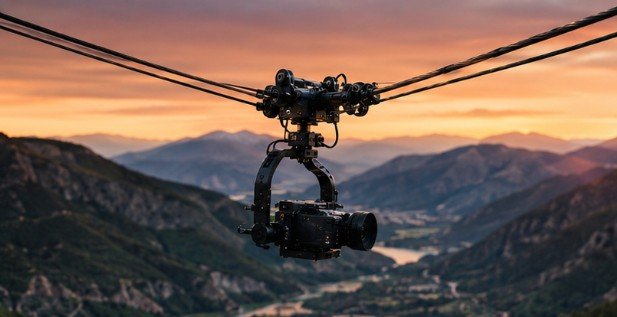
While cable rigs dominate indoor arenas and fixed stadium bowls, drones excel anywhere structural anchor points do not exist. A cable camera cannot follow a cross-country marathon runner, track a golf ball down a 500-yard fairway, or capture sweeping skyline establishing shots before cutaway breaks.
Drones deliver rapid deployment. A licensed operator can launch a cinema-grade multirotor in under ten minutes without mounting heavy winches to stadium girders or running thousands of feet of line across seating sections.
Modern drone platforms equipped with high-performance gimbals provide smooth, cinematic tracking shots that would require millions of dollars in cable infrastructure to replicate outdoors. If you want to learn how operators calibrate tracking stabilization on active shoots, read this guide on how to use gimbal hardware effectively.
Expanding the Broadcast Reality: Comparing Core Specs
To understand why network executives choose one platform over the other, compare their physical capabilities side by side:
| Operational Feature | Spidercam Cable Rig | Commercial Drone System |
| Max Payload Weight | Up to 30 kg (Full Broadcast Setup) | 2 kg to 6 kg (Compact Cinema Setup) |
| Flight Time / Power | Continuous (Direct AC Power Grid) | 15–30 minutes per battery set |
| Acoustic Noise | Near Silent (Electric Cable Winches) | High (High-RPM Propeller Wash) |
| Operating Area | Fixed 3D Box inside Anchor Points | Unlimited Range (Within Line of Sight) |
| FAA Stadium TFR Status | Fully Exempt (Not an Unmanned Aircraft) | Strictly Prohibited over 30,000+ Venues |
| Setup Time | 6 to 12 Hours (Rigging & Load Testing) | 10 to 20 Minutes |
Regulatory Realities: Federal Airspace vs. Cable Enclosures
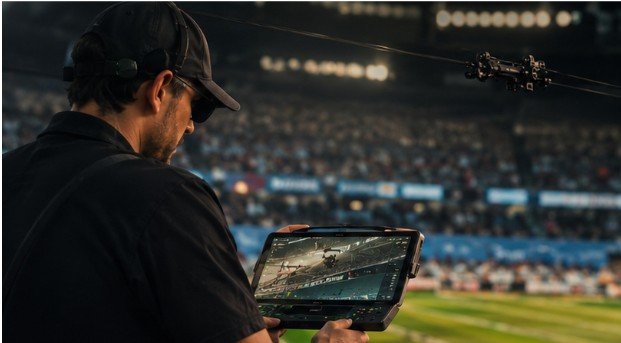
In the United States, federal aviation law draws a sharp boundary between airborne aircraft and ground-tethered cable systems. The Federal Aviation Administration (FAA) enforces strict Temporary Flight Restrictions (TFRs) over major sporting events.
Under FAA regulations, flying a drone within three nautical miles of any stadium seating 30,000 or more people—including NFL, MLB, NCAA Football, and NASCAR events—is illegal from one hour before to one hour after the game. Flying directly over concentrated crowds of spectators adds significant liability and requires complex Part 107 waivers.
Spidercams do not fly under FAA jurisdiction because they are structural cable systems rather than free-flying aircraft. They comply with industrial machinery safety standards like ISO 12100 and OSHA structural requirements. Redundant braking systems, real-time cable tension monitoring, and physical stop limits ensure that even if a motor fails, the payload remains suspended safely above the turf.
To explore how production teams handle mobile camera mounts safely on heavy-duty live shoots, explore this vehicle-mounted camera rigging case study.
Practical Selection Framework: Which Aerial System Fits Your Sport?
Production directors choose their aerial platform using a clear operational process:
- Assess Venue Restrictions: Is the event hosted inside a covered arena or a outdoor stadium subject to FAA TFRs? If flying over crowds in a major venue, a cable system is the only compliant choice.
- Evaluate Duration Requirements: Does the event require 4+ hours of uninterrupted continuous overhead coverage? Cable systems run endlessly on direct power, whereas drones require planned rotation schedules.
- Determine Camera Requirements: Does the director demand a heavy optical zoom broadcast camera, or can the shot work on a lighter, fixed-focal cinema sensor? Heavy optics require a cable system’s payload capacity.
- Calculate Setup Budget and Time: Is there a 12-hour rigging window available prior to the broadcast? If setup time is limited to 30 minutes, drones provide the practical solution.
For a look at how major networks integrate these multi-camera setups into live environments, read this sports broadcast production case study.
Limitations and Misconceptions
A common misconception is that drones will eventually render cable camera rigs obsolete as battery densities improve. However, battery chemistry is not the primary bottleneck—airspace safety, payload physics, and crowd protection are.
Cable systems have their own limitations:
- Rigging costs for winches, steel anchor points, and certified technicians run into tens of thousands of dollars per event.
- A low-flying punt or kick can occasionally collide with a cable, requiring clear ground-rule protocols during live games.
- Setup is labor-intensive and impossible in venues without load-bearing structural corners.
Drones remain unmatched for opening establishing shots, outdoor motorsports tracking along expansive tracks, and scenic alpine skiing coverage where building a cable anchor network is impractical.
Frequently Asked Questions
1. What is the best camera for live streaming sports?
The Sony HDC-4300 and Grass Valley LDX 150 are industry standards for broadcast live sports, offering native 4K, high dynamic range, global shutters, and high-frame-rate ultra-slow-motion capabilities over fiber connections.
2. What is the best drone for filming sports?
The DJI Inspire 3 is the top choice for professional sports filming, featuring a full-frame Zenmuse X9-8K Air gimbal camera, dual-operator controls, precise RTK positioning, and high-speed tracking capabilities up to 59 mph.
3. Which type of camera is best for live streaming?
PTZ (Pan-Tilt-Zoom) and dedicated broadcast system cameras with SDI or NDI outputs are best. They support remote operation, low-latency streaming, continuous power, and seamless tally light integration into live production switchers.
4. What is the best camera to shoot sports?
For handheld and sideline operators, flagship mirrorless bodies like the Sony Alpha 1 or Canon EOS R3 deliver ultra-fast autofocus, high burst rates, zero blackout viewfinders, and robust weather sealing for demanding sports environments.
The Verdict
Choosing between a Spidercam and a drone isn’t about picking a winner—it’s about matching the tool to the environment. Spidercams dominate the stadium bowl, delivering reliable, heavy-payload continuous coverage where drones cannot legally fly. Drones capture the world outside the venue, offering flexible, untethered movement across massive landscapes.
As broadcast technology evolves, expect to see both systems working in harmony: Spidercams capturing the tight, high-speed action on the field, and drones providing the grand context from the sky above.