





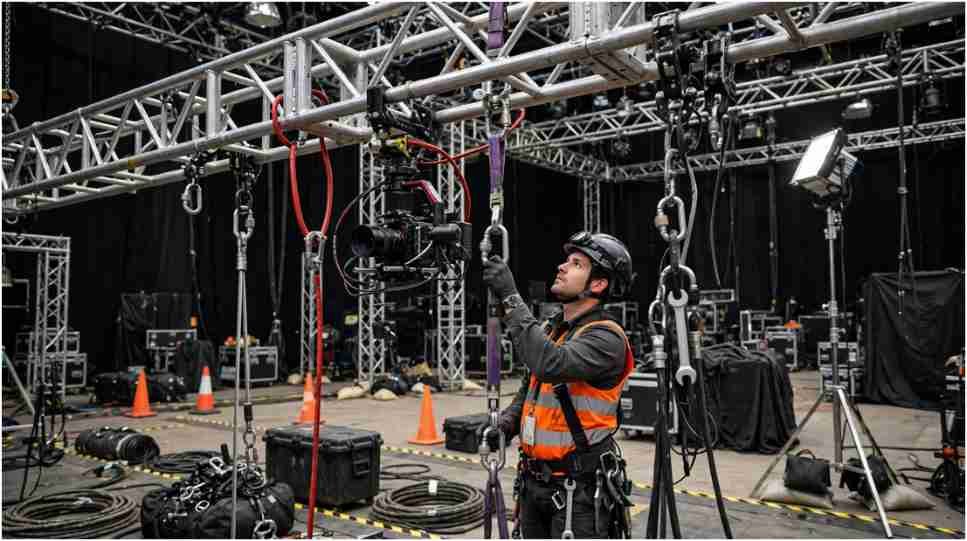
A shackle can look perfect and still be wrong for the load path. A sling can carry the weight on paper and still fail where it folds over a fitting. That is why shackle and sling safety for film rigging must be checked as a complete connection, not as separate rated parts.
When I review a rigging plan, I follow one sequence: load, sling, shackle, pin, anchor, movement. If any link changes direction, bunches, rotates, or sees more force than calculated, the stamped rating is no longer the whole story.
For US work, OSHA standards covering construction and general-industry sling use require rated capacities and legible identification to be respected. ETCP’s theatre-rigger competency framework also covers working load limits, sling forces, shock loads, hardware inspections, and pre-movement checks.
Start With the Load Path, Not the Hardware Bin
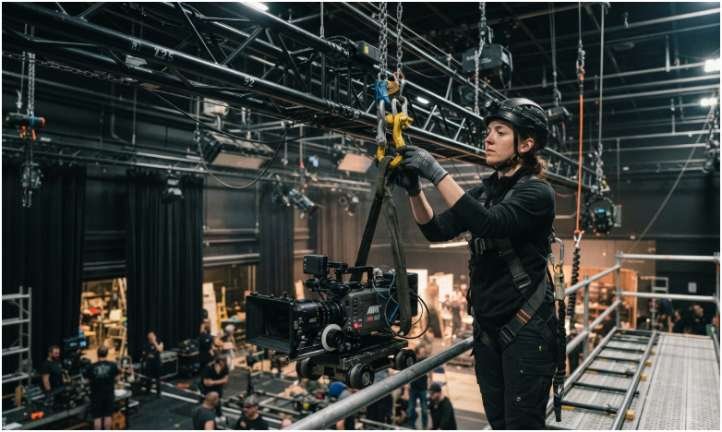
Good shackle and sling safety for film rigging starts before anyone reaches for a bow shackle. I first map force from the suspended object back to the structure. A component may exceed the object’s weight yet still become inadequate after bridle geometry or movement changes the force.
A film set overhead rigging load calculation should account for the suspended load, rigging hardware, bridle geometry, load sharing, and expected movement. ETCP specifically identifies object weight, sling-force calculations, dynamic loads, shock loads, and load distribution as core rigging knowledge.
WLL Is a Configuration, Not Just a Number
A Working Load Limit does not mean “safe in every possible arrangement.” OSHA requires employers to keep shackles within marked rated capacities, while sling identification can specify capacity according to factors such as hitch type and angle.
That is why how to calculate safe working load for film rigging cannot stop at “the shackle says 3.25 tons.” A side-loaded shackle, altered bridle angle, or pinched sling eye can change the usable capacity.
| Check | What I verify |
| WLL marking | Readable and adequate |
| Sling identification | Correct hitch and angle |
| Line of pull | Centered and manufacturer-approved |
| Pin security | Appropriate for duration and movement |
For me, shackle and sling safety for film rigging begins with verifying the configuration represented by that rating, not merely finding the number stamped into the steel.
Screw Pin or Bolt Type? Duration Changes the Answer
For temporary pick-and-place applications, screw-pin shackles are commonly used. Kito Crosby’s current guidance says the screw pin should be fully engaged and tightened before each pick. For permanent or long-term installations, it recommends bolt-type shackles and calls for the appropriate nut and cotter-pin arrangement.
That distinction matters to shackle and sling safety for film rigging because a production may combine static hangs, repeated resets, moving scenery, and powered equipment.
Kito Crosby specifically warns against allowing a live line to rotate a screw pin and recommends bolt-type hardware for long-term installations or situations where movement could rotate the pin.
Never replace a missing shackle pin with an ordinary shop bolt. OSHA’s construction rigging rule prohibits makeshift fasteners formed from bolts, rods, or similar substitutes.
Shackle Orientation Is Where Capacity Disappears
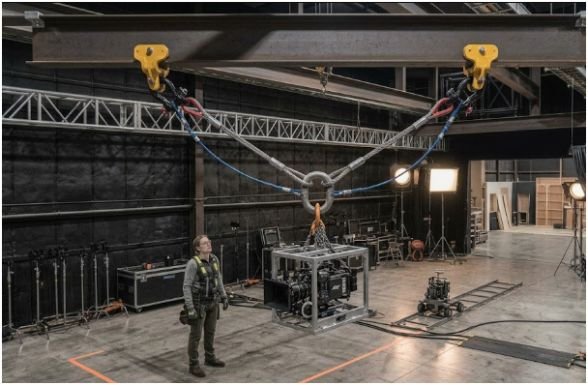
Correct shackle and sling safety for film rigging also depends on where the load actually sits.
The preferred arrangement centers the load and keeps the force aligned with the shackle’s intended loading direction. Multiple sling legs should sit in the bow rather than being crowded onto the pin. Kito Crosby also warns that folding, bunching, or pinching synthetic slings can reduce their rated load.
Side loading deserves even more attention. For certain Crosby screw-pin and bolt-type shackles from 3/16 to 3 inches, published guidance progressively reduces capacity as the side-load angle rises. At 71–90 degrees from in-line, the listed adjusted WLL is only 50% of rated capacity. Those figures are product-specific and should never be copied onto another manufacturer’s hardware.
If a narrow fitting can slide across the pin, use the manufacturer’s approved centering arrangement. Crosby documentation allows spacers in specified arrangements to keep a point load centered.
The same thinking supports dropped object prevention on film sets. A connection may remain attached but still become dangerous when the load shifts, the sling rubs an edge, or a pin begins rotating.
Sling Angles Can Double the Leg Force
For shackle and sling safety for film rigging, bridle geometry deserves the same attention as hardware size.
Consider an ideal symmetrical two-leg bridle supporting 1,000 pounds. Static leg tension can be represented as:
T = W ÷ [2 × cos(α ÷ 2)]
Here, W is the load and α is the included angle between the legs.
| Included angle | Approx. force per leg |
| 60° | 577 lb |
| 90° | 707 lb |
| 120° | 1,000 lb |
At a 120-degree included angle, each leg carries roughly the entire 1,000-pound static load. Nothing was added to the object. Geometry created the additional leg force.
Real systems may also include uneven loading, hardware weight, acceleration, and shock effects. ETCP therefore treats bridle calculations, dynamic loading, shock loading, and load distribution as separate rigging competencies rather than assuming weight alone determines sling force.
This worked example is one reason I consider calculation part of shackle and sling safety for film rigging, not something completed once and forgotten.
Protect the Sling Before It Becomes the Fuse
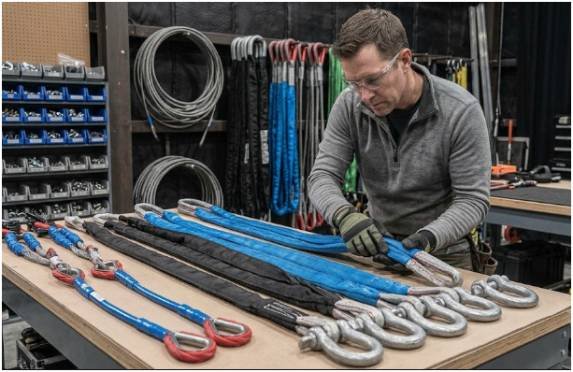
Synthetic webbing handles differently from steel hardware. Sharp scenery edges, truss corners, heat, chemicals, abrasion, and tight fittings can damage fibers long before the surrounding steel shows trouble.
OSHA requires synthetic web slings to be removed from service for conditions including acid or caustic burns, melting or charring, snags, punctures, tears, cuts, broken or worn stitching, and distorted fittings.
For shackle and sling safety for film rigging, I therefore treat edge protection as functional rigging equipment rather than cosmetic padding. The fitting must also be suitable for the sling. Manufacturer guidance warns that bunching and pinching synthetic material can reduce capacity.
Wire-rope slings need different inspection criteria. OSHA identifies kinking, crushing, bird-caging, heat damage, corrosion, damaged end fittings, and defined broken-wire thresholds as removal conditions.
A 60-Second Pre-Lift Check
Consistent shackle and sling safety for film rigging becomes easier when every connection gets reviewed in the same order:
- Read the WLL and identification on every sling and shackle.
- Confirm the correct pin, full engagement, nut, and cotter where required.
- Check sling eyes for folding, pinching, abrasion, cuts, and edge contact.
- Verify the line of pull, bridle angle, load distribution, and any required derating.
- Inspect the complete assembly before movement and control the area beneath the load.
OSHA’s sling guidance warns against damaged attachments, dragging slings over abrasive surfaces, and walking beneath suspended loads. ETCP’s theatre-rigger framework likewise includes whole-assembly pre-movement inspections and establishing controlled lifting and lowering zones.
| Component | Quarantine when you find |
| Shackle | Distortion, damaged pin or threads, cracks, significant nicks, corrosion, unreadable markings |
| Synthetic sling | Cuts, burns, melting, punctures, worn stitching, distorted fittings |
| Wire-rope sling | Kinks, bird-caging, crushing, corrosion, heat damage, excessive broken wires |
If a defect creates an argument beside a suspended load, I treat that uncertainty as a reason to stop. Quarantine the component and let a qualified person determine its status.
Frequently Asked Questions
1. Can screw-pin shackles be used for overhead film rigging?
Yes, when the manufacturer permits the application and pin rotation is controlled; long-term installations commonly favor bolt-type shackles.
2. What sling angle is safest for film rigging?
There is no single universal angle, but smaller included angles generally reduce leg tension; calculate the actual bridle and follow manufacturer ratings.
3. How often should slings be inspected on a film set?
Inspect rigging before use and follow the applicable OSHA requirements, manufacturer instructions, employer program, and production-specific procedures.
4. What is the biggest shackle and sling safety for film rigging mistake?
Treating the stamped WLL as valid regardless of sling angle, hitch, side loading, pin security, movement, or hardware condition.
The Shot Can Wait. The Hardware Cannot.
My final test for shackle and sling safety for film rigging is simple: what changes once the system begins moving?
If movement can rotate a pin, increase sling force, shift a pick point, or drag webbing across an edge, I want that problem solved before anything leaves the ground.
The useful habit is not memorizing one shackle chart. Trace the force through every connection. Check the manufacturer’s rating for that exact configuration. Quarantine questionable gear and control the load zone.
The camera can reset. The rigging should not need a second chance.