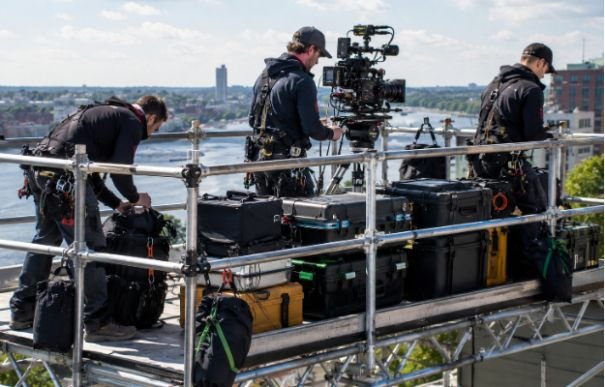






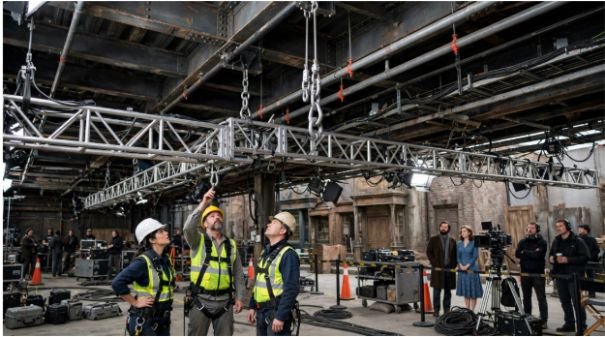
When I review a film-set rigging plan, I check clearance before trim height. A rig can carry its load and still be unsafe because it sits too close to power lines, sprinklers, beams, ducts, or people. Overhead rigging clearance requirements for film sets therefore combine electrical separation, fire protection, sling geometry, load control, and clear space below the rig.
Why Clearance Is More Than Trim Height
I treat clearance as usable safety space around the complete load path. Hoists, slings, scenic pieces, camera systems, and moving lifts all consume it.
For US productions, OSHA requirements depend on the activity and equipment. Construction crane operations fall under 29 CFR 1926 Subpart CC. Sling rules also appear in OSHA construction and general-industry standards. ESTA publishes ANSI entertainment standards that can supplement the legal baseline and project requirements.
That distinction matters because overhead rigging clearance requirements for film sets cannot be reduced to one number copied from another jurisdiction.
Electrical Clearance Around Film Rigging
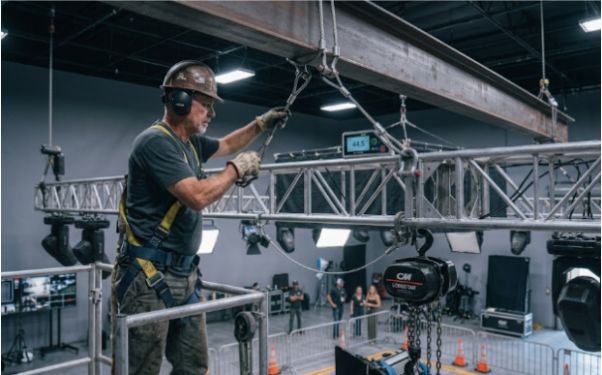
Power Lines Need a Voltage-Based Approach
For crane and derrick work covered by OSHA’s construction rule, the employer must assess whether equipment can enter a power-line hazard zone.
For lines up to 350 kV, OSHA provides a 20-foot option or Table A minimum approach distances with required protective measures. Higher-voltage lines require greater separation.
I would not apply a blanket 13-foot rule to a US set. Moving cranes, towers, load lines, and accessories can enter the hazard envelope.
OSHA also requires the work zone to be identified when assessing covered equipment. This is where overhead equipment safety for film production starts.
Indoor Power Still Needs Space
Stages may avoid utility lines, but temporary power still creates contact hazards. Overhead rigging clearance requirements for film sets should account for hoist travel, deflection, and repositioning.
A metal truss that clears a feeder during installation may not clear it after loading. The same concern applies when motor travel changes the final trim.
Sprinklers and Building Services
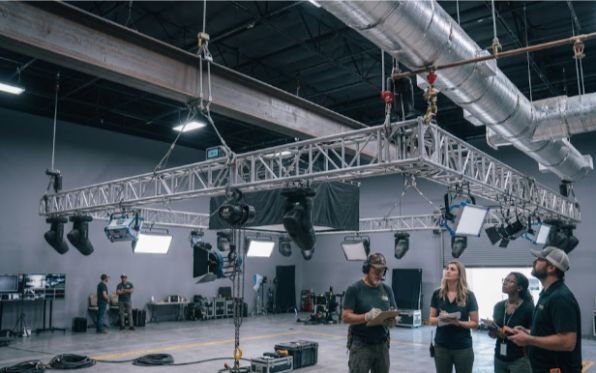
Keep Sprinkler Discharge Space Open
OSHA’s general-industry sprinkler rule requires at least 18 inches of vertical clearance between sprinklers and material below. It also requires sprinkler placement with minimal interference to discharge patterns.
I treat 18 inches as a minimum, not a target. Large solids or soft goods can still interfere with water distribution. NFPA guidance also addresses suspended obstructions near sprinkler discharge.
For that reason, overhead rigging clearance requirements for film sets should be checked against venue drawings and local fire-authority requirements before final trim.
Low Steel Can Force Bad Hardware Geometry
Beams and ducts can tempt crews to flatten slings or force hardware into tight paths. If space pushes hardware outside its rated configuration, I change the rig.
Gaining a few inches of trim is not worth creating side loading, an aggressive bend radius, or a connection that cannot be properly inspected.
Sling Geometry Can Eat Up Clearance
Worked Example: A 1,000-Pound Two-Leg Bridle
Clearance and load are directly linked. A shallow bridle saves vertical space but increases leg tension.
For an ideal, symmetrical two-leg bridle carrying a 1,000-pound static load:
| Bridle angle from horizontal | Approx. tension per leg |
| 60° | 577 lb |
| 45° | 707 lb |
| 30° | 1,000 lb |
At 30 degrees, each leg already carries the full static load before dynamic effects, hardware weight, or unequal loading are considered.
This is why safe use of slings in film production rigging must be planned with available headroom.
I do not treat 30 degrees as a universal legal minimum. The manufacturer’s rated configurations and applicable engineering requirements control.
This worked example also shows why overhead rigging clearance requirements for film sets cannot be separated from load calculations. Saving vertical space can transfer the problem directly into the sling forces.
Wire-Rope Assemblies Need Physical Room
OSHA’s construction rule specifies that cable-laid and 6×19 or 6×37 wire-rope slings need a clear rope length between splices, sleeves, or end fittings equal to at least 10 times the component rope diameter.
That makes overhead rigging clearance requirements for film sets partly a hardware-layout problem. The suspended object may fit while the sling assembly does not.
Clearance Below the Load Counts
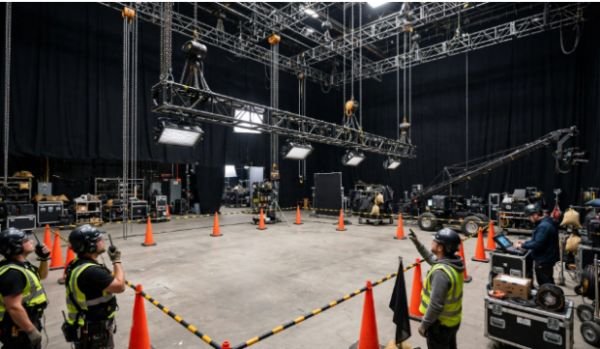
A rig is not safe because it clears the ceiling. I also plan a controlled area below active lifting and adjustment work.
The zone should reflect the load, lift path, and potential swing. Once the rig is static, production still needs rules for work beneath it.
That is where engineered retention and secondary safety cables for overhead film equipment fit into the operating plan.
Overhead rigging clearance requirements for film sets also need to consider actors, dollies, jibs, Steadicam paths, scenery, and other elements that may enter the space after rigging finishes.
This is an easy detail to miss. The installation envelope and shooting envelope are rarely identical.
WLL Tags and Safety Factors: Skip the Shortcut
I often see “5:1” treated as a universal rule for every entertainment-rigging component. That is too broad.
OSHA requires slings to remain within rated capacities, and covered sling types require durable capacity identification. OSHA has addressed a 5:1 factor in specific wire-rope contexts, but that does not turn 5:1 into one design rule for every truss, hoist, shackle, anchor, or suspended assembly.
I check manufacturer WLL, hitch type, angle, weakest component, structure, and applicable standard.
Missing capacity identification is not something I estimate around. OSHA requires identification for covered slings and prohibits loading beyond marked limits.
That is another reason overhead rigging clearance requirements for film sets must preserve enough room to inspect every critical connection.
A connection hidden against steel may technically fit, yet still prevent a rigger from confirming pin position, sling condition, or hardware alignment.
The Five-Question Clearance Check
Before I approve an overhead plan, I ask five questions: What can the rig contact? What can move into its space? What fire-protection equipment can it obstruct? Does the geometry increase load? Can every connection still be inspected?
If an answer depends on “it probably won’t move,” the clearance is unresolved.
This approach improves overhead rigging clearance requirements for film sets because it tests the operating rig, not just the drawing.
A useful rigging plot should therefore show more than suspension points. It should identify electrical hazards, sprinkler locations, structural obstructions, moving equipment, final trim, and areas that must remain accessible.
FAQ
1. What is the minimum power-line clearance for film rigging?
For covered crane operations, OSHA distance depends on voltage and compliance method; a 20-foot option or Table A distances may apply for lines up to 350 kV.
2. How much space is required below sprinkler heads?
OSHA 1910.159 requires at least 18 inches below sprinklers while the discharge pattern must remain unobstructed.
3. Do overhead rigging clearance requirements for film sets include sling angles?
Yes. Sling angle changes can sharply increase leg tension, so clearance and rated geometry must be checked together.
4. Can a crew use a sling with missing WLL identification?
Covered sling types require capacity identification; remove unidentified gear from service until its rating and compliance are properly established.
Give the Rig Room to Breathe
I would rather lose a few inches of trim than lose inspection space, electrical separation, or safe geometry.
Mark every overhead hazard on the rigging plot before equipment reaches the grid. Then verify overhead rigging clearance requirements for film sets again at final trim. The drawing proves the plan; the finished rig proves the clearance.