




A film production rigging hazard assessment should answer three questions before a load leaves the ground: what can fail, who could be exposed, and what controls must exist first? I treat the assessment as part of rig design, not paperwork completed after everything is hanging overhead.
For US productions, there is no single federal form covering every film rigging setup. Applicable requirements depend on the work, equipment, location, and jurisdiction. OSHA requires workplace hazard assessments for PPE under 29 CFR 1910.132, while separate standards can govern slings, material handling, cranes, fall protection, and related operations.
Industry-Wide Labor-Management Safety Committee bulletins also provide production-specific guidance, but the committee states that its bulletins are recommendations rather than substitutes for applicable laws and regulations.
What a Film Production Rigging Hazard Assessment Must Cover
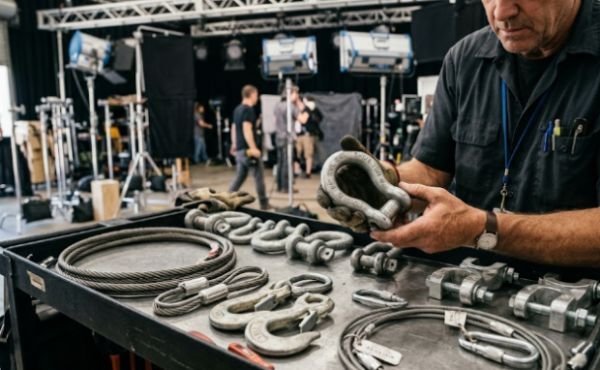
My film production rigging hazard assessment records more than the hardware hanging above the set. I document the load, supporting structure, connectors, lifting equipment, people exposed below, movement sequence, inspection status, environmental limits, communications, and emergency actions.
I also record the residual risk after controls are installed. Writing “use caution” does not reduce risk. A useful control changes the physical condition, removes people from exposure, prevents an unsafe movement, or creates a measurable shutdown point.
Start With the Rigging Load Path
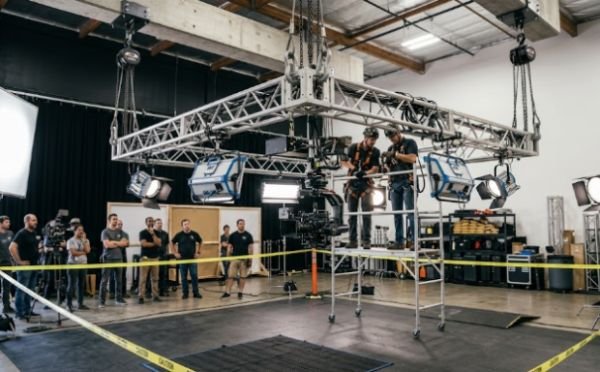
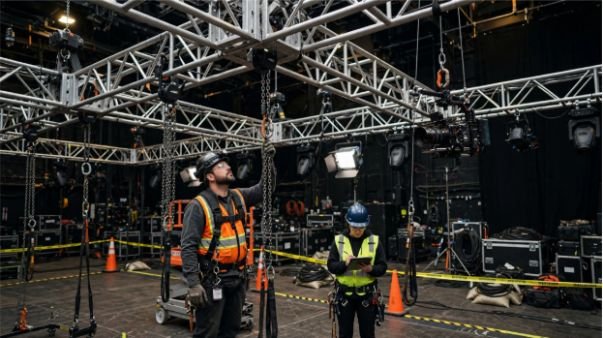
I begin every assessment by tracing where the force travels. The path may run from a camera or lighting package through clamps, shackles, slings, hoists, truss, bridles, and finally into structural anchors.
If one link is missing from the assessment, I do not consider the load path complete.
Verify Loads and Rated Capacity
First, I calculate known equipment weight. I then account for motors, cable, accessories, modifiers, moving components, and any forces created during operation.
I never use an arbitrary safety factor to compensate for missing information. When OSHA’s construction material-handling rigging standard applies, rigging equipment must have legible identification showing its recommended safe working load and must be inspected before use on each shift. Defective equipment must be removed from service.
This stage should connect directly with rigging load distribution for film sets. A rig weighing 800 pounds does not automatically place 400 pounds on each of two points. Geometry, point positions, bridle angles, truss behavior, and dynamic forces can change individual reactions.
Approve Anchors and Connections
A highly rated sling cannot make an unknown structural point safe.
I verify that anchors are suitable for both the anticipated force and its direction. I also inspect how connectors seat. Side-loading hardware, forcing a connector into an incompatible point, or changing the direction of pull can introduce hazards that a total-weight calculation misses.
I pair this process with how to inspect rigging hardware before filming so damaged, distorted, unrated, or illegibly marked components never become part of the working system.
Assess the Exposure Zone Below the Rig
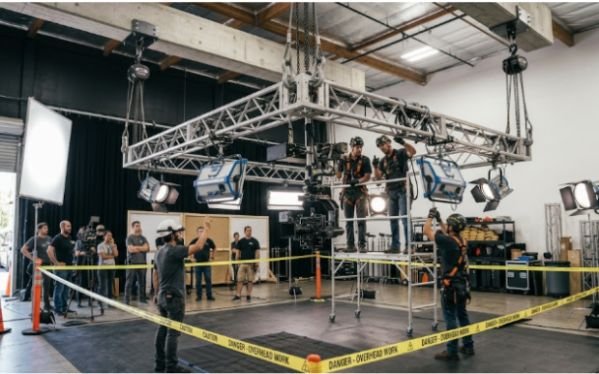
A film production rigging hazard assessment cannot stop at the question, “Will the rig hold?”
I also ask: “Who gets hurt if something moves or fails?”
Falling Objects and Suspended Loads
OSHA’s general-industry sling standard states that employees must remain clear of loads about to be lifted and suspended loads.
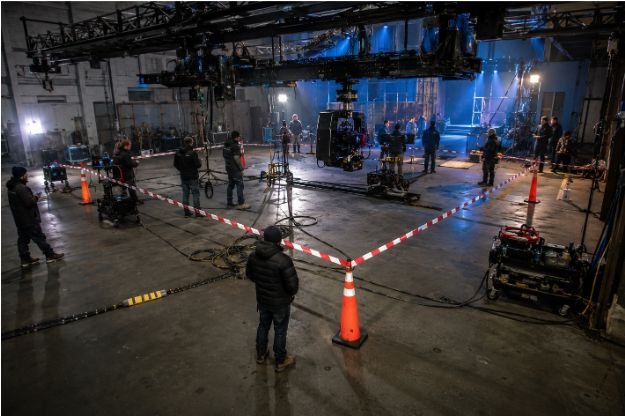
That makes the area beneath active lifting a controlled exposure zone in my assessment.
Depending on the equipment and operation, controls may include restricted access, suitable secondary retention, secured accessories, tool-control measures, spotters, or defined times when cast and crew may enter.
The key is exposure reduction. A hard hat does not make standing beneath an unnecessary suspended-load hazard acceptable.
Movement and Control
Motorized trusses, hoists, cable-camera systems, and moving scenic equipment create additional pinch, strike, and travel hazards.
My film production rigging hazard assessment identifies the movement path, operator position, communication method, stop procedure, clearance requirements, and the person authorized to halt operations.
OSHA’s hoisting requirements reinforce this stop-work principle: when an operator has doubts about safety, handling should stop until safety has been assured.
Add Reassessment Triggers Before Work Begins
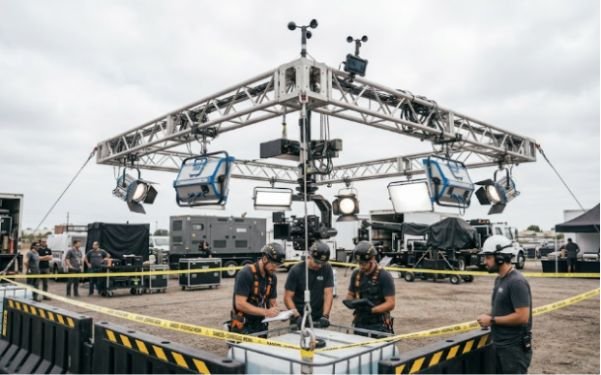
This is where I think many conventional risk forms become too static.
A good film production rigging hazard assessment says exactly what makes the previous approval invalid.
A heavier camera package may change loading. A different sling angle may alter anchor reactions. Repositioning a motor can change truss loading. Rain can affect equipment and working surfaces. Wind can change forces on large fabrics or outdoor structures.
OSHA’s nonmandatory PPE assessment guidance similarly recommends reassessing hazards when equipment or processes change.
I therefore establish change triggers before the first take.
Film Rigging Hazard and Control Matrix
| Hazard | Initial Risk | Essential Control | Trigger for Reassessment |
| Component overload | High | Verify load, ratings, geometry, and complete load path | Weight or geometry changes |
| Falling equipment | High | Control access and use suitable retention where required | Equipment or access changes |
| Defective hardware | High | Inspect before use and remove defective gear | Impact, deformation, missing identification |
| Unexpected movement | High | Define travel path, communications, and stop authority | Control or programming changes |
| Weather exposure | Variable | Establish operating and shutdown limits | Conditions approach defined limits |
I prefer this action-based matrix because every control can be physically verified. “Crew aware” is difficult to prove. “Area barricaded until lift is complete” is observable.
A Worked On-Set Rigging Assessment Example
Imagine I am assessing a 180-pound moving camera package supported by a small overhead truss and two hoists.
A weak form might record:
“Camera: 180 pounds. Two motors. Risk: low.”
That tells me almost nothing.
My film production rigging hazard assessment adds the truss weight, hoists, cabling, accessories, carriage, and relevant operating forces. I check actual point positions instead of assuming each hoist carries exactly half.
Next, I inspect the exposure path.
If the camera travels above a normal crew walkway, I do not simply add “watch overhead” to the form. I control the walkway during movement or alter the operating arrangement.
Finally, I define change triggers. Replacing the lens with a heavier package, relocating a motor, modifying the span, moving an anchor, or substituting hardware requires another review.
That is my three-layer test:
Load path → Exposure path → Change triggers.
It converts the assessment from a scoring exercise into an operating decision.
Who Should Review the Assessment?
I want the review performed by people who understand the system and have enough authority to stop unsafe work.
The exact team depends on the production. It may involve qualified rigging personnel, the key grip or rigging key, production safety staff, venue representatives, hoist operators, or structural engineers when engineering judgment is necessary.
ETCP currently offers Arena and Theatre rigger certifications covering areas that include temporary overhead systems, chain hoists, and truss. ESTA also develops consensus standards for entertainment environments, including film and video production.
Certification or experience alone does not automatically approve a particular installation. The specific rig still requires appropriate evaluation.
For everyday communication, I also pair the assessment with a film rigging safety checklist for production crews. Technical controls only work when the people entering the work area understand them.
Frequently Asked Questions
1. What should a film production rigging hazard assessment include?
Include the complete load path, equipment ratings, anchors, hardware condition, exposure zones, operating controls, environmental limits, emergency actions, and reassessment triggers.
2. Who is responsible for rigging hazard assessment on a film set?
Responsibility varies by employer, production structure, task, and jurisdiction, but technically qualified personnel should evaluate rigging hazards and controls.
3. How often should a film rigging risk assessment be updated?
Reassess whenever the load, anchor, geometry, hardware, operating method, environment, or personnel exposure changes.
4. Is a 5:1 safety factor always required for film rigging?
No. Never assume one universal ratio; follow applicable regulations, manufacturer ratings, engineered criteria, and relevant entertainment standards for the actual system.
Final Take: The Rig Changed? Your Paperwork Just Expired
I consider a film production rigging hazard assessment useful only when I can verify its controls physically on set. If the load changes, hardware gets replaced, wind increases, an anchor moves, or the crew’s exposure changes, the previous assumptions deserve another check.
Before operation, I inspect the hardware, confirm the load path, verify access controls, test communications, and make sure everyone knows who can stop the move.
A risk score does not support an overhead rig. The decisions made before the load leaves the ground do.