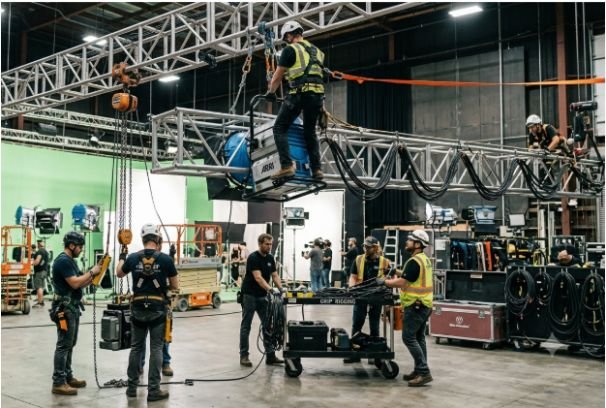






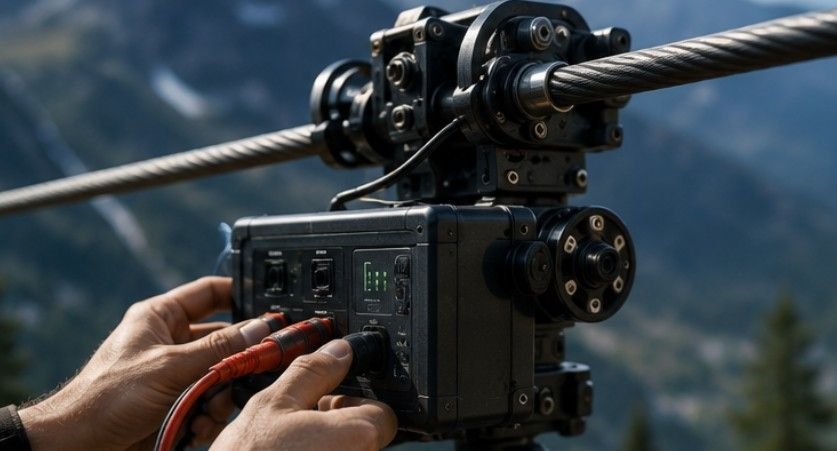
A cable cam can have plenty of battery capacity and still fail if the voltage is wrong, the ESC cannot handle peak current, or the receiver resets during acceleration. Learning how to power remote cable cam systems is less about buying the biggest battery and more about matching the electrical chain.
A Remote Cable Cam Has More Than One Power Load
The carriage is the high-demand side. It may power the traction motor, controller, sensors, braking functions, and accessories. The handheld remote is a much smaller load and may use an internal rechargeable cell or USB charging.
Noxon’s Portable Wirecam is specified for a 12V battery or mains supply and lists about six hours of autonomy in continuous movement. Its support page says the wireless controller can charge from a wall connection, power bank, or PC. Noxon’s Portable Wirecam specifications show why carriage and controller power should be planned separately.
| Setup | Power approach | Main concern |
| Portable commercial rig | Dedicated 12V/internal pack | Runtime |
| High-speed rig | High-discharge LiPo/approved V-mount | Peak current |
| DIY rig | Battery → ESC → motor, plus BEC | Compatibility |
Size the Battery by Voltage, Current, and Watt-Hours
Start with voltage. The pack must fall inside the approved input range of the ESC and other electronics. A higher-voltage battery is not automatically an upgrade.
Then check current. Acceleration, inclines, heavier camera packages, and rolling resistance can create current spikes. The battery, wiring, connectors, and ESC all need enough headroom.
For energy capacity, use:
Watt-hours = volts × amp-hours
The FAA uses this calculation for lithium-battery ratings. A hypothetical 22.2V, 8Ah pack stores 177.6Wh. If a cable cam averages 250W, the theoretical runtime is about 0.71 hour. Real runtime will be shorter, so validate it with a loaded rehearsal.
A representative test run is often more useful than relying on a motor’s headline wattage, which may describe peak rather than continuous demand.
How Commercial Cable Cams Handle High Power
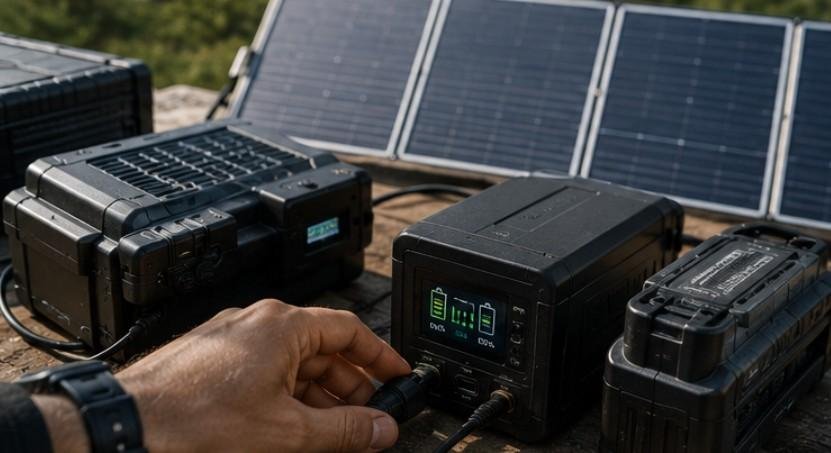
Commercial systems show why there is no universal battery setup. Noxon says its High-Speed Cablecam uses two six-cell LiPo batteries to support a system rated at 4,000W, with optional custom V-lock support. Its kit also lists a 100W charger for up-to-6S LiPo packs. Noxon’s High-Speed Cablecam details demonstrate how faster rigs require purpose-built power hardware.
Wiral instructs users to charge the dedicated Wiral LITE battery with its supplied charger and wait for the full-charge indicator before filming. The practical lesson is to treat battery and charger as a matched system unless the manufacturer approves alternatives.
Power planning also affects live coverage, where a battery swap can cost an unrepeated shot. See how cable camera systems work in live events for the wider operating context.
DIY Cable Cams Need Stable Receiver Power
A common DIY layout sends the main battery to an electronic speed controller, which drives the motor from the receiver signal. The easy-to-miss detail is receiver power.
Some ESCs include a BEC, or Battery Eliminator Circuit, that steps the main pack voltage down for the receiver. Others do not. Hobbywing documents high-voltage ESCs that require a separate receiver supply, while its UBEC instructions show an external regulator taking power from the main battery and feeding the receiver at a suitable voltage.
A motor surge can create a voltage drop. If the receiver browns out, the rig may lose control even though the main battery still has charge. ESC manufacturers specifically identify inadequate BEC capacity as a cause of receiver brownouts and unstable electronics.
Before a custom rig goes overhead, verify polarity, connector ratings, ESC input range, receiver voltage, failsafe behavior, and low-voltage cutoff. Do not improvise series or parallel battery arrangements on set.
Run This Ground Test Before Rigging
Before putting the carriage on the line:
- Fully charge the carriage battery and controller.
- Confirm battery voltage matches the equipment specification.
- Fit the real camera and gimbal payload.
- Run repeated starts, stops, and the fastest planned acceleration.
- Check for receiver resets, hot connectors, ESC overheating, low-voltage warnings, or inconsistent braking.
- Record battery use and calculate how many packs the shoot requires.
Electrical testing belongs alongside cable camera rigging safety for filmmakers, because a power failure can become a stopping-distance or motion-control problem.
US Crews Need a Battery Travel Plan Too
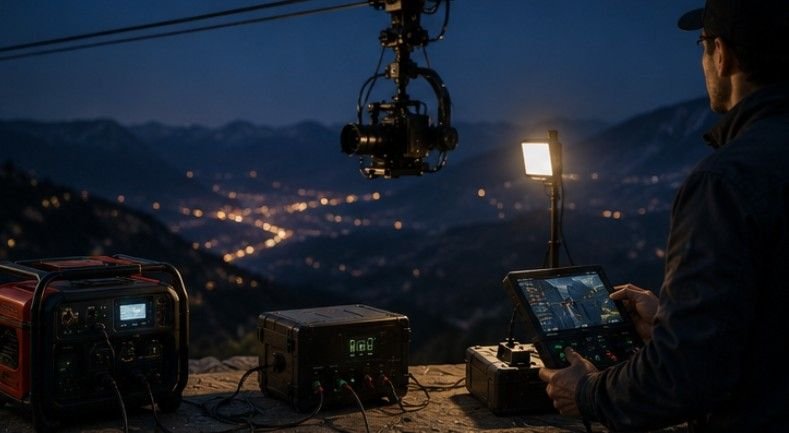
The FAA says rechargeable lithium batteries up to 100Wh are generally allowed on passenger aircraft for personal use. Batteries from 101–160Wh require airline approval, while batteries above 160Wh are prohibited. Spare lithium batteries must stay in carry-on baggage and be protected against short circuits. FAA airline battery guidance should be checked before flying because airlines may impose stricter limits.
The FAA also warns against traveling with damaged or recalled lithium batteries and notes that overheating, damage, overcharging, or internal defects can lead to thermal runaway.
Bigger Is Not Always Better
A larger battery adds mass to the moving carriage. That can increase motor demand, braking distance, and rigging forces.
A USB power bank that works for the controller is not automatically suitable for the drive system. Its voltage and current output may be wrong for the traction motor and ESC.
Power requirements can even influence platform choice. Crews comparing endurance, repeatability, operating space, and deployment constraints may also find cable camera vs drone for cinematic shots useful.
Frequently Asked Questions
1. Can I power a cable cam with a V-mount battery?
Only if the manufacturer supports it or the system has a correctly engineered interface. Some professional cable cams offer approved V-lock solutions, but direct connection is not universally safe.
2. How do I calculate cable cam battery runtime?
Divide usable battery watt-hours by measured average watt draw, then verify the estimate with the full camera payload and planned movement pattern.
3. Should the remote controller use separate power?
Usually. Commercial remotes commonly have their own battery or USB charging. DIY receivers may use an ESC BEC, external BEC, or dedicated low-voltage supply.
4. Can a higher-voltage battery make the cable cam faster?
Only when every component is designed for that voltage. Exceeding an ESC or motor rating can cause failure, overheating, or loss of control.
The best answer to how to power remote cable cam equipment is not “use the largest battery.” Match voltage, current capability, energy capacity, receiver power, and charger compatibility, then prove the setup under load. Reliable overhead movement starts with a disciplined ground test.