



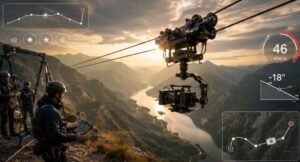

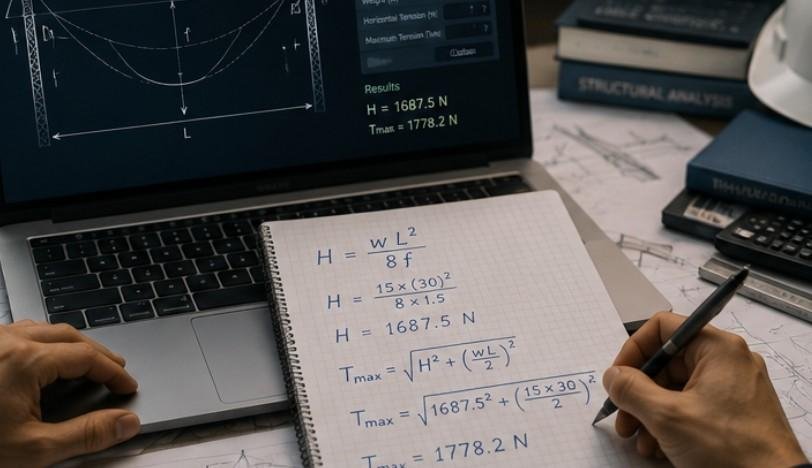
Cutting cable sag in half can roughly double the horizontal tension in the line. That is the first thing to understand before anyone reaches for a winch. If you are learning how to calculate cable cam tension, the goal is not to make the line look perfectly straight; it is to preserve clearance while staying inside the limits of the rope, anchors, terminations, winch, and hardware.
The familiar (T_h = wL^2/(8d)) formula describes a uniformly distributed load. A camera trolley is a moving concentrated load, so treating its weight as “pounds per foot” can understate the force that matters.
Start With the Four Inputs That Control Tension
For a level, single-span cable cam, record:
- L — span: horizontal distance between anchors.
- d — sag: vertical drop from the support line to the cable.
- w — distributed load: cable weight per foot plus other truly distributed loads.
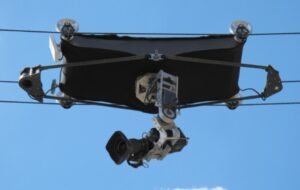
- P — point load: trolley, gimbal, camera, lens, batteries, monitor, wireless gear, and accessories.
Engineering texts distinguish these cases because cables take different shapes under concentrated and distributed loads. The general cable theorem links horizontal tension and cable dip to the bending moment produced by the same loading on a simply supported beam.
Weigh the assembled moving rig instead of relying on a camera-body specification. If power is still undecided, settle how to power a cinema camera rig with V-mount batteries before calculating, because the batteries belong in (P).
The Standard Sag Formula—and Its Limitation
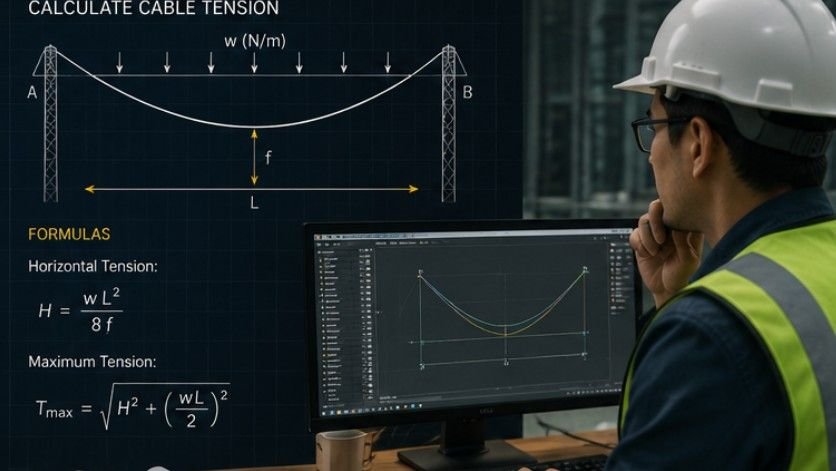
For a cable carrying a uniform vertical load, the parabolic approximation is:
[
T_h = \frac{wL^2}{8d}
]
Maximum support tension is commonly estimated as:
[
T_{max}=T_h\sqrt{1+\left(\frac{4d}{L}\right)^2}
]
Firgelli’s engineering calculator uses these relationships for preliminary analysis and explicitly defines (w) as distributed load. It also notes that significant point loads need more detailed treatment.
A Better Quick Estimate for a Midspan Trolley
For level supports, modest sag, and a trolley at midspan, a useful static approximation is:
[
H \approx \frac{\frac{wL^2}{8}+\frac{PL}{4}}{d}
]
Then:
[
V \approx \frac{wL+P}{2}
]
[
T \approx \sqrt{H^2+V^2}
]
The (PL/4) term represents the central point load. This follows from the general cable theorem and static equilibrium, making it more representative of a cable cam than spreading the camera package across the line.
Worked Example: A 100-Foot Cable Cam
Assume a 100 ft span, 8 ft sag, cable weight of 0.08 lb/ft, and a 30 lb moving rig.
Cable self-weight term:
[
0.08 \times 100^2 / 8 = 100
]
Camera term:
[
30 \times 100 / 4 = 750
]
Horizontal tension:
[
H=(100+750)/8=106.25\text{ lbf}
]
Vertical reaction at either support:
[
V=(8+30)/2=19\text{ lbf}
]
Support tension is therefore about 108 lbf.
Now tighten the same system without changing the payload:
| Midspan sag | Horizontal tension | Support tension |
| 8 ft | 106 lbf | 108 lbf |
| 4 ft | 213 lbf | 213 lbf |
| 2 ft | 425 lbf | 425 lbf |
The payload never changed; sag alone drove the increase. That is why “make it tighter” is not a safe engineering instruction.
Editor note: a line chart of sag versus tension would show this inverse relationship clearly.
Static Tension Is Not the Same as a Safe Working Limit
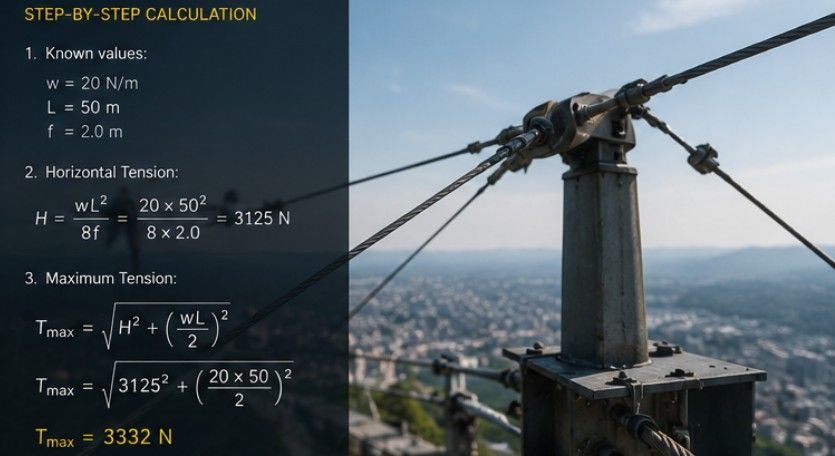
A calculated 108 lbf does not make a 108-lbf-rated system acceptable. Cable cams accelerate, brake, vibrate, and may be stopped abruptly. Samson Rope warns that normal working-load calculations do not cover shock loading and that rapidly applied loads can produce much higher peak forces, particularly in low-elongation HMPE rope.
Do not turn that warning into an arbitrary multiplier. Dynamic allowances should come from the cable-cam manufacturer, rope and hardware ratings, and qualified rigging or engineering review.
Noxon likewise says there is no universal correct cable-cam tension: payload, span, sag, anchor strength, clearance, and system limits all matter. Its built-in tension indicator is described as a traction reference, not an absolute tension gauge.
Build the Real Shooting Payload First
Small accessories can move the calculation more than expected. A monitor may require a mount, receiver, cable, hood, or separate battery, so decide the on-camera monitor brightness needed for daylight filming before freezing the load figure.
Likewise, a V-mount battery setup for mirrorless cinema cameras changes the moving mass. Run the tension calculation on the configuration that will actually travel on the line.
A Practical Cable-Cam Calculation Checklist
Before tensioning:
- Measure span and anchor-height difference.
- Weigh the complete moving trolley package.
- Get the rope’s actual weight per foot and manufacturer ratings.
- Choose enough sag to maintain required clearance.
- Calculate static tension at relevant trolley positions.
- Check rope, terminations, winch, anchors, connectors, and support structures against rated limits.
- Account for acceleration, braking, wind, incline, temperature, and rope stretch.
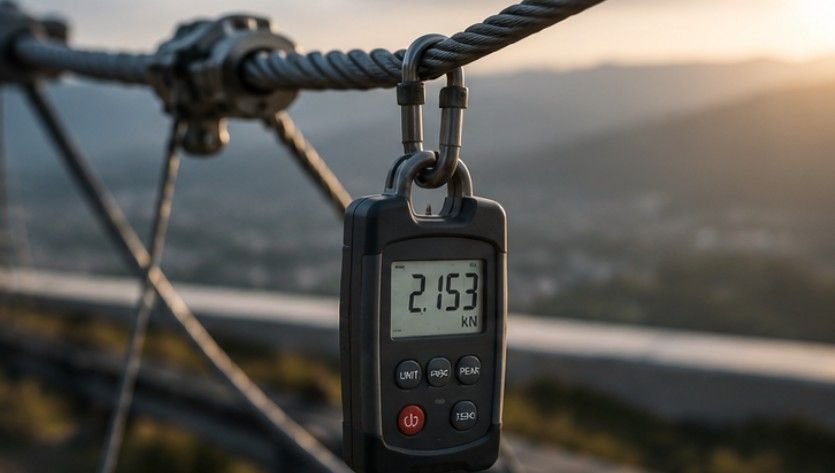
- Verify installed tension where the system allows and inspect before operation.
For U.S. work, OSHA rules may apply depending on the equipment and activity. OSHA prohibits covered rigging from being used above rated capacities, while its crane standard requires specified wire ropes to receive visual inspection before or during each shift.
Where the Simple Math Stops Working
Do not rely on the midspan shortcut for unequal anchor heights, steep inclines, multi-span lines, deep sag, strong wind, multiple loads, substantial rope stretch, or aggressive high-speed braking.
The trolley also moves, so cable geometry and support reactions change with position. Safety-critical installations may require piecewise statics, an exact catenary model, load-cell verification, or structural analysis rather than a single spreadsheet result.
Frequently Asked Questions
1. What is the easiest formula for cable cam tension?
For uniform load, use (T_h=wL^2/(8d)). For a midspan trolley, include the point-load term (PL/4) before dividing by sag.
2. Does less sag always mean more cable tension?
With the same span and load, yes. In the simplified model, halving sag roughly doubles horizontal tension.
3. Should camera weight be included in (w)?
Usually no. A moving camera carriage is a concentrated load (P); (w) should represent cable weight and other distributed loads.
4. Can a tension calculator approve a real cable-cam rig?
No. Use it for preliminary estimates. Final decisions must follow manufacturer limits, actual site conditions, competent rigging practice, and engineering review where safety demands it.
A cable cam does not become safer because the line looks straighter. The useful number is the force the entire system actually sees, and enough controlled sag is often what keeps that force manageable.