



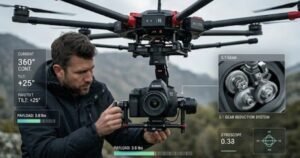
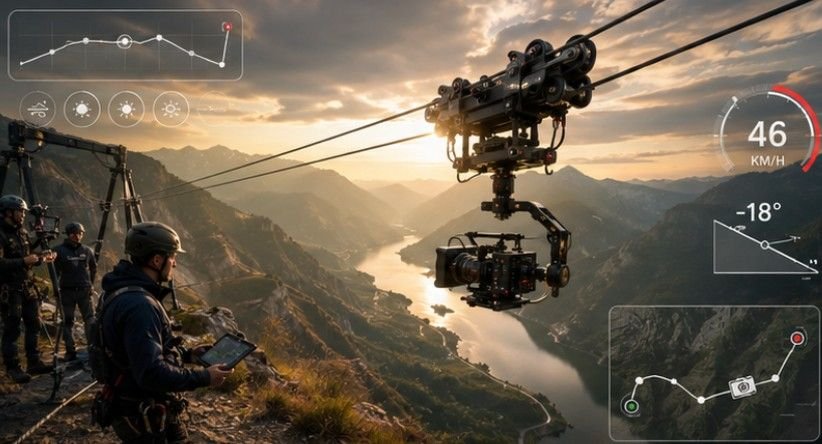
A camera moving at highway speed while carrying a cinema package sounds closer to a stunt rig than ordinary production equipment. Yet that is exactly the territory the flyline cable cam system is designed to enter: fast, repeatable tracking shots along a tensioned line where drones, cranes, dollies, and vehicles may be impractical.
FlyLine’s current specifications list a maximum speed of 45 mph, a 25 kg camera-and-gimbal payload, and travel of roughly 8–12 kilometers per charge. Those numbers are impressive, but they are only part of the story. The real value—and risk—comes from how the system is rigged, stabilized, stopped, and integrated into an actual production environment.
What Is the Flyline Cable Cam System Actually Designed to Do?
FlyLine is a point-to-point cable camera platform. Rather than flying freely like a drone, its trolley travels along a synthetic cable tensioned between two suitable anchor locations.
Those anchors may be permanent structural points or appropriately engineered temporary supports. The manufacturer mentions possibilities such as scaffolding, lifts, and similar structures, but that should never be interpreted as permission to attach a system to whatever happens to be available. Anchor suitability depends on loading, line tension, geometry, hardware, structure, and operating conditions.
The advantage is predictable camera movement. A properly configured system can repeat roughly the same path while the operator controls trolley speed, camera framing, and stabilization independently.
That makes cable cameras especially useful for sporting events, automotive work, warehouses, stages, concerts, downhill action, large interiors, and shots where a drone cannot safely maintain the desired route.
Why Motion Control Matters More Than Maximum Speed
Forty-five miles per hour makes a dramatic headline, but controlled deceleration is usually more important on set.
FlyLine offers an optional automatic endpoint motion-control system known as MoCo. Operators can establish stopping points so the trolley decelerates before reaching the end of its usable travel instead of depending entirely on manual timing.
That becomes particularly valuable during repeat takes.
Imagine following a cyclist toward the end of a 300-foot run. A small throttle error at walking speed may be harmless. At significantly higher speed, the same timing error can rapidly consume the remaining stopping distance.
The manufacturer also lists regenerative braking, giving the drive system another important tool for controlled deceleration.
How Does FlyLine Keep the Image Stable?
Cable travel is predictable, but a suspended camera platform can still rotate or sway.
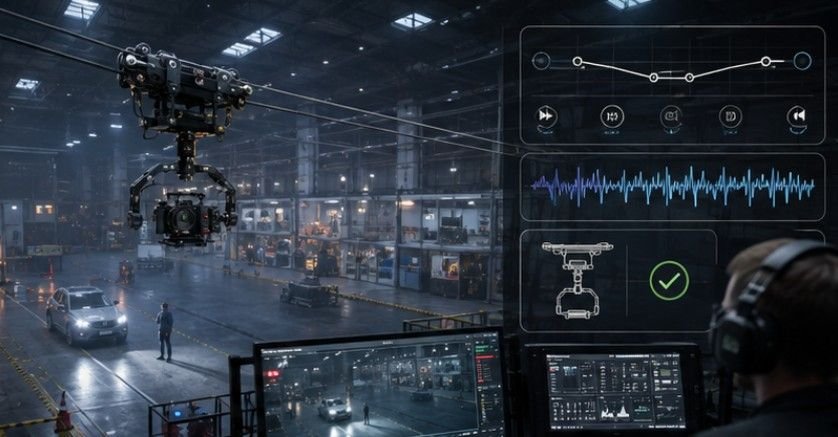
FlyLine can use Kenyon gyros to reduce unwanted trolley movement. A stabilized camera gimbal can then handle additional pan, tilt, roll, and framing corrections. The two technologies solve different problems: the gyro works on platform stability, while the gimbal primarily stabilizes and aims the camera.
The system also uses an ultrasonic motor driver and multi-brush motor design intended to reduce operating noise. That matters on dialogue-heavy sets where a mechanically loud trolley passing near microphones can ruin an otherwise excellent take.
The Five-Point Test Before Rigging a Cable Cam
A production should evaluate more than whether the camera fits under the published 25 kg payload limit.
1. Calculate the complete moving load
Include the camera, lens, gimbal, batteries, transmitters, accessories, mounting plates, stabilization equipment, and trolley.
Payload limits should never be confused with rope working-load limits or anchor capacity.
2. Evaluate both anchor points
Cable tension can impose substantial forces on anchors, particularly as the line becomes tighter and flatter.
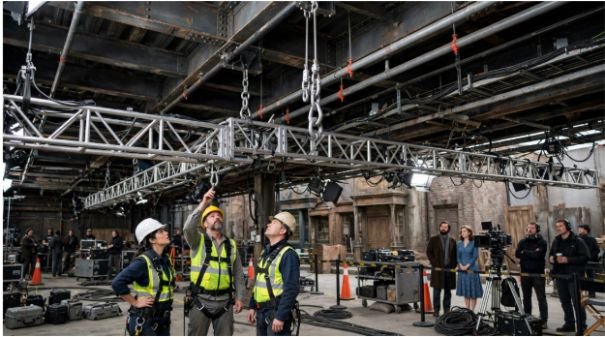
A qualified rigger or engineer should determine whether the supports, connections, hardware, and surrounding structure are suitable for the intended installation.
Princeton University’s rigging guidance emphasizes operator training, inspections, suitable slings, and proper load-handling practices.
3. Inspect rope and hardware
Look for abrasion, cuts, distorted hardware, damaged fibers, contamination, questionable splices, and contact with sharp surfaces.
OSHA advises removing damaged synthetic rope slings from service and protecting them from conditions that can compromise their capacity with OSHA synthetic rope sling safety guidance
OSHA regulations also emphasize following manufacturer ratings and recommendations for synthetic rope.
4. Establish an exclusion zone
Never treat the area beneath a moving camera rig as ordinary crew space.
OSHA guidance for suspended-load rigging specifically warns against personnel standing or passing below suspended loads. Production-specific requirements will vary, but the principle is straightforward: plan the cable path so a mechanical failure does not place people unnecessarily in the hazard zone.
For additional engineering guidance, ASME maintains standards covering synthetic rope selection, inspection, attachment, maintenance, and replacement.
5. Perform progressively faster test runs
Do not begin with the hero shot.
Start slowly without talent beneath the operating path. Verify trolley response, braking, endpoints, communication, line behavior, camera clearance, stabilization, RF reliability, and emergency procedures before gradually increasing speed.
Where Does FlyLine Make More Sense Than a Drone?
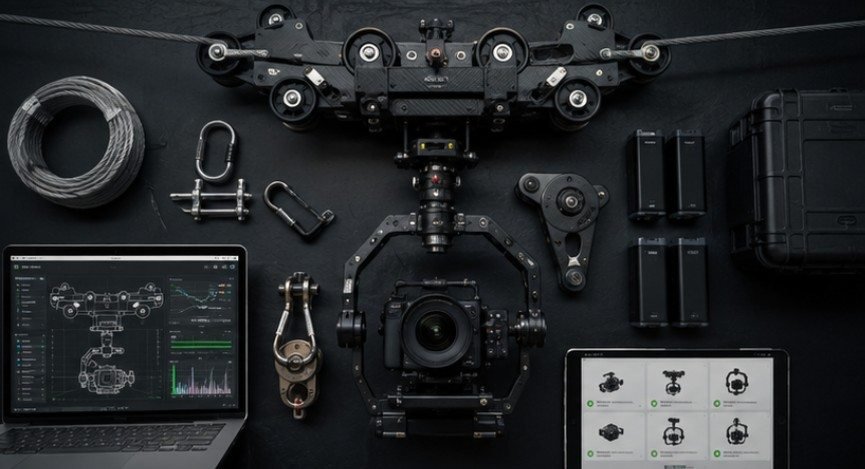
A cable camera system wins when repeatability, payload, predictable movement, or controlled operating space matters more than three-dimensional freedom.
A drone can climb, orbit, reposition, and change direction instantly. FlyLine cannot; it follows one cable path.
That limitation becomes an advantage in controlled environments. The camera cannot unexpectedly drift twenty feet sideways because of wind, GPS behavior, or pilot correction. For repeated sports passes, factory sequences, arena coverage, or vehicle tracking, that fixed trajectory may be precisely what the director needs.
The tradeoff is setup. A drone can sometimes launch within minutes. A professional cable system requires anchors, rope installation, tensioning, clearance checks, safety planning, stabilization, testing, and teardown.
What About Outdoor Filming and Permits?
A cable system eliminates many drone-specific aviation issues, but that does not make every outdoor location automatically available.
Commercial productions on U.S. public land may require authorization depending on the agency, location, activity, structures, crew, equipment, and impact. For example, the U.S. Forest Service identifies commercial filming among activities that can require special-use authorization on National Forest System land.
A long cable span can also affect trails, public access, vegetation, structures, vehicles, and spectators. Location approval should therefore happen before the rigging crew arrives, not after the line has been unpacked.
Common Misconceptions About FlyLine
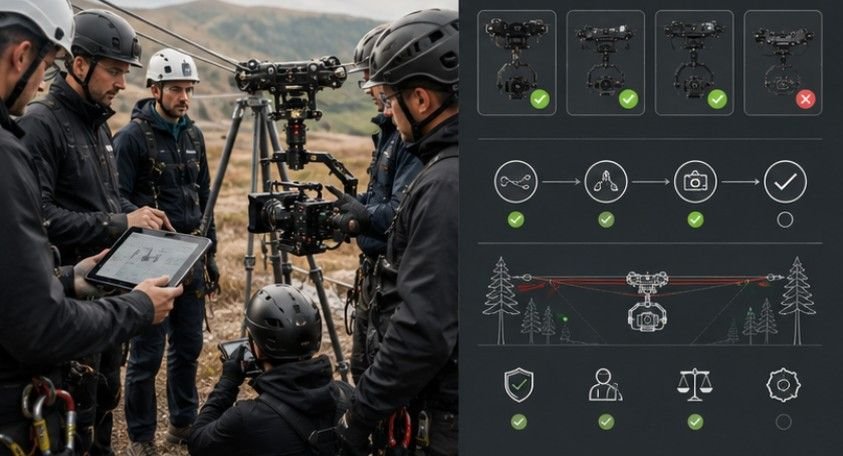
The first misconception is that maximum speed defines shot quality. It does not. Most memorable cable-camera shots depend on acceleration, timing, framing, repeatability, stabilization, and carefully selected perspective.
Another misconception is that a rope with a high breaking strength automatically makes an installation safe. Rope strength is only one variable. Anchor strength, hardware, wear, knots or splices, line geometry, tension, shock loading, payload, and safety factors all influence the system.
Finally, a 25 kg payload rating does not mean every 25 kg camera package belongs on every span. The complete rig needs to be evaluated as a system.
Frequently Asked Questions
1. How fast can the flyline cable cam system travel?
The manufacturer currently lists a maximum speed of approximately 45 mph or 70 kph, with adjustable drive ratios allowing much slower controlled movement as well.
2. How much camera weight can FlyLine carry?
FlyLine publishes a maximum camera-and-gimbal payload of 25 kg, approximately 55 pounds. Rigging capacity and anchor loads must still be evaluated separately.
3. Can FlyLine operate on a sloped cable?
Yes. The current specification lists a maximum cable slope of 15 degrees, equivalent to approximately a 27% grade.
4. Is FlyLine suitable for indoor filming?
Yes. Its variable-speed operation and relatively quiet motor system can suit studios, warehouses, arenas, and stages when adequate structural rigging and safety clearance are available.
The Shot Is Only as Good as the Rigging Behind It
The most striking number attached to FlyLine may be 45 mph, but speed is not what makes the system valuable. Controlled movement is.
A properly planned flyline cable cam system can deliver fast, repeatable cinematic tracking while carrying camera packages far heavier than lightweight aerial systems. Yet those advantages come with serious rigging responsibilities. Verify the exact equipment specifications, engineer the anchors, inspect every rope and fitting, establish exclusion zones, program safe endpoints, and test gradually. When those fundamentals are handled correctly, the cable almost disappears—and the audience simply sees a camera move that would otherwise be extremely difficult to achieve.