



A 50-pound broadcast camera suspended by steel lines over 80,000 cheering fans can accelerate to 20 miles per hour in less than two seconds, operating with sub-millimeter positioning precision. Yet, mention “cable camera systems” to a facilities engineer, and they will likely start describing RG59 coaxial runs and Power over Ethernet (PoE) drops.
This dual meaning creates massive confusion across production and security industries. In truth, the term covers two distinct engineering domains: aerial cable-suspended camera rigs that fly over live events, and hardwired camera cabling infrastructures that power surveillance networks. Understanding the various types of cable camera systems requires looking at both airborne cable cams and grounded wiring architectures.
The Two Worlds of Cable Camera Systems
The camera industry splits cable-driven photography into two distinct categories based on physics and purpose. One relies on tensile steel lines to suspend and maneuver moving optical payloads through three-dimensional space. The other uses copper and glass-fiber conductors to transport video signals and high-voltage power across fixed physical structures.
Types of Cable Camera Systems
|
+———————–+———————–+
| |
Aerial Cable Rigs Hardwired Surveillance Rigs
(3D Winch / Linear Track) (Coaxial, Siamese, PoE, Fiber)
Editor Note: A tree diagram chart or block diagram works best here to illustrate the structural split between aerial motion rigs and hardwired physical cabling systems.
Broadcast and Cinematic Aerial Cable Systems
1. 2D and 3D Cable-Suspended Arena Rigs (Skycam, Spidercam, Robycam)
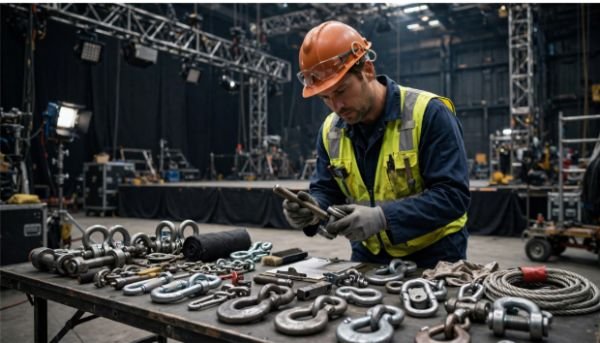
These systems form the backbone of modern sports broadcasting. Suspended from four perimeter towers or stadium catenary beams, motorized winches continuously adjust high-tensile Kevlar or steel cables under real-time computer control.
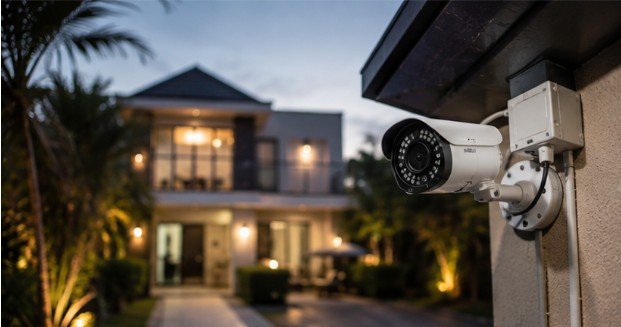
By manipulating line tension simultaneously across all four corners, operators fly a gyro-stabilized camera package through X, Y, and Z axes. If you want to understand how Spidercam works in stadium sports inside the rig, it relies on vector algorithms calculating thousands of tension adjustments per second to prevent line slack and maintain horizon stability.
Unlike uncrewed aircraft, line-suspended cameras operate under strict mechanical limits, keeping payloads securely tethered away from spectators while adhering to Federal Aviation Administration rules and venue safety protocols.
When choosing between aerial platforms, reviewing Spidercam vs drone for live sports tech safety FAA rules highlights why major leagues insist on winch-driven lines for indoor arenas and densely populated stadiums.
2. Single-Axis Linear Cable Cams
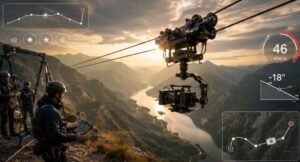
Linear systems move back and forth along a single support rope or steel line. They range from massive motorized cinema rigs used on feature films to lightweight portable tracking systems like the Wiral LITE. These single-line rigs use drive wheels locked onto the cable to pull camera gimbals along horizontal lines, delivering silky smooth tracking motion through tight forest canopies, sidelines, or architectural corridors.
Security and Surveillance Wiring Infrastructure
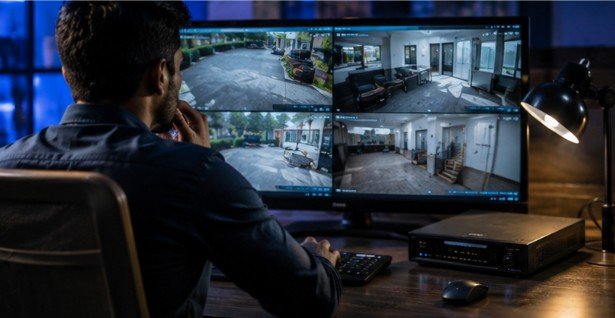
On the ground, cable camera systems refer to physical wiring networks that transmit video streams from fixed security lenses to local network video recorders (NVRs) or central monitoring walls.
1. Coaxial and Siamese Cabling (RG59 & RG6)
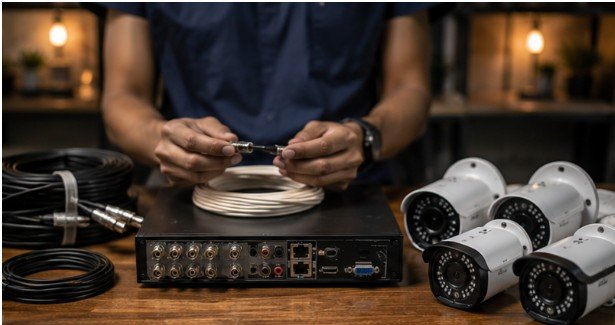
Traditional analog security architectures rely on 75-ohm coaxial lines. Standard RG59 coax handles video signals effectively up to 750 feet, while thicker RG6 cable features enhanced copper shielding to preserve high-frequency signals over extended runs up to 1,000 feet.
To eliminate running separate electrical wiring, installers frequently use Siamese cable, which pairs an RG59 coaxial video core with 18-gauge two-conductor power lines under a single protective outer jacket.
2. Ethernet and Power over Ethernet (Cat5e, Cat6, Cat6a)
Modern digital IP camera systems rely on twisted-pair Ethernet wiring using Power over Ethernet (PoE) standards (IEEE 802.3af/at/bt). A single Category 6 RJ45 cable delivers gigabit data bandwidth alongside up to 60 or 90 watts of DC power directly to motorized pan-tilt-zoom (PTZ) cameras over distances up to 328 feet (100 meters).
Understanding how to wire CCTV camera system for architectural precision requires matching cable categories to system bandwidth requirements and spatial constraints.
3. Fiber Optic Lines
When video distribution spans massive logistics centers, municipal transit grids, or multi-building campuses, copper wires succumb to signal attenuation and electromagnetic interference. Single-mode and multi-mode fiber optic cables use modulated light signals down glass strands, transporting uncompressed 4K and 8K video feeds across several miles without degradation.
Technical Specifications Matrix
| System Category | Cable Type / Media | Max Effective Distance | Primary Advantage | Primary Limitation |
| 3D Aerial Rig | Kevlar / Steel Cable | Arena / Stadium Span | Safe high-speed 3D motion | Complex multi-point setup |
| Linear Cable Cam | UHMWPE Synthetic Rope | 100 to 500 Feet | Quick linear tracking | Restricted to single path |
| Analog CCTV | RG59 Siamese Coax | 750 Feet | Legacy compatibility | Requires dedicated power wire |
| IP Security | Cat6 Ethernet (PoE) | 328 Feet (per segment) | Single-cable power & data | 100m distance limit without switch |
| Enterprise Grid | Fiber Optic | Multiple Miles | Zero signal loss over miles | Higher hardware & termination cost |
A Quick Field Decision Framework
When selecting the right physical cable hardware or aerial camera rig for a site or shoot, run through this quick checklist:
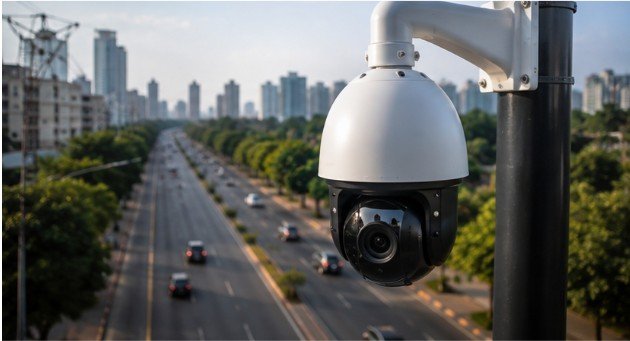
- Environmental Assessment: Are you indoors, outdoors over crowd lines, or running wires through plenum spaces?
- Payload or Bandwidth Needs: Are you carrying a 30-lb cinema camera array, or streaming 4K H.265 video data?
- Distance Boundaries: Is your run under 300 feet (Ethernet), under 750 feet (Coax), or spanning thousands of feet (Fiber / Steel line)?
- Power Delivery: Will power travel through the same line bundle (PoE / Siamese) or require localized power drops?
Frequently Asked Questions
1. What are the different types of wired camera systems?
Wired camera systems primarily divide into analog CCTV setups using coaxial/Siamese cabling, modern IP networks using Power over Ethernet (PoE) category cables, and enterprise fiber optic video networks.
2. What are the different types of camera cables?
The main camera cables include RG59 and RG6 coaxial cables, Siamese combined power/video lines, Cat5e/Cat6/Cat6a Ethernet cables, fiber optic lines, and specialized HDMI/SDI broadcast cables.
3. What are the 7 different types of cable connectors?
Common camera system connectors include BNC, RJ45, HDMI, SDI (BNC), DIN, RCA, and fiber optic connectors such as LC or SC types.
4. What are the four main types of cameras?
The four main camera categories are Digital Single-Lens Reflex (DSLR), Mirrorless cameras, Point-and-Shoot compacts, and Action/Security cameras (including specialized IP dome and bullet bodies).
Matching System Mechanics to the Mission
Whether flying a stabilized cinema rig across an NFL field on tensioned Kevlar lines or wiring a multi-floor commercial facility with Cat6 network drops, selecting the correct cable camera system comes down to physics and bandwidth.
Aerial cable rigs solve motion challenges where free flight is unsafe, while structured surveillance cabling ensures reliable, low-latency video security transmission. Matching line tension rating, signal loss per foot, and environmental resistance directly dictates how effectively your visual system performs under real-world pressure.