





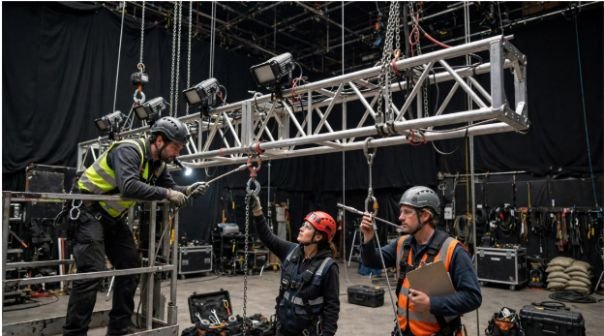
A suspended load can turn a normal setup into a line-of-fire hazard within seconds. My first rule when reviewing suspended load safety rules for film sets is simple: nobody gets a shot, adjustment, or shortcut that requires standing directly beneath a moving load.
That principle applies to lighting truss, flown scenery, speakers, camera systems, green screens, and similar overhead equipment. In the U.S., exact legal requirements depend on the work, equipment, employer, location, and applicable state plan. OSHA crane and material-handling rules provide important reference points, while entertainment standards and production procedures can add further controls.
Why Suspended Load Safety Rules for Film Sets Start With Exposure Control
Exposure control comes before clever rigging.
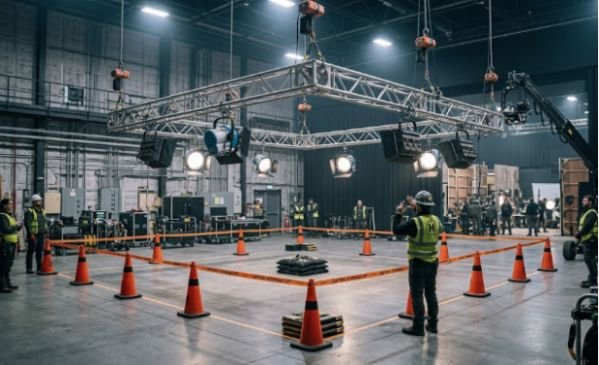
OSHA requires covered crane operations to use hoisting routes that minimize employee exposure where possible. It also restricts who can occupy the fall zone around a suspended load.
I therefore treat suspended load safety rules for film sets as a hierarchy. First, remove people from the hazard. Second, verify the rigging can carry the load. Third, control its movement.
A hard hat is useful PPE, but it cannot make standing beneath a heavy suspended truss acceptable.
A rigging risk assessment for film production should identify the load weight, pick points, route, landing position, nearby departments, electrical hazards, and possible rotation or snagging before lifting starts.
Build the Lift Around Ratings and Inspection
Verify WLL Before the Load Moves
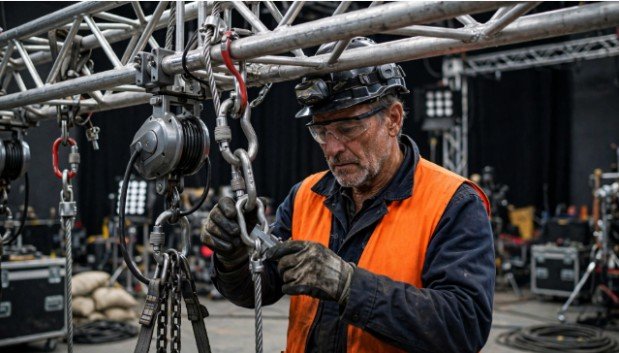
Every sling, shackle, hoist, lifting point, and rigging accessory must remain within its applicable rated capacity.
OSHA requires covered rigging equipment to carry legible identification showing its recommended safe working load. Rigging equipment must also be inspected before use during each shift and as necessary while in use. Defective equipment must leave service.
For me, suspended load safety rules for film sets make WLL verification a paperwork task as much as a hardware task. I want the actual load weight, component ratings, and rigging configuration confirmed before anything leaves the floor.
Dynamic loading deserves equal attention. A load that accelerates, stops, swings, or drops into a restraint can impose forces greater than its static weight. The increase depends on the system.
That is why I would never apply a casual shock-load multiplier instead of using manufacturer data or an engineering calculation.
Use Secondary Retention as a Separate Safety Layer
Where the manufacturer, engineer, venue, equipment design, or production procedure requires secondary retention, I treat it as independent protection.
The secondary connection should not simply duplicate the same weak point capable of defeating the primary attachment.
This is where dropped object prevention on film sets extends beyond the main truss. Loose accessories, clamps, lenses, practical fixtures, tools, and small components may also require secure retention when their failure could expose people below.
Secondary retention reduces risk. It does not make standing under suspended equipment safe.
Build an Exclusion Zone Around the Real Hazard
Clear the Fall Zone
I do not use ten feet as a universal magic number.
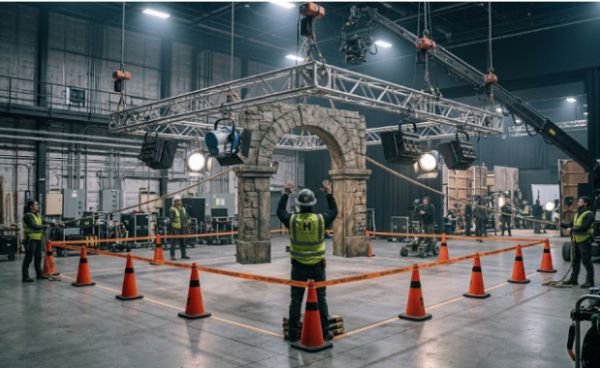
Effective suspended load safety rules for film sets require an exclusion area based on the real hazard. Consider the load’s dimensions, height, possible swing, travel path, snag points, and landing area.
OSHA’s covered crane requirements focus on the fall zone and minimizing employee exposure rather than prescribing one universal 10-foot radius for every suspended load.
Barricades, cones, warning tape, spotters, or access controls can make the boundary obvious.
Film crews make this harder because departments move constantly. Video village can shift. Art carts appear. Background performers move. Camera teams begin rehearsals.
Good film set rigging exclusion zone safety therefore needs a clear owner. The restricted area stays controlled until the person responsible releases it.
Control Rotation Without Entering the Line of Fire
Hands should not become the load-control system.
For covered crane operations, OSHA requires a tag or restraint line when necessary to prevent hazardous load rotation.
A tagline still requires planning. Its position should avoid entanglement, electrical contact, pinch points, and trip hazards.
The operator and rigging crew should also know when a tagline is inappropriate for the specific equipment or movement.
This distinction matters because suspended load safety rules for film sets should remove hazards rather than trade one hazard for another.
One Person Directs the Lift, Everyone Can Stop It
Conflicting directions can turn controlled movement into unpredictable movement.
Under OSHA’s covered crane and derrick requirements, only one person generally signals the operator at a time. Signal personnel must understand the signals being used and basic equipment dynamics, including load swing and stopping behavior.
That supports one of my most practical suspended load safety rules for film sets: one designated person directs movement, but everybody keeps stop authority.
OSHA specifically states that anyone who becomes aware of a safety problem must alert the operator or signal person using the stop or emergency-stop signal.
Film-set hierarchy should disappear at that moment. If somebody sees danger, the lift stops.
For unusual lifts, I also want a focused safety meeting before movement begins. Contract Services’ entertainment-industry curriculum includes both Rigging Safety and Safe Rigging and Materials Handling training, covering planning, powered hoists, hardware inspection, and safe load attachment.
My Three-State Load Check
My practical framework for suspended load safety rules for film sets treats a load as three different hazards.
| Load State | Main Question | Minimum Control |
| Parked | Is it ready to lift? | Weight, ratings, inspection, attachments and route verified |
| Moving | Can it travel safely? | Clear fall zone, signal control and controlled rotation |
| Suspended | Can it remain overhead? | Approved support, access controls and monitored conditions |
State 1: Parked
Before the first inch of movement, I verify the load, hardware, pick points, route, and landing position.
This is the cheapest moment to discover a problem.
State 2: Moving
Once movement begins, improvisation stops.
The signal person, operator, load-control method, exclusion zone, and landing plan should already be established.
State 3: Suspended
A load does not stop being hazardous because it stops moving.
This is an often-overlooked part of suspended load safety rules for film sets. OSHA’s covered crane rules tightly restrict leaving equipment controls while a load remains suspended. The specified exception requires several conditions, including competent-person oversight and exclusion of employees from the fall zone.
Worked Example: Flying an 800-Pound Lighting Truss
Imagine an 800-pound lighting truss must move from floor level to trim height above a studio set.
A weak plan asks one question: can the hoist lift 800 pounds?
My application of suspended load safety rules for film sets starts with a better question: is 800 pounds actually the complete suspended weight?
I check whether that figure includes fixtures, cables, clamps, adapters, and rigging hardware. Then I verify approved pick points, sling configuration, readable WLL markings, and inspection status.
Next comes the path.
Two grips may be standing well outside the truss’s final position but still inside its possible swing or fall zone. They move before the lift begins.
Then I confirm one signal chain, appropriate load-control methods, the STOP procedure, and the planned trim position.
Only then does the load move.
This example shows why “never stand underneath” is the foundation rather than the entire safety system. Good planning prevents one hardware fault or communication error from immediately becoming an injury.
Mistakes That Turn Routine Lifts Into Hazards
The problems I watch for are often procedural rather than spectacular.
Crews may estimate load weight instead of confirming it. A sling tag becomes unreadable. Several people begin calling directions. Somebody reduces the exclusion area because the schedule is slipping.
Another department may also walk back into a zone that was safely cleared five minutes earlier.
Effective suspended load safety rules for film sets account for these human factors instead of assuming everybody will remember that a lift is underway.
Another mistake is treating a secondary bond as permission to work underneath equipment. Redundancy can reduce the chance of a dropped object, but the overhead hazard remains.
Do not assume a lunch-break or overnight suspension is automatically acceptable either. Applicable equipment procedures, competent oversight, access controls, and load-security measures must govern that decision.
FAQs
1. What are the most important suspended load safety rules for film sets?
Keep nonessential people outside the fall zone, verify load ratings and rigging, control movement, and never position workers directly beneath a moving suspended load.
2. How often should film-set rigging equipment be inspected?
Under OSHA’s covered material-handling rule, rigging equipment must be inspected before use each shift and as necessary during operation.
3. Does every film set require a 10-foot exclusion zone?
No. The controlled area should reflect the actual fall, swing, travel, and landing hazards instead of relying on one arbitrary distance.
4. Who can call an emergency stop during a suspended lift?
Anyone who becomes aware of a safety problem may give the stop or emergency-stop signal under OSHA’s covered crane requirements.
A Clean Lift Beats a Clever Recovery
I judge suspended load safety rules for film sets by one simple question: can the crew stop the operation before one person enters the wrong place?
If the answer is uncertain, the lift is not ready.
Recheck the weight. Read the ratings. Inspect the hardware. Clear the fall zone. Confirm the signal chain. Verify retention and the entire travel path.
A delayed setup may cost a few minutes. A failed overhead lift can cost far more.