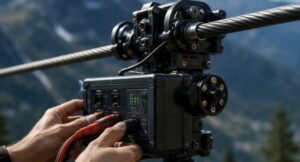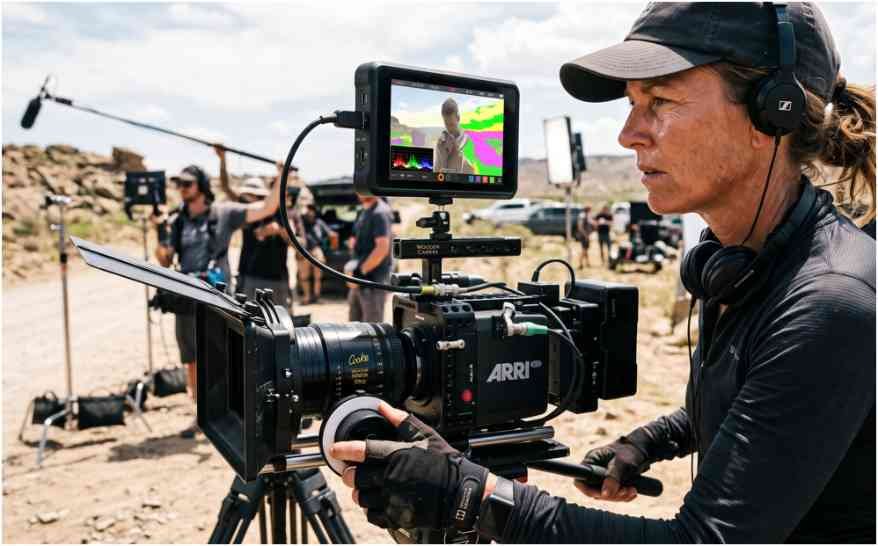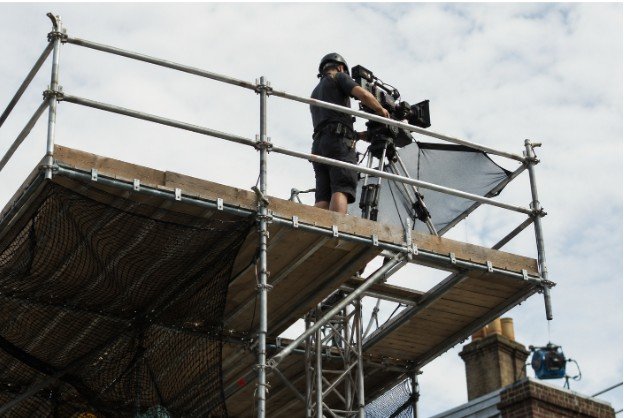




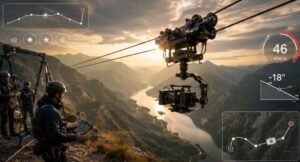
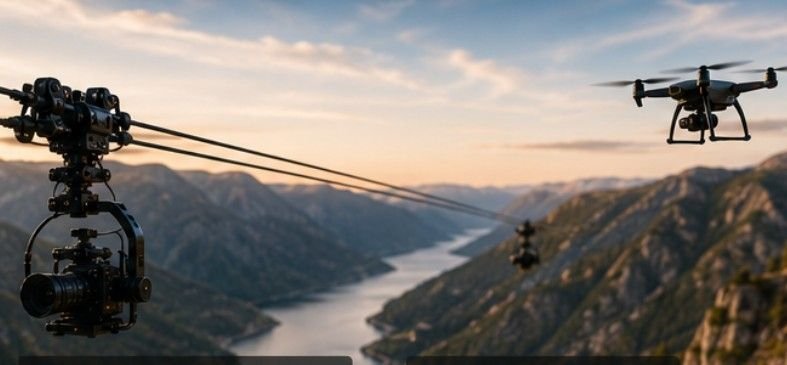
During the Super Bowl broadcast, millions of viewers watch dynamic, low-altitude tracking shots soaring inches above athletes’ helmets. What most viewers do not realize is that despite multi-million-dollar production budgets, these shots are rarely captured by uncrewed aerial vehicles. When evaluating when to use cable cam over drone setups, top-tier cinematographers consistently choose suspended wire systems for high-stakes environments.
Drones have revolutionized aerial cinematography, making high-angle imagery accessible to every film crew. However, multi-rotor aircraft carry fundamental physical, legal, and operational limitations. Understanding the mechanical differences between propulsive flight and suspended trajectory allows camera operators to select the optimal tool for complex production demands.
The Physics of Repeatability and Motion Control
The primary advantage of a wire-suspended rig lies in mechanical determinism. Multi-rotor drones rely on continuous atmospheric adjustments, constantly recalculating motor speed to combat crosswinds, air density changes, and thermal updrafts. Even advanced GPS and optical flow systems permit subtle positional drift that ruins pixel-perfect compositing across multiple takes.
A suspended wire system operates along a fixed geometric vector. Once tensioned between anchor points, a trolley moves along a predictable line with zero lateral deviation. For visual effects teams requiring identical passes for plate shot layering, clean plate extraction, or time-lapse transitions, line repeatability is unmatched.
When directors demand frame-accurate consistency across twenty takes, understanding how cable camera systems work becomes essential for the camera team. Winch-driven cable rigs integrate directly with motion control software, enabling frame-accurate synchronization with actors, pyrotechnics, and lighting cues that free-flying drones cannot match.
Navigating Airspace, Crowds, and FAA Regulations
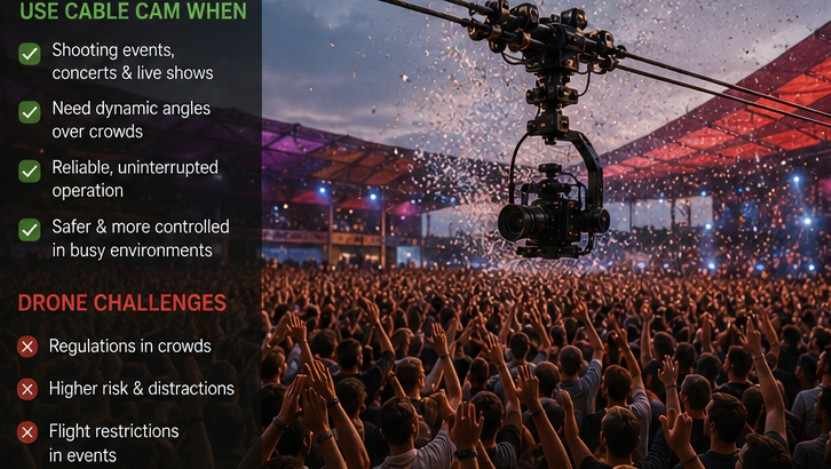
Federal aviation laws heavily govern commercial drone operations. The Federal Aviation Administration (FAA) Part 107 regulations impose strict mandates on flying over human beings, moving vehicles, and within controlled airspace. Securing waivers for flight over crowded sports stadiums, music festivals, or urban streets can require months of administrative review—with no guarantee of approval.
Cable systems operate under structural rigging and venue safety standards rather than national airspace laws. Because the payload is physically anchored to load-tested structures, it poses zero risk of a flyaway caused by radio frequency interference or battery degradation.
- Stadium Operations: Major sporting leagues explicitly prohibit unanchored multi-rotors directly over playing fields due to athlete safety.
- Controlled Airspace: Production sets located within airport surface zones face strict altitude ceilings and flight authorization delays that do not apply to tethered line rigs.
- Zero Flyaway Risk: Signal jamming from dense Wi-Fi environments or massive crowds can trigger emergency return-to-home protocols in drones, interrupting critical takes.
For high-density public events and dense urban shoots, analyzing a cable camera vs drone for cinematic shots reveals that wire systems eliminate major liability concerns while providing unrestricted line-of-sight access over talent.
Acoustic Isolation and Confined Spaces
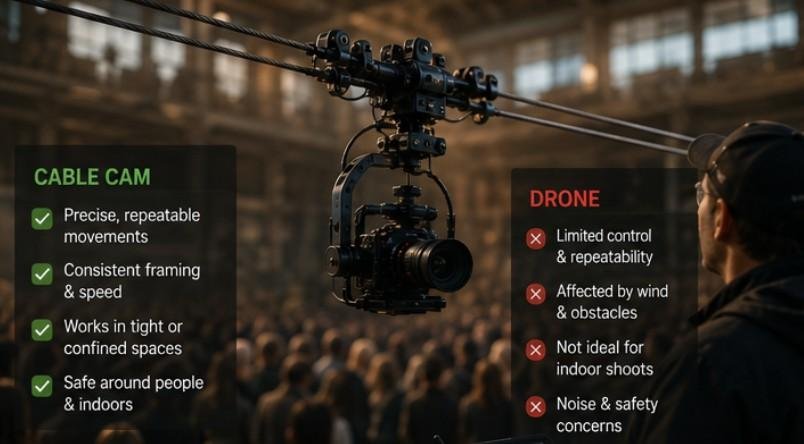
A standard cinema drone flying an RED or ARRI payload generates between 75 and 85 decibels of high-frequency noise. This acoustic profile bleeds directly into production microphones, destroying usable dialogue and forcing expensive Automated Dialogue Replacement (ADR) in post-production.
Cable trolleys utilizing high-durometer polyurethane wheels on synthetic ropes run near-silently. Directors can glide a camera two feet above actors during an intimate exterior dialogue scene without compromising production audio.
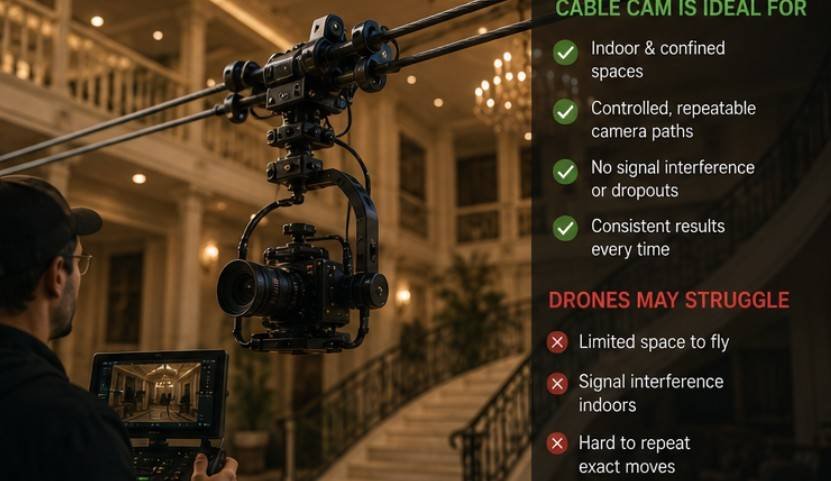
In addition to noise management, physical space constraints dictate camera platform selection. Dense forest canopies, narrow architectural corridors, and indoor arenas present catastrophic obstacles for spinning propellers.
[Tree Canopy / Anchor A] ================= (Cable Cam Trolley) ================= [Structure / Anchor B]
|
[3-Axis Gimbal]
|
[Quiet Dialogue]
A cable trolley navigates tight gaps between branches or steel trusses with zero air displacement, avoiding the downwash dust storms that multi-rotors create in dry or dusty environments.
Decision Matrix: Cable Cam vs. Cinema Drone
Choosing the correct platform requires balancing location geometry, budget, safety, and creative control.
| Operational Factor | Cable-Driven System | Multi-Rotor Drone |
| Path Repeatability | Absolute sub-centimeter vector tracking | Subject to GPS drift and wind currents |
| Acoustic Signature | Ultra-quiet (<35 dB); safe for live dialogue | High-frequency motor noise (75–85+ dB) |
| Flight Duration | Unlimited (direct power cable or battery swaps) | Limited (12–25 minutes per battery set) |
| Airspace Licensing | Local venue permit and structural rigging signoff | FAA Part 107, Remote ID, potential airspace waivers |
| Setup Time | High (1–3 hours for line tensioning and rigging) | Low (15–30 minutes to initialize and calibrate) |
Editor’s Note: For pitch presentations, this dataset renders effectively as a radar chart comparing mechanical agility versus operational friction.
Practical Deployment Framework
Before committing to a wire system on set, production managers and key riggers should execute a structural assessment checklist to verify feasibility:
- Calculate Line Sag and Load Dynamics: Determine payload weight (gimbal, camera, lens, wireless transmitters) and compute line sag using standard catenary curve formulas to ensure adequate ground clearance.
- Verify Anchor Structural Integrity: Inspect anchor points—such as steel I-beams, concrete pillars, or rated rigging trees—to ensure they withstand lateral tensions often exceeding 1,000 pounds.
- Establish Emergency Stop Baselines: Set physical end-stops and soft-limit braking zones on the winch system to prevent trolley collision with rigging points.
Learning how to set up a cable camera system for filmmaking ensures the rigging crew maintains safety margins while optimizing line speed for fast-paced action sequences.
Limitations and Trade-offs
While cable systems excel in precision and safety, they are not a universal replacement for aerial drones.
Wire-suspended rigs are bound to a single axis or vector unless complex 3D wire arrays (such as Skycam setups) are installed. Installing a 3D system requires extensive rigging infrastructure, specialized crew members, and higher equipment budgets.
Drones offer complete 3-axis spatial freedom, allowing operators to change altitude, pan, and reposition dynamically across vast geography in seconds. If a scene demands a sweeping establishing shot over miles of open coast, a drone remains the superior tool.
Safety standards governed by the Entertainment Services and Technology Association (ESTA) require rigorous load calculations and inspection routines for all overhead suspended equipment, adding technical overhead to production schedules.
Frequently Asked Questions
1. Why are they using cables for drones?
Cable-tethered drones receive continuous power and data from ground stations, allowing infinite flight endurance and interference-free transmission for security monitoring and long-duration live broadcasts.
2. Can I shoot down a drone spying on my property?
No. In the United States, aircraft are protected under federal law (18 U.S.C. 32). Firing at or damaging any aircraft, including drones, is a federal felony.
3. How to make your drone shots look professional?
Use neutral density (ND) filters to lock shutter speed at twice your framerate, execute slow multi-axis camera movements, and utilize manual exposure controls to prevent shifting bright spots.
4. Do you need to use a flashing light when flying a drone at night?
Yes. FAA Part 107 rules require anti-collision lighting visible for at least three statute miles when operating drones during civil twilight or at night.
The debate between wire systems and multi-rotors is not about which platform is universally better, but which tool serves the physical realities of the set. Drones offer unmatched spatial freedom, but cable cams deliver safety, acoustic silence, and mechanical repeatability where aerial aircraft cannot fly. Choose the wire when precision and control matter most.