



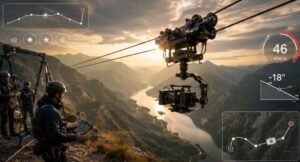
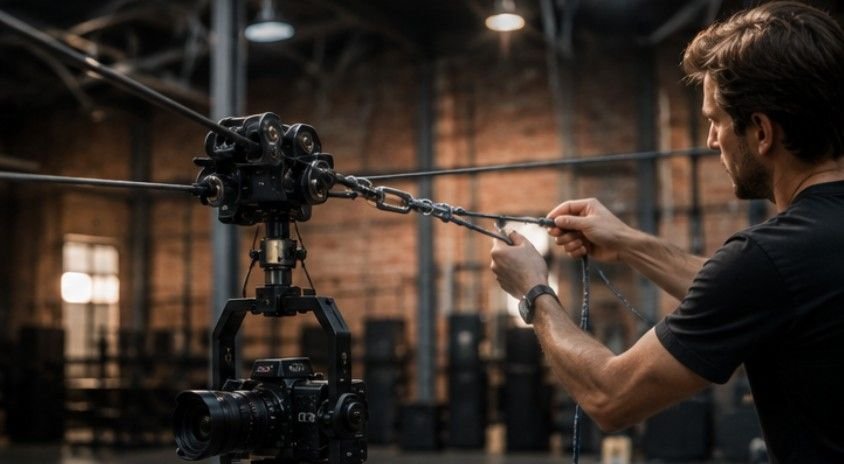
A 100-foot cable span under 500 pounds of tension carries enough stored kinetic energy to shear standard hardware if it snaps, yet film crews routinely hang $50,000 cinema payloads on lines thinner than a pinky finger. The secret to capturing buttery smooth, high-speed tracking shots isn’t found in gyro-stabilizer algorithms—it begins with choosing the best rope for cable camera rig systems.
If your line stretches even two percent under acceleration, your camera will bounce like a yo-yo every time the drive trolley changes direction. Eliminating that vertical chatter requires understanding how different rope materials react to static load, velocity, and thermal friction.
+————————————————————-+
| CABLE CAMERA TENSION MAP |
+————————————————————-+
Anchor A Anchor B
[==]===================\ /=================== [==]
\ /
\ / <– Sag Angle (1-3% Target)
[Trolley]
[Payload]
The Physics of Line Tension: Why Nylon Will Ruin Your Shot
When a cable cam accelerates from zero to thirty miles per hour, it exerts dynamic forces far exceeding the static weight of the rig. Standard nylon and cotton cords feature high elastic stretch—often expanding between eight and fifteen percent under working loads. On a cable camera span, that elasticity creates a severe “trampoline effect.”
To maintain a flat trajectory, key grips rely on high-modulus lines that feature near-zero elongation. When a trolley moves across a span, the line experiences continuous mechanical stress and localized friction heating.
Ropes with high creep—the gradual, permanent stretching under continuous tension—cause the camera to sag lower over long shoot days, wrecking frame consistency and risking ground collision.
Material Breakdown: Comparing Lines for Cable Camera Systems
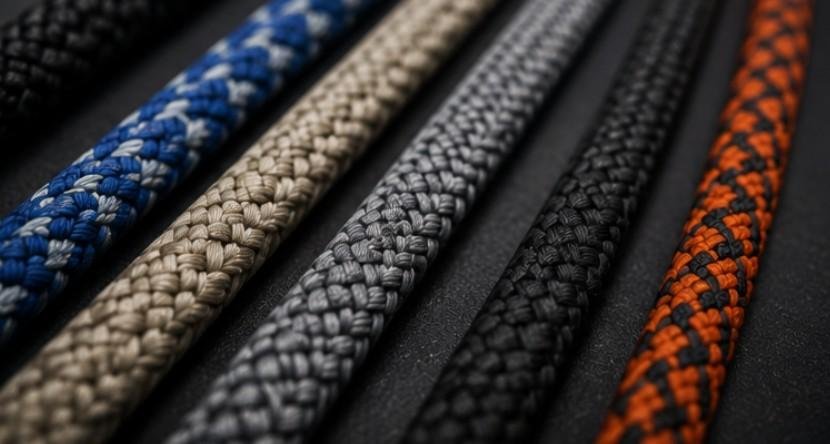
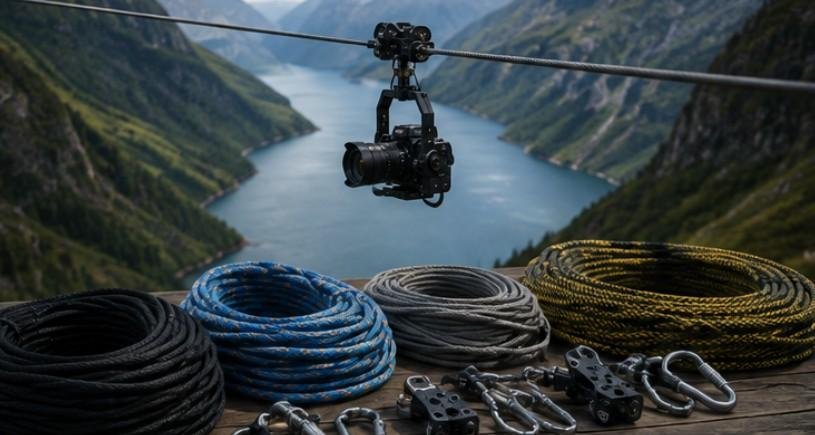
Selecting line material involves balancing tensile strength against weight, rigidity, and field transportability. Three core categories dominate professional and consumer cable cam rigs setups .
PVC-Coated Steel Aircraft Cable
Galvanized or stainless steel wire rope remains the traditional choice for permanent installations and heavy cinema rigs.
- Performance: Steel wire provides absolute zero stretch and immunity to friction heating caused by metal trolley wheels. The smooth PVC coating protects drive wheels from biting directly into the steel strands.
- Drawbacks: Heavy wire rope requires mechanical winches to tension properly. It can kink permanently if mismanaged and carries a severe snap-back risk under catastrophic tension failure.
- Best Application: Long-term stadium installations, heavy cinema gimbals (like a full DJI Ronin 2 package), and high-speed linear runs.
Dyneema and UHMWPE Synthetic Lines
Ultra-High Molecular Weight Polyethylene (UHMWPE) fibers, commercially known as Dyneema or AmSteel-Blue, have revolutionized portable production.
- Performance: Pound for pound, Dyneema is up to fifteen times stronger than steel wire while remaining seven times lighter. Its working elongation is under one percent, making it nearly as rigid as steel without the weight penalty.
- Drawbacks: UHMWPE fibers have a relatively low melting point around 275°F (135°C). Rapid trolley braking can generate enough surface friction to glaze or weaken the synthetic fibers.
- Best Application: Professional portable cable cams, remote location filming, and high-speed tracking runs where fast setup is critical.
Static Polyethylene and Kernmantle Lines
Specialized static lines, often derived from arborist or climbing half-rope designs, offer a lightweight entry point.
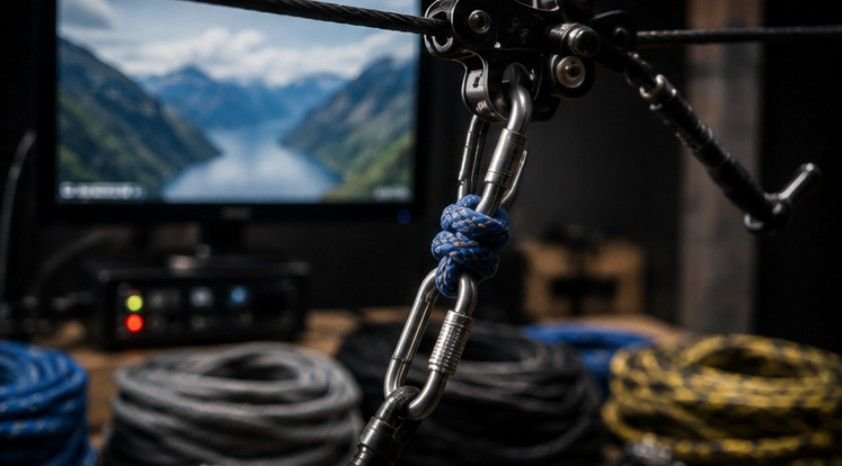
- Performance: Highly flexible, affordable, and easy to knot or tie off without specialized rigging hardware.
- Drawbacks: These lines exhibit moderate elasticity under dynamic loads, leading to noticeable sag on spans over fifty feet.
- Best Application: Lightweight action-camera setups (such as the WIRAL LITE) or mirrorless rigs on short spans under slow speed.
| Material Type | Tensile Strength (3/8″ dia.) | Elongation at Load | Relative Weight | Heat Resistance |
| 7×19 Galvanized Steel | ~14,400 lbs | ~0.0% | Heavy | High (1,000°F+) |
| Dyneema (SK78 / AmSteel) | ~18,800 lbs | < 1.0% | Ultra-Light | Low (275°F melting) |
| Static Kernmantle (Poly) | ~5,500 lbs | 3.0% – 5.0% | Moderate | Moderate (350°F) |
[Editor’s Note: A line graph comparing elongation percentages under increasing static load would help riggers visualize sag thresholds across these three line types.]
Compliance, Safety, and Dynamic Load Calculations
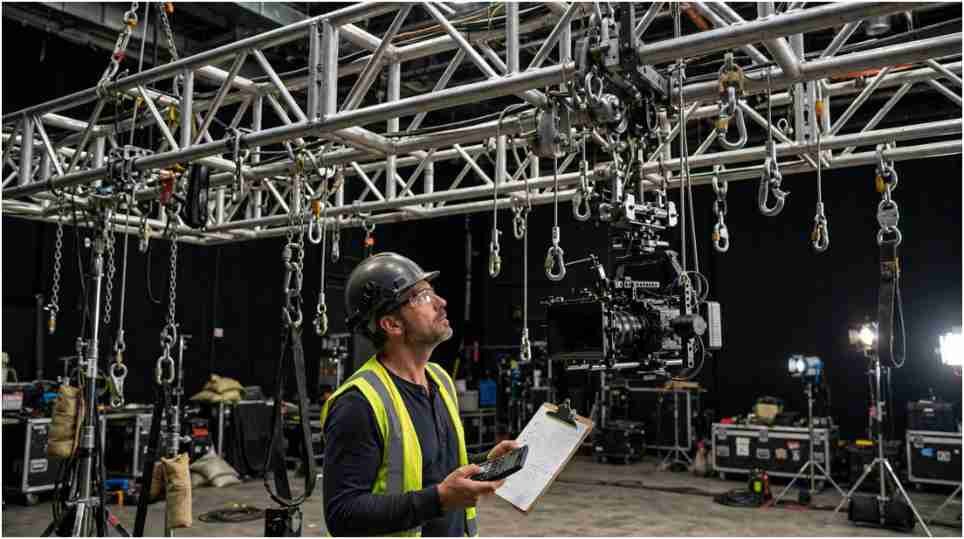
Hanging gear over talent, crews, or live crowds requires strict adherence to safety protocol. OSHA regulations and industry standards mandate clear working load limits for temporary overhead structures. Riggers must calculate the total load using a minimum design factor of 5:1 for general hardware, while dynamic overhead movement often demands 10:1 safety margins.
Horizontal line tension increases exponentially as cable sag decreases. Attempting to pull a cable completely straight creates near-infinite tension at the anchors. Always factor a target sag angle of one to three percent into your load math. Ensure your rigging layout aligns with established ANSI rigging standards for film production to maintain legal compliance and crew safety.
The 4-Step Field Test for Rig Tension and Cable Sag
Before mounting an expensive camera setup, execute this field protocol to verify line stability:
- Anchor Stress Verification: Secure both termination points around load-bearing structures rated for at least 5,000 pounds. Inspect tree trunks, steel girders, or certified trussing for sharp edges.
- Pre-Stretching the Span: Pull the main line to operational tension using a ratcheting winch or block-and-tackle system. Allow the line to sit under tension for ten minutes to settle knot-tightening and construction stretch.
- Dead-Weight Deflection Measurement: Hang a test weight equal to your full payload (camera, gimbal, batteries, trolley) at the exact center of the span. Measure the vertical deflection. If sag exceeds three percent of total length, increase tension or step up to a stiffer line diameter.
- Thermal Brake Run: Run the empty trolley across the line at maximum operating speed and apply hard braking. Immediately touch the cable line at the braking zone. Glazing or sticky residue on synthetic lines indicates excessive heat buildup requiring lower speeds or metal cable lines.
Limitations and Real-World Trade-Offs
No single cable fits every filming environment. Follow all cable camera system safety guidelines at all times. While Dyneema excels in field portability, it degrades under prolonged UV exposure if left outdoors for months without protective jacketing. It is also vulnerable to sharp-edge abrasion from rock faces or concrete ledges.
Conversely, steel cable offers unmatched durability against abrasion and heat, but its sheer weight creates massive natural sag on long outdoor spans. Riggers must often trade quick setup times for line rigidity depending on the location’s physical constraints.
Frequently Asked Questions
1. What is the best camera rope strap?
The best camera rope strap uses high-grade, woven climbing rope or paracord with reinforced leather end-tabs and quick-release anchor clips. It balances neck comfort, weather durability, and high tensile safety for heavy DSLR camera setups.
2. What type of rope is best for rigging?
Dyneema (UHMWPE) and static low-stretch kernmantle ropes are best for general rigging. They provide exceptionally high breaking strength, minimal stretch under load, and excellent resistance to moisture and UV exposure.
3. What is the strongest wire rope?
Extra Improved Plow Steel (EIPS) and Extra Extra Improved Plow Steel (EEIPS) 7×19 wire ropes represent the strongest standard steel cables. They offer maximum tensile capacity for heavy industrial lifting and rigid cable-cam spans.
4. What is the best cable to use for security cameras?
Solid copper RG59 Siamese coaxial cable works best for analog systems, while outdoor-rated, shielded Cat6 Ethernet cable (with UV-resistant jacket) is ideal for IP security cameras requiring Power over Ethernet (PoE) transmission.
Selecting the line for your cable camera rig comes down to a clear trade-off between weight and heat tolerance. Dyneema provides unmatched portability with zero bounce for field shoots, while coated steel remains the king of high-speed cinema runs. Match your line to your load, respect your anchor physics, and never compromise on safety margins.