





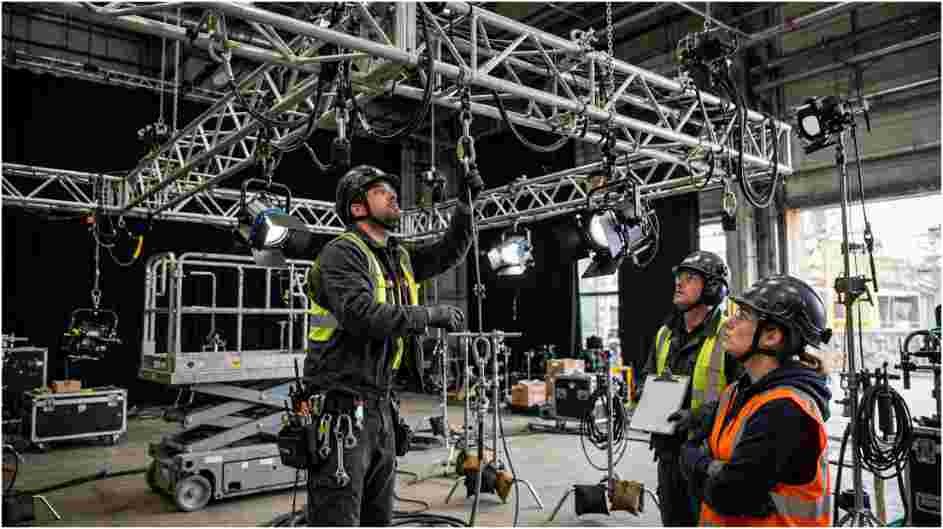
The worst rigging failures rarely start with one dramatic error. They start with a shortcut that looks harmless. When I review common film rigging safety mistakes to avoid, I use a simple failure-chain test: what carries the load, what catches it if the primary connection fails, and who can enter the danger zone?
That approach matters on film sets because rigs change fast. Lights move, camera packages gain accessories, cable paths shift, and weather can alter conditions.
Why Rigging Errors Become Production Risks
A rig should not be judged only because it is holding now. It should also remain safe when one condition changes.
Contract Services currently offers Rigging Safety and Safe Rigging and Materials Handling training for motion-picture workers. The latter covers overhead lifting, powered hoists, rigging hardware inspection, and attaching loads.
The common film rigging safety mistakes to avoid below focus on weak links that can turn a normal setup into a dropped-object, fall, or structural hazard.
Mistake 1: Treating Rigging Hardware Inspection as a Quick Glance
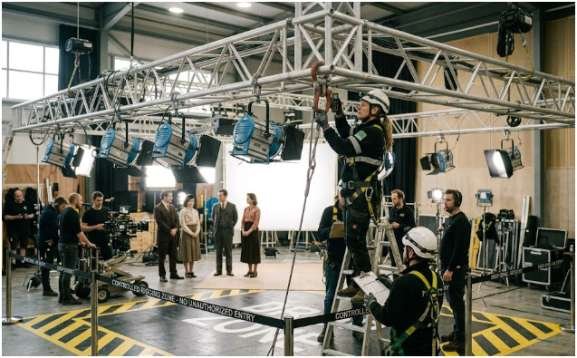
A fast visual scan is not the same as a proper inspection.
For work covered by OSHA’s general-industry sling rule, slings and their fastenings and attachments must be inspected each day before use. Damaged or defective slings must be removed from service. OSHA’s construction rigging rule contains a similar pre-use requirement.
Check for deformation, cuts, damaged stitching, corrosion, heat damage, worn fittings, missing identification, or anything else affecting rated performance.
A film production rigging hazard assessment should also examine surrounding conditions. Sharp edges, moving scenery, vehicle traffic, electrical hazards, weather, and changing access can create risk even when the hardware looks sound.
Mistake 2: Guessing at Load Capacity
Another of the common film rigging safety mistakes to avoid is treating the equipment label as the total suspended load.
A 60-pound fixture can become a heavier system once you add its yoke, mounting hardware, modifiers, motors, cabling, and accessories. Movement may also introduce forces that a simple static-weight estimate does not capture.
Use documented ratings from manufacturers, engineers, or applicable standards. Never estimate a working load limit by hardware size or by what worked on another shoot.
The complete suspended assembly matters—not just the headline weight of the camera or light.
Mistake 3: Using Rated Hardware in the Wrong Configuration
Correct hardware can still become unsafe when loaded incorrectly.
Side-loading a connector, forcing incompatible fittings together, placing a sling against a damaging edge, or allowing a connection to rotate can change how the system behaves.
This is why common film rigging safety mistakes to avoid cannot be solved by simply buying stronger gear. Selection, orientation, attachment, and load direction matter too.
ESTA maintains entertainment-industry standards covering rigging inspections, chain hoists, support points, and temporary structures.
Manufacturer instructions should also be treated as part of the setup process rather than something reviewed only after a problem occurs.
Mistake 4: Building Temporary Rigging Structures Without a Clear Load Path
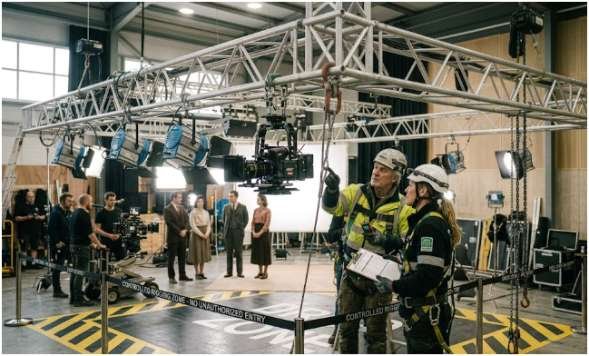
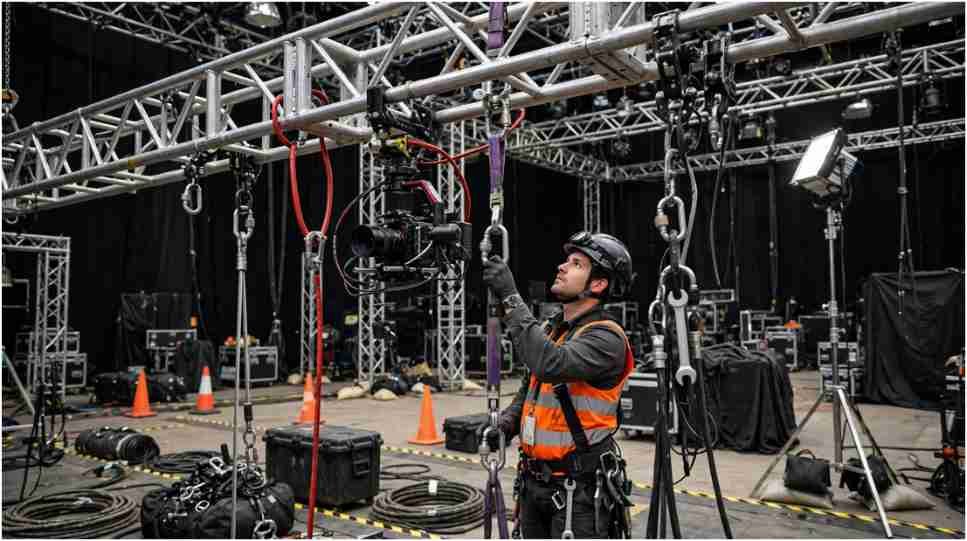
Temporary grids, truss frames, goalposts, pipe structures, and custom supports need a defined load path.
Every suspended load must transfer into a support suitable for that load. Decorative architecture, unknown roof members, improvised braces, or unverified attachment points should never be assumed safe.
Before adding equipment, connect the planning process to safe temporary rigging structures for film sets. Structure, ballast, bracing, anchorage, environment, and intended loading must function as one system.
This is where qualified riggers and, when necessary, structural engineers become essential. A structure that looks rigid can still have an unsuitable attachment point or load path.
Mistake 5: Allowing People Under Active Rigging Work
One of the easiest common film rigging safety mistakes to avoid is unnecessary exposure below suspended equipment.
Keep nonessential cast and crew away during installation, adjustment, movement, and other higher-risk work. Productions can use controlled access, barriers, spotters, scheduling, or another suitable method.
A performer does not need to stand beneath a rig while technicians are still modifying it.
The same thinking should apply to equipment carts, monitors, background performers, and crew traffic. A clear area below the load reduces exposure before another control ever becomes necessary.
Mistake 6: Treating Secondary Safeties as Decoration
A secondary restraint should provide meaningful backup.
Where equipment instructions, production procedures, or applicable standards require one, the secondary attachment should not simply reproduce the same weak failure point.
Ask one question: if the primary attachment disappeared, what would happen next?
That question exposes many common film rigging safety mistakes to avoid before equipment is positioned over performers, crew, or expensive production assets.
A backup system only adds protection when its placement, attachment, and capacity suit its intended purpose.
Mistake 7: Failing to Reinspect After Changes
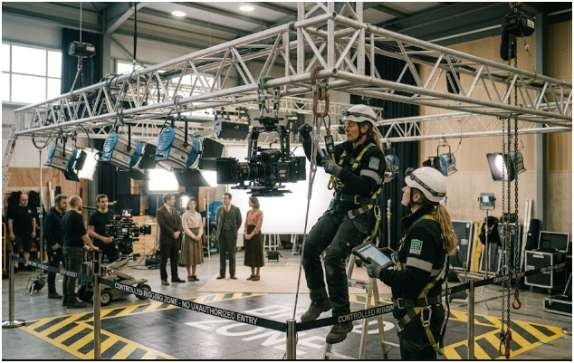
A rig approved in the morning may not be the same rig after lunch.
A monitor gets added. A lamp moves. Cable is rerouted. A camera head changes. A truss shifts. Outdoor conditions worsen.
Reinspect after meaningful changes, impacts, unexpected movement, suspected overloads, or environmental events.
Contract Services’ current lightning guidance, for example, warns crews to stay clear of elevated metal equipment such as camera booms and aerial lifts when lightning creates a hazard.
Change management is therefore part of rigging safety. “It passed earlier” is not enough when the configuration or environment is different.
Mistake 8: Poor Communication and No Rigging Emergency Procedures
Safe hardware does not compensate for confused people.
Before movement begins, crews need to know who controls the operation, who can stop it, how an exclusion zone is communicated, and what call or signal means stop.
That is where film set rigging emergency procedures belong. Productions should establish how to stop equipment, secure the area, call for emergency assistance, keep responder access clear, and prevent a second incident.
The Industry-Wide Labor-Management Safety Committee states that its Safety Bulletins are recommended guidance rather than law. Applicable federal, state, and local requirements take precedence.
Clear authority also matters. Crew members should never hesitate because they are unsure who is allowed to halt an unsafe operation.
My Three-Question Failure-Chain Audit
I reduce common film rigging safety mistakes to avoid to three checks:
- What carries the load?
- What contains the load if the primary connection fails?
- Who can enter the hazard zone?
If any answer is vague, the setup needs more review.
The key distinction is between hardware inspection and system inspection.
A connector can pass inspection while the entire rig remains unsafe. The problem may instead be the support point, attachment angle, clearance, backup, access control, or overall load path.
That distinction catches risks that a component-by-component checklist can miss.
Frequently Asked Questions
1. What is the most common rigging mistake on a film set?
Relying on assumptions instead of verified ratings, inspections, load paths, and controlled access creates avoidable risk.
2. How often should film rigging equipment be inspected?
Inspect according to applicable OSHA requirements, manufacturer instructions, and production procedures, with additional checks after relevant changes.
3. Who should inspect film rigging?
Use the competent or qualified person required for the applicable equipment, regulation, employer procedure, and task.
4. How do common film rigging safety mistakes to avoid affect performers?
They can increase exposure to falling objects, unstable structures, moving loads, falls, and obstructed emergency routes.
Final Take: A Great Shot Is Not Worth a Weak Rig
I treat common film rigging safety mistakes to avoid as signs of a weak system rather than isolated bad habits. The answer is rarely “add more hardware.” Better planning matters more.
Verify ratings. Inspect properly. Establish clear load paths. Use effective backups. Control access. Recheck modified rigs. Make communication unmistakable.
Before the camera rolls, find the first weak link rather than waiting for the final one to fail. If the rig cannot be clearly explained, properly documented, and supported by qualified review, it is not ready for the shot.