





A temporary truss can look rock-solid and still contain one dangerous unknown. That is why I approach safe temporary rigging structures for film sets from the load path outward, not from the equipment inward.
Every light, camera, modifier, cable bundle, truss section, hoist, clamp, and anchor ultimately transfers force somewhere. If one part of that route lacks a verified capacity, I would treat the entire load path as unresolved.
The safest safe temporary rigging structures for film sets are not simply strong structures. They are systems with known loads, rated components, controlled access, documented inspections, and clear responsibility.
What Actually Makes a Temporary Film Rig Safe?
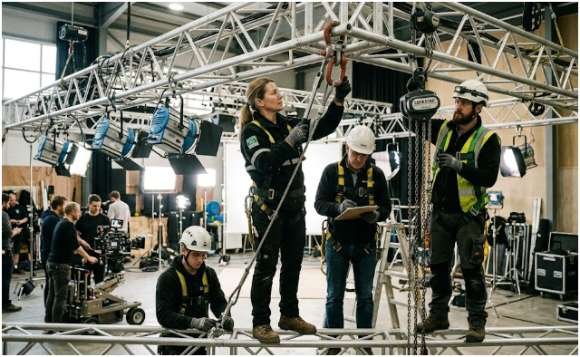
Temporary rigs may include ground-supported truss, goalposts, scaffold towers, camera platforms, suspended grids, or combinations of these systems.
The exact configuration matters less than one basic principle: every force needs a verified route into a structure capable of accepting it.
Start With the Complete Load Path
A useful load-path check looks like this:
Supporting structure → anchor → lifting or suspension equipment → connector → truss or support → mounted equipment
Each connection needs compatible, legible, rated equipment.
OSHA requires covered rigging equipment used for material handling to carry legible identification showing its recommended safe working load. The same regulation requires defective equipment to be removed from service.
This is why an impressive truss rating means little if the attachment point remains unknown.
Treat Every Set Change as a New Condition
Film crews constantly adapt. A fixture moves. A camera gets heavier. Another modifier appears. A truss span changes.
Those changes can alter point loads and support reactions.
For me, safe temporary rigging structures for film sets require change control. When the load, geometry, anchor, support condition, or environment changes materially, the rig should be reviewed again.
That simple rule catches risks that a morning checklist may miss.
Choosing Truss, Scaffold, and Hoist Systems
No single temporary structure suits every production. The equipment should match the loads, location, access needs, and manufacturer-approved configuration.
| System | Common Film Use | Critical Verification |
| Modular truss | Lights, cameras, temporary grids | Span, point loads, supports, connections |
| Scaffold | Camera platforms, crew access | Foundation, bracing, platform capacity |
| Chain hoist | Raising suspended structures | Rated load, inspection, controls, attachment |
| Rigging hardware | Connecting load-path components | WLL markings, condition, compatibility |
Modular Truss Systems
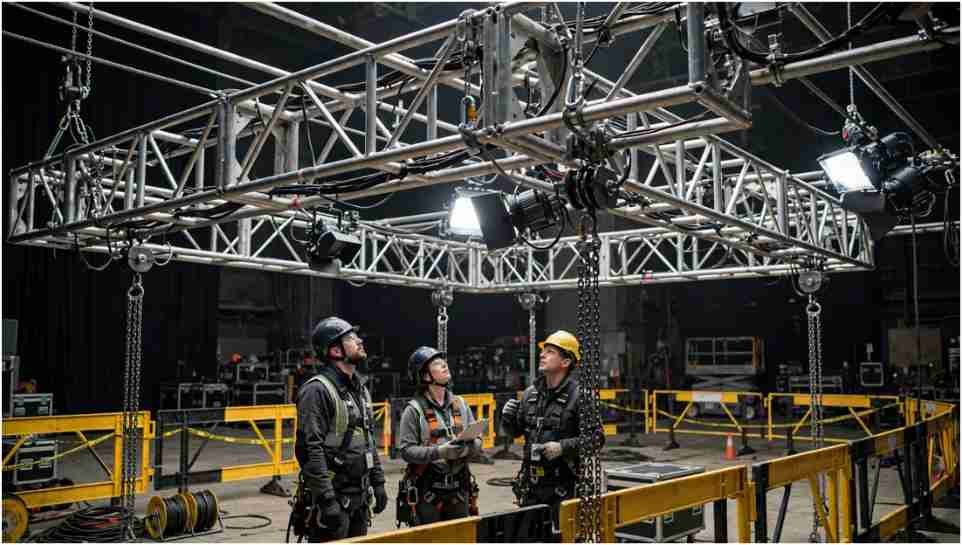
Aluminum truss is popular because crews can configure it into grids, goalposts, towers, and other production structures.
Modularity does not make improvisation safe.
Truss capacity changes with span, support position, load placement, orientation, and manufacturer data. Outdoor entertainment structures also have a dedicated industry standard. ESTA lists ANSI E1.21-2024 for temporary structures used in technical production of outdoor entertainment events.
Scaffold Frameworks
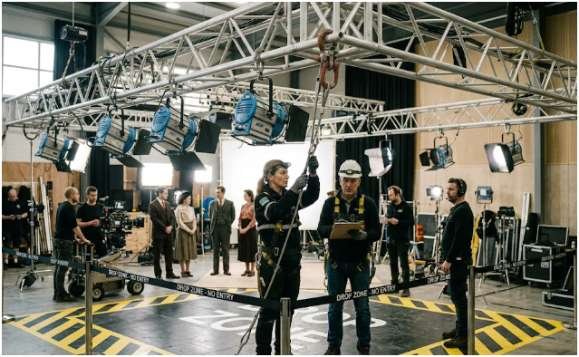
Scaffold can provide stable working platforms when correctly selected and erected.
For scaffolds covered by OSHA’s construction standard, each scaffold and component must support its own weight plus at least four times the maximum intended load. OSHA defines that intended load broadly enough to include people, equipment, tools, materials, and transmitted loads.
That rule should not be copied onto truss calculations. Different systems follow different ratings and standards.
Electric Chain Hoists
Electric chain hoists can simplify controlled lifting, but they should never become makeshift load-measuring devices.
Columbus McKinnon documentation specifically warns against using a hoist’s overload limiting clutch to measure load. Its guidance also treats limit switches as emergency devices rather than routine stopping controls.
Entertainment-industry standards also address electric chain-hoist design, inspection, and maintenance.
Load Capacity Is More Than Adding Equipment Weight
This is where safe temporary rigging structures for film sets become an engineering problem rather than an inventory exercise.
Suppose a temporary grid carries:
| Item | Example Weight |
| Lighting fixtures | 200 lb |
| Cable and accessories | 60 lb |
| Mounting hardware | 40 lb |
| Truss self-weight | 120 lb |
| Inventory total | 420 lb |
It would be dangerous to conclude that the structure only needs a 420-pound rating.
That number does not establish point-load distribution, support reactions, dynamic effects, span capacity, connection loads, or anchor capacity. Those factors still require manufacturer data and, where appropriate, review by a qualified person or structural engineer.
I also avoid applying a generic rule such as “stay below 50% or 80% of WLL.” OSHA instead requires covered equipment to stay within its marked or rated limits, while individual systems may have additional design requirements.
Inspection and Tag-Out Rules That Prevent Failures
A rig can be correctly designed and still become unsafe after transport, assembly, repeated use, or an impact.
Inspect Before Work Starts
OSHA 1926.251 requires covered rigging equipment to be inspected before use on each shift and as necessary during use. Defective equipment must be removed from service.
Inspection points can include deformation, damaged threads, illegible identification, cracks, sling damage, distorted hardware, and abnormal wear.
Productions building a formal rigging hardware inspection intervals for film production procedure should separate daily pre-use checks from periodic examinations and manufacturer-required maintenance.
Do not leave rejected hardware beside usable equipment. Quarantine and clearly identify it so another crew member cannot return it to service accidentally.
Treat Secondary Retention as a Separate System
Where a fixture or system requires secondary retention, that backup should not simply duplicate the same failure point.
A secondary restraint only adds meaningful redundancy when it has an appropriate attachment, compatible hardware, minimal unnecessary slack, and a verified supporting location.
That consideration becomes especially important when planning how to secure film equipment above performers, because equipment placement can put cast directly inside the consequence zone of a failure.
Exclusion Zones Protect More Than the Rigging Crew
Good safe temporary rigging structures for film sets also control the space beneath and around the structure.
During lifting, assembly, adjustment, and striking, unnecessary personnel should remain outside the fall zone.
OSHA’s crane and derrick rules require hoisting routes that minimize worker exposure where available and tightly restrict who may enter a fall zone around suspended loads.
Even when that specific crane rule does not govern a particular film rig, the principle is useful: fewer people below an active suspended load means fewer people exposed if something goes wrong.
The production should also establish communication and response responsibilities before lifting begins. Those controls belong in documented film set rigging emergency procedures, not in instructions invented after an incident starts.
Outdoor Temporary Structures Need Extra Planning
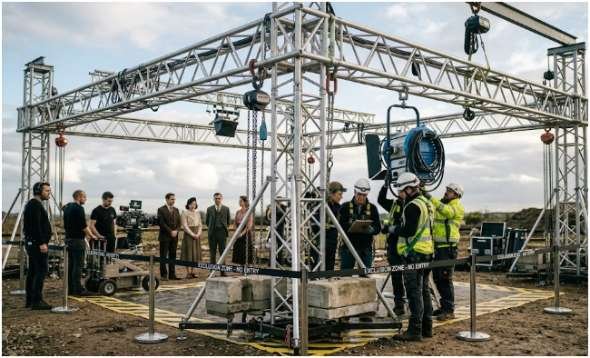
Outdoor rigs add variables that indoor studio setups may not face.
Wind, uneven ground, soil conditions, ballast, drainage, weather changes, vehicle movement, and public access can all affect the structure.
For safe temporary rigging structures for film sets outdoors, I would never treat yesterday’s approved configuration as automatically valid at a new location.
ESTA’s ANSI E1.21 specifically addresses temporary structures used for technical production of outdoor entertainment events and provides an industry framework for structural reliability and safety.
Any attachment to an existing building also deserves verification. Decorative ceilings, ducts, pipework, and unknown architectural features should never be assumed to be structural anchors.
A Practical Temporary Rigging Sign-Off
Before releasing the area for filming, I would want these questions answered:
| Verification | Question to Resolve |
| Load path | Can every connection be traced to a verified support? |
| Equipment | Are ratings and identification legible? |
| Configuration | Does it match manufacturer or engineered requirements? |
| Inspection | Has damaged equipment been removed? |
| Personnel | Is the drop/fall zone controlled? |
| Changes | Has anything changed since approval? |
| Emergency response | Does the crew know who stops work and clears the area? |
This is the information-gain point I consider most useful: verification should follow the load path, while re-verification should follow change.
That combination catches both original design errors and new risks created during production.
FAQs
1. What are the safest temporary rigging structures for film sets?
Safe temporary rigging structures for film sets use verified supports, correctly rated components, documented inspections, controlled access, and configurations suited to the actual loads.
2. Can film lights be suspended from temporary truss?
Yes, when the complete truss system, connections, supports, and loads comply with manufacturer requirements and applicable engineering criteria.
3. How often should temporary rigging hardware be inspected?
Covered OSHA rigging equipment for material handling requires inspection before use each shift and additional inspection when necessary during use.
4. Who should approve a complex temporary film rig?
Complex or unusual structures should be reviewed by appropriately qualified personnel, with structural engineering involvement when the design or applicable rules require it.
If the Load Path Is Fuzzy, the Rig Is Not Ready
Temporary does not mean casual.
The strongest approach to safe temporary rigging structures for film sets is to stop asking only, “Is this piece of gear strong enough?” Ask instead, “Can I verify every stage between the equipment and the final supporting structure?”
Then ask the second question: “What changed since that verification?”
If either answer is unclear, stop the setup before cameras roll. Verify the load path, isolate questionable hardware, control the area below, and get the appropriate qualified person involved.
A production schedule can recover from a rigging delay. It has a much harder time recovering from a preventable overhead failure.