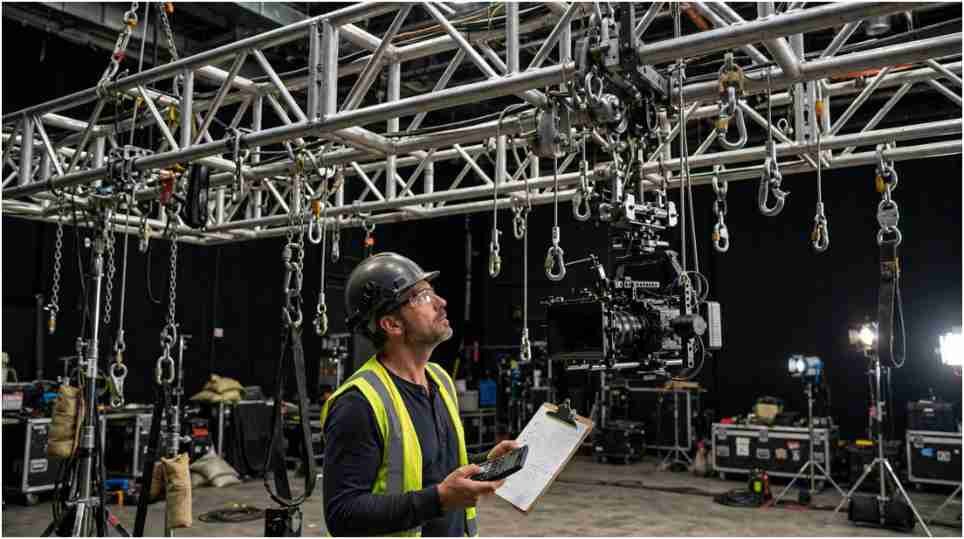






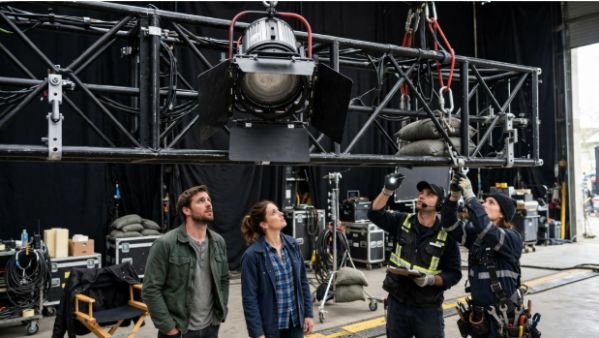
The instant a light, camera, microphone, monitor, or accessory goes over talent, I stop treating it like ordinary mounting. Knowing how to secure film equipment above performers means planning for failure before anyone stands beneath the rig. I want a rated primary mount, a suitable support point, independent secondary retention where required, secured accessories, and a clear performance zone.
Start With Three Load Paths
When I assess how to secure film equipment above performers, I trace three paths: primary, secondary, and accessory. This “three-path check” catches hazards hidden by a secure-looking fixture.
| Load path | What I verify | Stop-work trigger |
| Primary | Rated mount and approved support | Unknown rating, damage, improvised attachment |
| Secondary | Separate rated retention method | Missing, damaged, or weak attachment |
| Accessory | Positive retention for detachable parts | Loose frame, lens, battery, or adapter |
ANSI E1.53-2025 covers primary and secondary mounting devices for portable stage and studio luminaires, accessories, and similar equipment. OSHA sling rules also make the weakest component important when determining usable capacity.
Use Rated Primary Mounts and Known Support Points
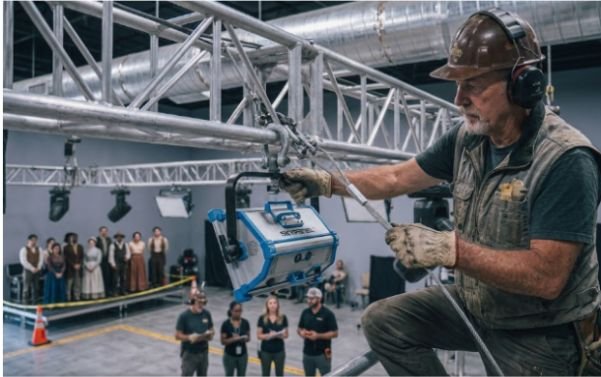
For how to secure film equipment above performers correctly, I confirm the equipment weight, accessories, mounting hardware, sling or connector, and support point.
I never assume a pipe, ceiling member, scenic element, or truss is suitable because it looks strong. The load path needs documented capacity and an approved configuration.
Treat the Weakest Component as the Limit
If one sling, shackle, clamp, or connector has a lower rating than the rest, that part limits the system. OSHA’s general-industry sling standard states that attachments must equal the sling’s capacity, or the sling cannot be used beyond the weakest component’s rating.
That is why I review safe use of slings in film production rigging before focusing on the fixture. Sling type, hitch, angle, edge contact, and connector choice can affect usable capacity. OSHA also requires rated-capacity information for covered slings.
A clamp with an impressive rating does not rescue an unrated support point or undersized connector.
Add a Real Secondary Retention System
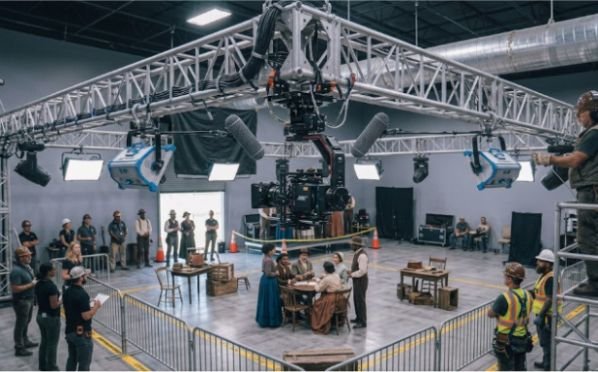
A primary clamp is not a secondary. When required, I use a separate retention device at the manufacturer-designated safety point or another approved structural location.
This is central to how to secure film equipment above performers because the secondary must retain the item if the intended primary mounting method fails. ANSI E1.53 addresses primary and secondary mounting devices for stage and studio luminaires and related portable equipment.
For a deeper look at this part of the system, secondary safety cables for overhead film equipment should be chosen by documented rating and correct attachment method, not appearance.
Keep the Possible Drop Short
I route secondary retention to limit unnecessary free fall without interfering with normal fixture positioning. I avoid removable handles, plastic covers, or other parts that could detach with the failed mount.
I check the whole secondary path: fixture attachment, cable or bond, connector, termination, and structural attachment. A strong cable attached to a weak point is still a weak system.
Secure Every Detachable Accessory
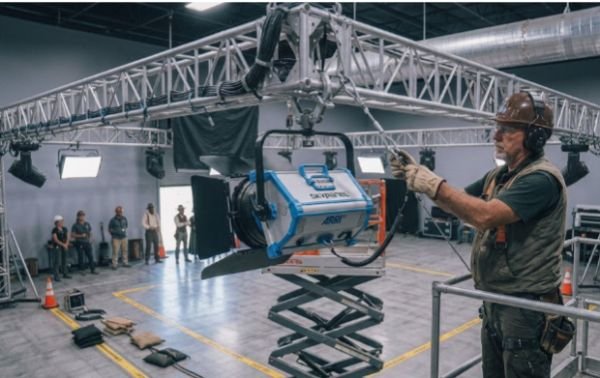
When crews ask how to secure film equipment above performers, they often focus on the main light or camera. I also inspect barndoors, gel frames, lenses, batteries, wireless receivers, monitor hoods, microphones, and cable adapters.
If gravity can separate an item after one fastener loosens, I treat it as its own dropped-object hazard. Each accessory needs positive retention suitable for that equipment.
That discipline is part of how to secure film equipment above performers without expecting one clamp or safety cable to control every possible failure.
Verify Clearance Before Talent Enters
A secure fixture can still create a strike hazard if it conflicts with performers, props, moving scenery, or camera movement.
Before approving how to secure film equipment above performers, I verify overhead rigging clearance requirements for film sets. I check full performer blocking, raised arms, props, camera moves, doors, lifts, scenery travel, effects, and cable paths.
There is no single clearance distance that fits every film rig. Required separation depends on the equipment, movement, manufacturer instructions, venue conditions, and production design.
If an actor’s blocking changes or scenery gets repositioned, I treat that as a reason to reassess the overhead setup.
Keep People Clear During Hoisting
Mounting equipment above performers is not the same as moving a suspended load over performers.
OSHA’s general-industry overhead-crane rule requires operators to avoid carrying loads over people. Construction rules also restrict who may enter the fall zone during suspended-load handling. I clear the area, complete the lift, secure and inspect the installation, then release the performance space.
That sequence is part of how to secure film equipment above performers safely. Talent should not stand beneath gear that is still being raised, landed, or repositioned.
This distinction matters. A secondary safety does not make it acceptable to expose performers to an active hoisting operation.
My Pre-Take Overhead Check
I use the same sequence before performers step underneath. Consistency makes small omissions easier to catch.
| Check | What I confirm |
| Weight | Fixture plus all suspended accessories |
| Ratings | Mounts, slings, connectors, and support are suitable |
| Condition | No cracks, fraying, stripped threads, or missing retainers |
| Primary | Seated, tightened, locked, and correctly oriented |
| Secondary | Installed independently as required |
| Accessories | Detachable parts have positive retention |
| Clearance | Blocking and camera movement stay clear |
| Change check | Reinspect after repositioning or added equipment |
Where OSHA construction rigging rules apply, covered rigging equipment must be inspected before use on each shift, and defective equipment must be removed from service.
I also repeat this check after changing fixture height, camera accessories, rig geometry, scenery, or performer blocking.
A 27-Pound Example That Exposes Bad Logic
Suppose a fixture weighs 22 pounds and attached accessories add another 5 pounds. I start with a 27-pound suspended package, not the 22-pound fixture label.
I still would not accept a mount rated only slightly above that figure simply because the arithmetic appears acceptable. I verify the approved configuration, weakest component, support point, geometry, and secondary retention.
This is why how to secure film equipment above performers cannot be reduced to “fixture weight versus clamp rating.” The complete system matters.
A 27-pound fixture package connected through an unsuitable sling, damaged clamp, or unknown support remains an unacceptable setup regardless of the strongest component’s rating.
FAQs
1. What is the safest way to hang a film light above an actor?
Use a rated primary mount, verified support, required secondary retention, secured accessories, safe clearance, and a completed inspection before the actor enters.
2. Does every overhead film light need a safety cable?
Follow the applicable standard, manufacturer instructions, venue rules, and production safety plan; ANSI E1.53 covers secondary mounting devices for portable stage and studio luminaires.
3. How often should overhead rigging be inspected on a film set?
Inspect before use and after changes; where OSHA construction rules apply, covered rigging equipment requires inspection before each shift and as needed during use.
4. Who should decide how to secure film equipment above performers?
Use a competent, appropriately qualified person who can verify the load path, support, ratings, secondary retention, and site-specific hazards.
The Shot Is Never Worth a Shortcut
I consider the rig finished only when one failed connection does not automatically become a falling-object incident. My approach to how to secure film equipment above performers is simple: verify the primary load path, provide correct secondary retention, control detachable accessories, clear people during hoisting, and recheck after changes.
Before the next take, run the three-path check again: primary, secondary, accessories. If any path depends on an unknown rating, improvised connection, damaged part, or removable component, stop and correct it first.