



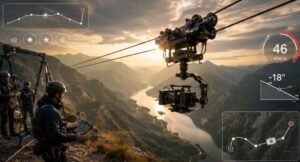

Cable camera systems such as arena cable cams and large multidirectional camera rigs can move heavy payloads above performers, crews, scenery, vehicles, and spectators. When a controller, winch, cable, brake, or programmed boundary fails, the moving rig may carry considerable kinetic energy.
I treat cable camera emergency stop procedures as a complete response plan rather than a single button press. The operator must activate the approved stop control, warn everyone below, secure the danger area, isolate hazardous energy, inspect the entire system, and authorize a controlled restart.
Because system designs differ, every production must follow the manufacturer’s manual, engineered installation plan, and site-specific safety assessment.
What Should an Operator Do During a Cable Camera Emergency?
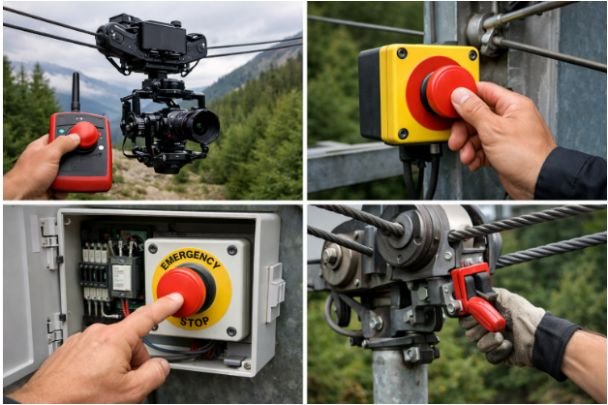
The operator should immediately press the nearest approved physical E-stop button on the operator console, pilot station, or designated emergency control panel. Press it firmly and decisively without attempting to finish the camera move.
The emergency control should place the system into its designed safe state. Depending on the equipment, it may remove drive power, apply brakes, command controlled deceleration, or disable further movement.
However, no one should assume the camera will stop instantly. The trolley may continue traveling because of momentum, while the suspended payload and cables may swing or oscillate.
If the primary control fails, trained personnel should use the manufacturer-approved secondary shutdown method. They should not automatically disconnect main winch power unless the equipment manual and emergency plan identify that action as safe. An improvised shutdown could affect braking, tension management, or control circuitry.
OSHA recognizes the importance of accessible emergency controls in machinery applications, but the specific control design must match the equipment and hazard.
How Do You Clear the Camera Drop Zone Safely?
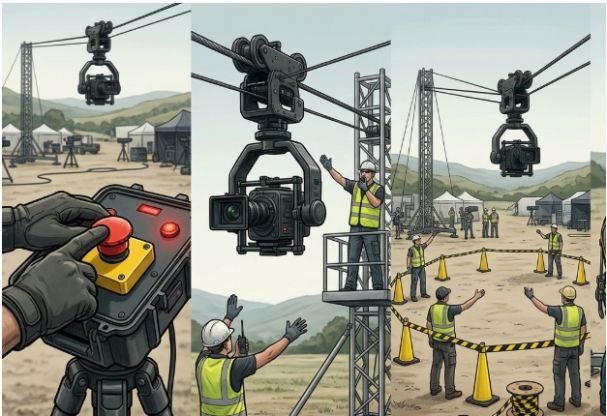
As soon as the operator activates the stop, a designated crew member should announce a clear command such as “Emergency stop—clear the cable camera area” over the production radio channel.
Spotters should repeat the warning and move performers, spectators, and nonessential crew away from the trolley path, camera drop zone, anchor points, winches, tensioned cables, and any structure supporting the system. The controlled area may need to extend beyond the space directly beneath the camera because a loose or damaged cable can whip, recoil, sag, or move sideways.
No one should run beneath the rig to catch the camera or stabilize a swinging payload. Crew members must also avoid standing in line with tensioned cables, winches, pulleys, anchors, or termination points.
I would immediately establish a perimeter and prevent anyone from entering until a qualified rigger or system technician confirms that the equipment has reached a stable condition.
Cable Camera Emergency Stop Procedures Crews Must Follow
Freeze the Controls and Observe the Rig
Once the operator activates the emergency stop, no one should move the joystick, pilot the trolley, reset the controller, or attempt to steer the malfunctioning rig away from an obstacle. Additional commands could worsen an unstable condition or defeat protective functions.
From a safe location, the operator, spotters, and rigging team should observe the trolley, payload, cables, anchors, winches, trusses, and nearby structures. They should look and listen for cable whipping, sudden slack, abnormal sag, snapping sounds, anchor movement, structural deformation, smoke, electrical odors, or uncontrolled payload swing.
The team should continue broadcasting the emergency status over the assigned radio channel so departments do not mistakenly resume work or enter the exclusion zone.
Isolate Hazardous Energy Before Anyone Approaches
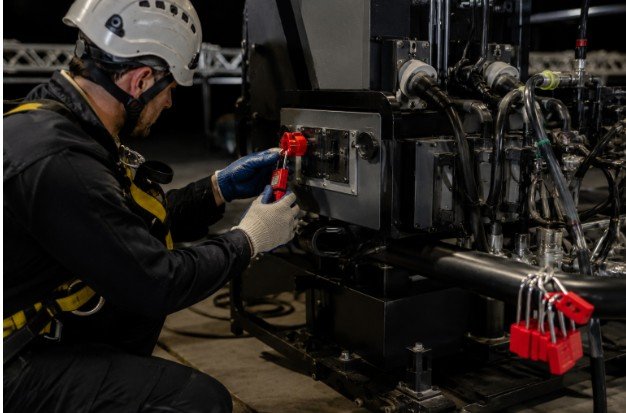
After all movement has stopped, authorized personnel should shut down and isolate the applicable electrical, mechanical, hydraulic, pneumatic, battery, and stored-energy sources before inspection or repair begins.
Pressing an E-stop does not necessarily isolate every hazardous energy source. OSHA’s lockout/tagout standard addresses servicing and maintenance where unexpected startup or the release of stored energy could injure workers. OSHA also states that control-circuit switches and relays do not qualify as energy-isolating devices.
The production’s authorized employee should apply the required lockout/tagout procedure, verify isolation, and account for stored cable tension before anyone touches the drive system or rigging.
What Must Be Inspected After an Emergency Stop?
A qualified cable camera technician and experienced rigger should determine why the stop occurred before anyone resets the system.
They should inspect the moving trolley, camera mount, gimbal, safety restraints, drive motors, winches, braking components, batteries, controllers, sensors, encoders, communication links, programmed travel limits, power cables, and emergency controls.
The rigging inspection should cover every tension and support cable, termination, pulley, anchor, truss, beam, tensioning component, and structural connection. The team must investigate loose loops, abrasion, broken wires, flattened sections, heat damage, connection movement, uneven tension, or unexpected cable sag.
Production-safety guidance recommends experienced riggers, checks for overhead obstructions, secured equipment, and stable camera-supporting structures.
What Common Failures Can Trigger an Emergency Stop?
Loss of the Programmed Operating Envelope
A software fly-out can occur when the control system loses, corrupts, or incorrectly interprets its digital boundary map. The trolley may move beyond its approved operating envelope or approach scenery, scoreboards, lighting grids, audience areas, or structural obstacles.
The operator should stop the system rather than attempting to correct the path manually. Technicians must check the software configuration, position data, sensors, encoders, control limits, and calibration before another test.
Cable Slack or Uneven Winch Movement
A winch that pays out too quickly can create dangerous slack loops, abnormal sag, loss of trolley stability, or uneven cable loading. The crew should clear the expanded danger area and watch for whipping or sudden retensioning.
Power Surges and Controller Failures
An electrical surge, voltage irregularity, communication loss, damaged controller, or failed component may interrupt winch control or braking behavior. Authorized electrical and system technicians should inspect the power supply, protective devices, controllers, motors, brakes, and communication hardware.
Obstacle or Structural Collisions
The camera may strike lighting equipment, scoreboard structures, trusses, scenery, vehicles, or temporary installations. Even a minor collision can damage the trolley, camera mount, cables, programmed limits, or supporting structure. The production should treat the rig as out of service until the complete system has been inspected.
Using a Vehicle Camera Rig Safety Checklist for Moving Film Shoots helps crews verify that mounting hardware, vibration-control components, safety tethers, communication systems, and rig attachments remain secure before filming resumes. A thorough post-incident inspection reduces the risk of hidden damage causing equipment failure and helps ensure safe operation during subsequent moving shots.
How Should the Incident Be Documented?
The production should record the exact time, trolley speed, payload, direction of travel, location, weather, operator commands, observed failure, stop response, cable condition, equipment damage, and personnel involved.
The report should also identify inspection findings, repairs, replaced components, diagnostic results, calibration work, testing, and the person who approved the restart. Thorough records can help reveal repeated faults and improve future cable cam safety protocols.
When Can the Cable Camera Restart?
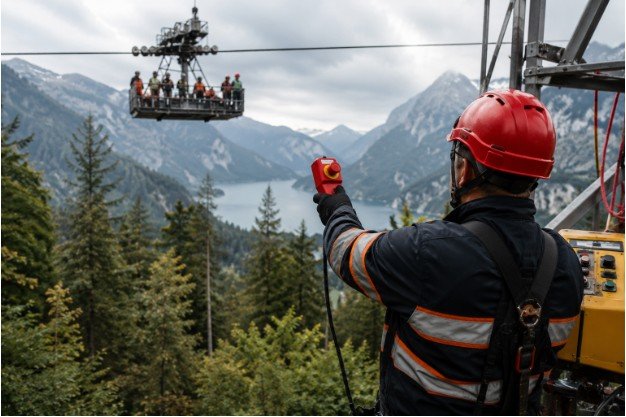
Resetting the E-stop does not authorize normal operation. The system should remain out of service until qualified personnel identify the cause, complete repairs, verify rigging integrity, and perform all manufacturer-required software and hardware diagnostics.
The team should recalibrate the system when the failure affected encoders, sensors, programmed boundaries, positioning data, or control maps. Recalibration may not be necessary after every stop, but technicians must follow the manufacturer’s requirements.
Before filming resumes, the crew should clear the travel area and conduct a controlled, low-speed test without performers or unnecessary personnel beneath the rig. The test should verify trolley movement, braking response, communication, travel limits, emergency controls, cable behavior, and manual restart requirements. One cable-camera manufacturer also recommends physical emergency-stop precautions near the ends of a point-to-point system, illustrating why model-specific manuals matter.
Frequently Asked Questions (FAQs)
1. Should the operator cut winch power if the E-stop fails?
The operator should use the approved secondary shutdown process. Cutting main power without understanding the braking and tension systems could create another hazard.
2. Can an operator joystick a malfunctioning cable camera to safety?
No. The operator should freeze the controls and avoid further movement commands until qualified personnel assess the fault.
3. Does pressing the E-stop make the rig safe to approach?
Not necessarily. Residual movement, stored tension, electrical energy, and suspended loads may remain. Authorized personnel must isolate hazardous energy before inspection or servicing.
4. Does every emergency stop require recalibration?
Not always. Recalibration is necessary when a fault affects positioning, encoders, sensors, software boundaries, or manufacturer-defined calibration settings.
Final Safety Takeaway
I believe the safest response combines decisive action with disciplined control. Effective cable camera emergency stop procedures require an immediate approved stop, a clear radio warning, an expanded exclusion zone, frozen controls, careful observation, energy isolation, complete inspection, incident documentation, diagnostics, and controlled testing.
No generic article can replace the system manual, engineered plan, qualified rigging team, or production-specific safety program. When the crew cannot confirm that every component operates correctly, the camera should remain out of service.