





A rigging risk assessment for film production should answer one hard question before anything leaves the ground: what could fail, and who could be hurt if it does?
I treat the assessment as an operating document, not paperwork for the production folder. A truss can be engineered correctly at 7 a.m. and become unsafe after someone adds fixtures, changes a bridle, moves the exclusion zone, or ignores rising wind.
For U.S. productions, the exact legal requirements depend on the work, location, equipment, and applicable federal or state rules. OSHA requires workplace hazard assessment in several contexts, while its rigging standards also address rated capacities, inspections, suspended loads, and fall hazards.
What a Film Rigging Risk Assessment Must Actually Do
A strong rigging risk assessment for film production connects four things: the hazard, the people exposed, the control measure, and the person responsible for enforcing it.
I want the document to show the condition before controls and the residual risk afterward. If a high-risk overhead load remains high risk after the proposed controls, the answer is not another signature. The rig needs redesign, stronger controls, or a different shooting method.
A simple 1–5 likelihood and 1–5 severity matrix can help production teams rank hazards consistently. The matrix is a decision tool rather than a substitute for engineering calculations or applicable safety requirements.
Film Rigging Hazard Identification Before Anything Goes Up
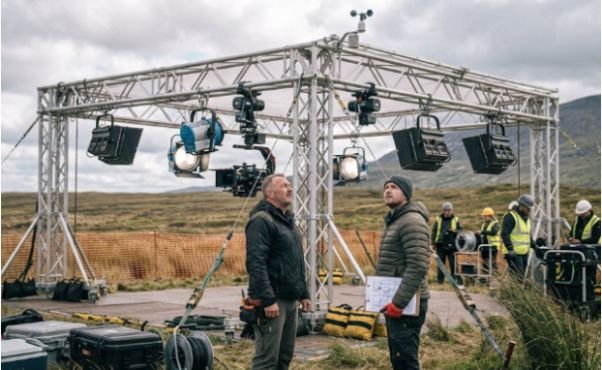
My first pass through a rigging risk assessment for film production follows the load from its support point to the people beneath it. This exposes weak links that equipment-only inspections can miss.
Structural Loads and Load Paths
Start with every component carried by the structure. That includes truss, lamps, cameras, motors, cable, distribution equipment, scenic elements, screens, hardware, and accessories.
Then examine how the load reaches the building, temporary structure, ground support, or engineered rigging point. Entertainment standards published through ESTA address areas such as powered hoist systems, chain hoists, their use, and rigging support points.
The practical lesson is simple: never judge an overhead system only by the weight of its largest fixture.
For more detail on secondary restraints, attachment methods, and overhead controls, production teams should also review how to secure suspended equipment on a film set.
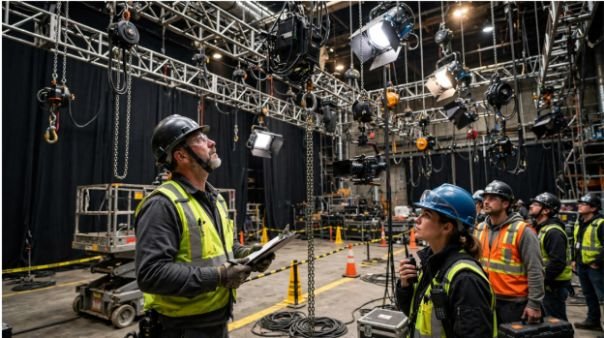
Exclusion Zones and Falling Objects
A reliable rigging risk assessment for film production must control people as carefully as equipment.
OSHA construction provisions addressing suspended loads require load routes to be planned and restrict workers from being directly beneath suspended loads except in specified circumstances. Crane rules also limit who may enter a fall zone while loads are being handled.
On a film set, I convert that principle into a clearly controlled rigging area. Access changes during lifting, focusing, adjustment, rehearsal, and strike.
That makes film set rigging exclusion zone safety part of the risk assessment rather than a strip of tape added after the rig is built.
Rigging Hardware and Secondary Safeties
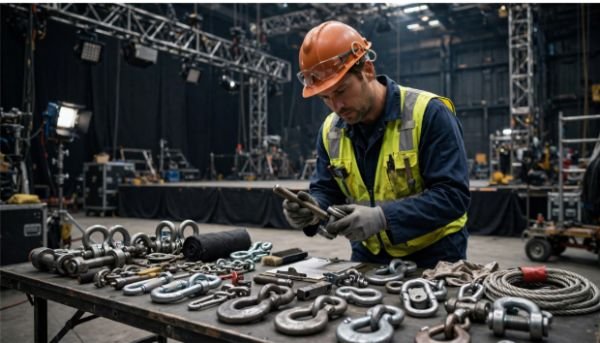
Every sling, shackle, connector, hoist, span set, attachment, and safety component should be appropriate for its intended use.
OSHA requires applicable rigging equipment to be inspected before use on each shift under its construction rigging rules. Those rules also require legible identification of recommended safe working loads and prohibit overloading rated equipment. General-industry sling rules likewise address rated capacities and identification.
I would reject makeshift hardware immediately. OSHA’s construction rigging provisions specifically prohibit makeshift attachments formed from items such as bolts or rods.
A Practical Film Rigging Risk Assessment Matrix
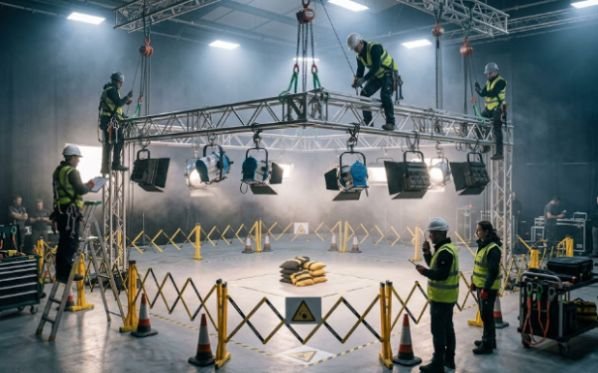
I structure a rigging risk assessment for film production around the actual sequence of work rather than a generic hazard list.
| Activity | Main Hazard | Initial Risk | Key Control | Residual Target | Owner |
| Planning | Structural overload | High | Load calculation and approved support points | Low | Rigging supervisor |
| Active rigging | Dropped objects | High | Exclusion zone, tool control and access restriction | Low | Rigging lead |
| Hardware setup | Component failure | High | Rated equipment and documented inspection | Low | Rigging crew |
| Power installation | Electrical damage | Medium | Cable inspection, routing and strain relief | Low | Electrical department |
| Performer rigging | Fall or system failure | Extreme | Specialist design, inspection and controlled rehearsal | Reduced to approved level | Stunt coordinator |
| Strike | Fatigue and dropped loads | Medium | Controlled sequence, lighting and supervision | Low | Department heads |
The residual-risk column matters most. It forces production to prove that a control changed the exposure instead of merely documenting the original hazard.
Working Load Limits, Bridles, and Structural Approval
A rigging risk assessment for film production should never assume that a component is safe because it “looks strong.”
Rated capacities depend on the equipment, configuration, hitch, geometry, and manufacturer instructions. OSHA requires slings covered by its standards to carry capacity markings and prohibits exceeding applicable rated capacities.
Bridle geometry deserves special attention. As the geometry changes, forces at the supporting legs can also change. That is why I treat any bridle-angle change as an engineering or qualified-rigger review point rather than an informal adjustment.
ETCP provides professional certification programs for Arena and Theatre Riggers. Certification can help demonstrate expertise, but productions should verify the competency, regulatory, contractual, and venue requirements that actually apply to their job.
Weather, Wind, and Outdoor Rigging Risks
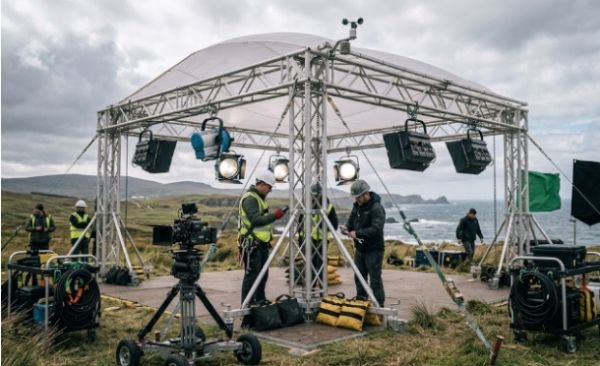
Outdoor screens, diffusion frames, banners, temporary roofs, truss, and scenic surfaces can create significant wind exposure.
I would not place a generic “20–25 mph means stop” rule in every assessment. A universal number can create false confidence because allowable conditions depend on the engineered system, manufacturer instructions, configuration, anchorage, surface area, and site conditions.
The motion-picture industry’s Safety Bulletin program recommends pre-planning for severe weather, including extreme wind, and developing an action plan for locations exposed to weather hazards. Those bulletins are industry guidance and expressly advise productions to consult applicable regulations.
For outdoor productions, wind limits for overhead rigs on film sets should therefore be tied to defined monitoring, action thresholds, and shutdown responsibilities.
Stunt Rigging and People-Suspension Risks
Performer flying deserves its own assessment. I do not treat it as ordinary equipment lifting with a person substituted for the payload.
The assessment should cover the complete performer system, harness fit, attachment points, operating sequence, communication, rehearsal, rescue arrangements, clearance zones, and foreseeable failure modes.
Fall protection is a recognized entertainment-industry concern. OSHA states that entertainment employees still require protection from occupational hazards even where conventional solutions may not suit theatrical work.
A rescue method also needs to work when the normal lifting system cannot. “Call the lift operator” is not a rescue plan if the lift, motor, power source, or access route is the reason someone is stranded.
The Change-Trigger Rule Most Assessments Miss
This is the rule I consider most useful: the assessment expires when the conditions it assessed materially change.
A rigging risk assessment for film production should be reviewed when any of these five conditions change:
| Change Trigger | Why It Matters |
| Load | Added cameras, lights, scenic pieces, cable, or accessories alter the system |
| Geometry | Moving a bridle, hoist, support, or attachment can alter load distribution |
| Environment | Wind, rain, temperature, or ground conditions can change exposure |
| People | Cast, extras, audience, or crew may enter areas previously kept clear |
| Operation | A static rig may become moving, performer-loaded, or repeatedly cycled |
This avoids a common paperwork trap. A document can remain unchanged while the actual rig becomes a completely different risk.
I recommend adding a “last verified after change” field beside the supervisor’s sign-off. It gives the crew a visible reason to stop and reassess instead of assuming yesterday’s approval still applies.
Who Owns Each Rigging Safety Decision?
Responsibility should never disappear into “all crew.”
The rigging supervisor should control rigging design, equipment selection, load information, and the rigging sequence. Electrical leads should own relevant power and cable controls. The stunt coordinator should control performer-flying procedures. Production management should support access restrictions, scheduling, emergency planning, and stop-work decisions.
OSHA also requires PPE hazard assessments where its general-industry PPE standard applies. PPE should support stronger controls rather than replace them; OSHA’s compliance guidance specifically states that PPE should be used with engineering controls, guards, and sound work practices rather than being the sole protective measure.
Daily toolbox discussions can then focus on what changed instead of repeating the same speech every morning.
The Camera Can Wait; Gravity Won’t
My strongest rule for a rigging risk assessment for film production is simple: if the crew cannot explain the load path, exclusion area, failure controls, weather limits, and rescue response, the rig is not ready for talent.
A good assessment does more than generate a risk score. It creates clear stop points.
Check the rig before the lift. Check the people before movement. Then check the assessment again whenever the plan changes.
One delayed shot costs time. An uncontrolled overhead failure can cost far more.
Frequently Asked Questions
1. What should a film rigging risk assessment include?
It should identify structural, falling-object, hardware, electrical, weather, access, fall, operational, and emergency-response hazards.
2. Who should complete a rigging risk assessment on a film set?
A competent production safety team should involve the qualified rigging personnel and relevant department leads responsible for the specific work.
3. How often should overhead film rigging be reassessed?
Reassess it before use and whenever the load, geometry, weather, equipment, work method, or exposed personnel materially change.
4. Is a rigging risk assessment for film production required by OSHA?
OSHA requires applicable workplace hazard controls and assessments under specific standards, but productions must determine which federal, state, local, equipment, and work-specific requirements apply.