





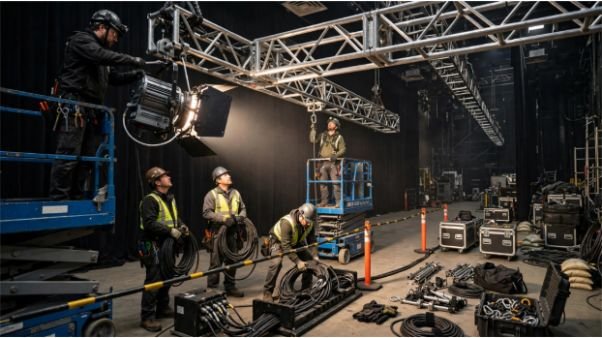
A fixture overhead should never depend on luck, one clamp, or a rushed final check. When I evaluate how to secure suspended equipment on a film set, I trace the full load path: equipment, mount, connector, support, secondary restraint, and the space below it.
That turns overhead safety into a system, not a hardware choice. Every suspended item needs a rated primary connection, suitable secondary retention, verified support, inspection, and controlled access beneath the rig.
Start With the Entire Load Path
The first step in how to secure suspended equipment on a film set is finding where every pound of load travels. I do not start by asking which clamp fits. I trace each connection from the fixture to the supporting structure.
OSHA requires rigging equipment covered by its material-handling rules to carry legible manufacturer load markings. The agency also requires covered equipment to be inspected before use and defective gear to be removed from service. ESTA publishes entertainment-industry standards covering hoist systems used to lift and suspend production loads.
Count the Complete Suspended Weight
Include the fixture, yoke, mount, clamp, motors, camera accessories, battery plates, and cable-support hardware.
Consider a 32-pound LED panel with a 5-pound yoke and 4 pounds of mounting hardware. The basic static suspended mass is already 41 pounds. That figure is only a starting point. A qualified rigger must still account for working-load limits, sling geometry, movement, support capacity, and other forces.
I would not apply a blanket “5:1” or “10:1” rule to every rigging component. Safety factors depend on the product and intended use. ETC, for example, lists a 5:1 safety ratio for one specific safety cable with a 400-pound safe working load. That figure is not automatically valid for clamps, truss, shackles, or structures.
Use Rated Rigging Hardware and Secondary Safeties
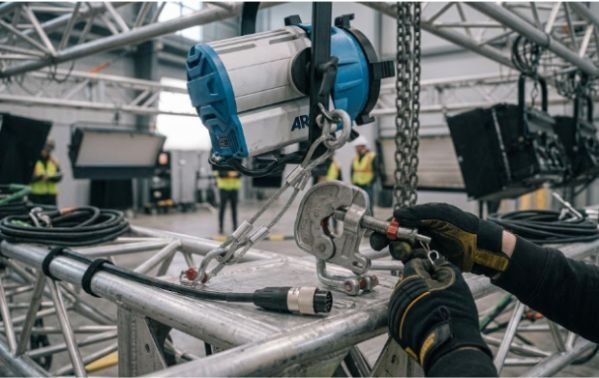
A dependable answer to how to secure suspended equipment on a film set separates primary support from secondary retention.
Build the Primary Connection
Use hardware designed and rated for the intended overhead application. Follow the fixture manufacturer’s approved mounting points and installation requirements.
For example, ETC specifies designated primary suspension points for certain luminaires. Manufacturer instructions should therefore outrank improvisation.
I avoid unmarked substitutes, damaged fasteners, or makeshift connections with unknown working-load limits. A bolt fitting through a hole does not prove that it is suitable for overhead suspension.
Add Independent Secondary Retention
A safety cable or other approved secondary restraint should retain the item if its primary connection fails. It should attach through the correct fixture point and around an appropriate supporting member according to manufacturer instructions.
This is the practical heart of dropped object prevention on film sets. I apply the same question to barn doors, wireless receivers, battery plates, monitors, adapters, and similar accessories.
If the main fastener loosens, what stops that accessory next?
Inspect Before Anything Goes Up
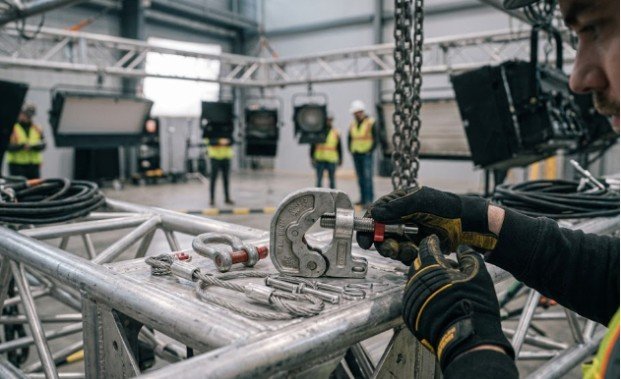
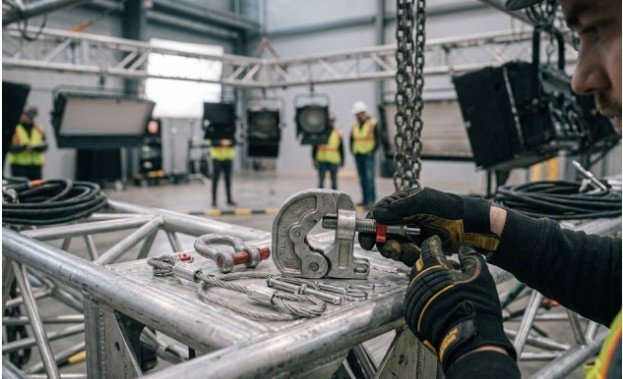
Inspection is part of how to secure suspended equipment on a film set, not a separate maintenance job.
OSHA requires pre-use inspection for rigging equipment covered by its material-handling standard. Contract Services also includes rigging hardware inspection, overhead lifting, load handling, and overhead electrical rigging in its current entertainment-industry safety training.
| Component | Check Before Use | Stop-Work Sign |
| Clamp or coupler | Correct type, WLL visible, fully seated | Crack, deformation, stripped thread |
| Safety cable | Rated assembly and sound termination | Fray, kink, damaged connector |
| Shackle or pin | Correct size and secured pin | Bent body or damaged pin |
| Fixture or yoke | Approved mounting point intact | Crack or loose hardware |
| Supporting structure | Capacity and attachment verified | Unknown rating or visible damage |
My sequence is simple: identify, inspect, connect, verify, then lift.
A written checklist for how to secure suspended equipment on a film set also improves the handoff between departments. An unreadable load rating is an unresolved problem, not permission to guess.
Establish a Drop Zone Before the Lift
Knowing how to secure suspended equipment on a film set also means controlling the space below it.
OSHA’s sling requirements state that workers must be kept clear of loads about to be lifted and suspended loads. That principle matters during installation, adjustment, testing, and removal.
Good film set rigging exclusion zone safety creates a boundary everyone can understand. Depending on the location, that could involve barriers, cones, spotters, controlled access, or another production-approved method.
Keep the zone active while people are working overhead. Reopen it only after the responsible crew member has completed the required checks.
Support Power and Data Cables Separately
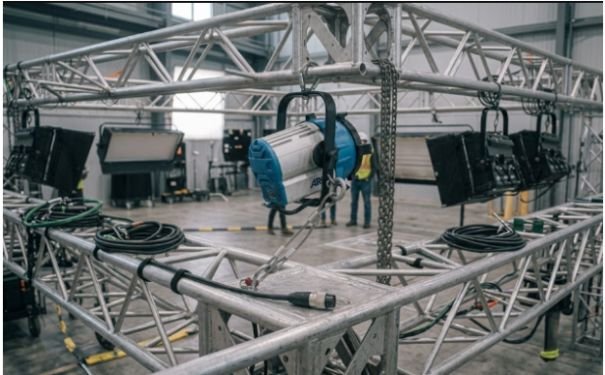
When reviewing how to secure suspended equipment on a film set, I make sure electrical and signal cables do not pull against the fixture or become accidental suspension members.
OSHA rules covering shipyard lighting prohibit lights from being suspended solely by electrical cords unless the equipment was designed for that purpose. The regulation applies to a specific workplace context, but it illustrates the underlying hazard clearly: a power cord should not casually become structural support.
Provide suitable strain relief. Support heavy cable runs separately and route them along the supporting structure.
Leave enough slack for intended pan, tilt, or movement, but avoid large loops that can snag equipment or people.
Outdoor Rigging: Wind and Dynamic Loads
Exterior setups introduce forces that static fixture weight cannot describe. Large diffusion frames, LED panels, soft boxes, and similar surfaces can catch wind and increase loading.
That means how to secure suspended equipment on a film set outdoors must include manufacturer limits, engineered guidance where required, and location-specific weather decisions.
Contract Services notes that aerial-lift wind limits can be lower when additional rigging activities are involved. It also directs productions to follow manufacturer instructions for the specific machine and rigging method.
This is why exterior planning should connect directly with wind limits for overhead rigs on film sets.
I would never choose one universal shutdown wind speed for every truss, lift, frame, or fixture. Equipment geometry, manufacturer limits, configuration, and engineering all matter.
My Two-Failure-Path Check
This is the extra layer I add when thinking about how to secure suspended equipment on a film set.
Before the area below reopens, I ask two questions.
What happens if the primary attachment fails?
Then I ask what happens if the secondary restraint fails or shares the same damaged attachment point.
If both failure paths depend on one connector, one mounting point, or one unverified structure, the setup may look redundant without providing meaningful independence.
| Safety Layer | Question I Want Answered |
| Primary support | What normally carries the equipment? |
| Secondary retention | What catches it after primary failure? |
| Supporting structure | What ultimately carries both systems? |
| Access control | Who can enter the potential fall area? |
| Final verification | Who is qualified to release the rig? |
Contract Services currently offers dedicated courses covering entertainment rigging, overhead lifting, rigging hardware, load attachment, and overhead electrical rigging. These subjects reinforce why competent supervision matters when loads go above people.
For U.S. productions, requirements can also vary with the state, workplace, equipment, and task. Industry safety bulletins themselves advise productions to consult applicable federal, state, local, and manufacturer requirements.
FAQs
1. How Do You Safely Hang Film Lights From Truss?
Use manufacturer-approved mounting points, rated hardware, suitable secondary retention, verified support capacity, and qualified supervision.
2. Does Every Suspended Film Light Need a Safety Cable?
Use the secondary-retention method required by the fixture manufacturer, production policy, applicable standard, and local requirements.
3. Can Hardware-Store Clamps Be Used for Overhead Film Gear?
Do not replace purpose-designed and rated overhead hardware with unmarked clamps or fasteners of unknown capacity.
4. What Is the Safest Way to Learn How to Secure Suspended Equipment on a Film Set?
Learn how to secure suspended equipment on a film set through formal entertainment-rigging training and supervised practical work with qualified personnel.
“Probably Fine” Is Not a Rigging Standard
For me, how to secure suspended equipment on a film set comes down to three answers: what carries it, what catches it, and who verified both.
If one answer is vague, the rig is not ready.
Before the next overhead build, trace the complete load path. Run the two-failure-path check. Control access underneath. Then get the required qualified verification before normal crew activity resumes below the equipment.
An overhead rig should earn trust through verification, not optimism.