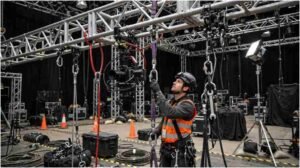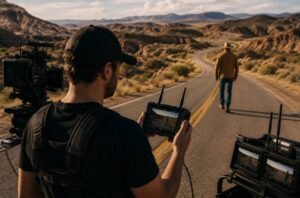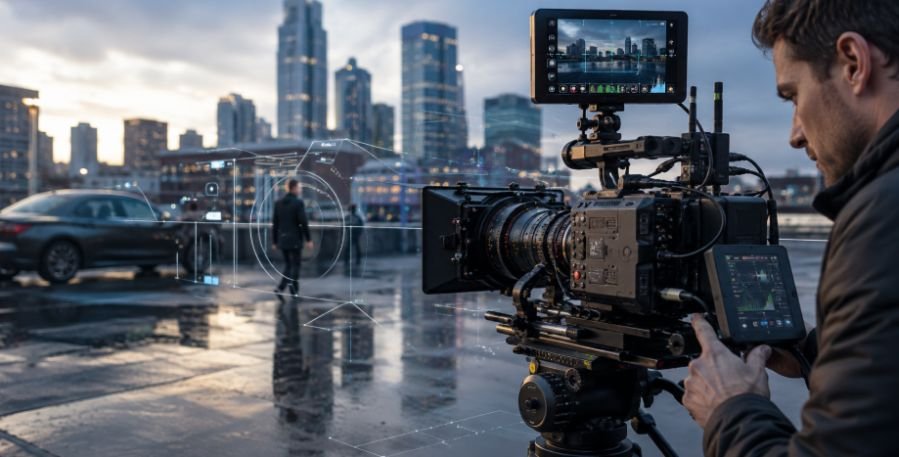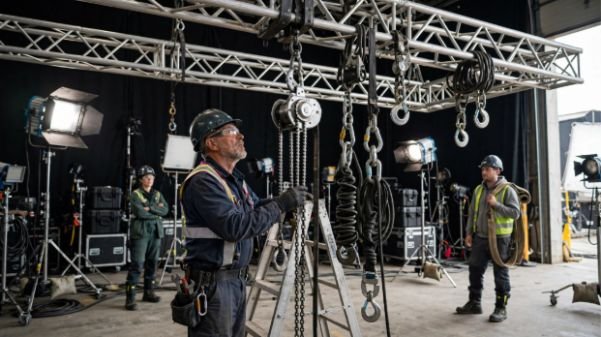




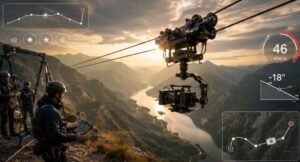
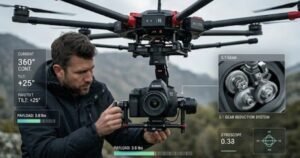
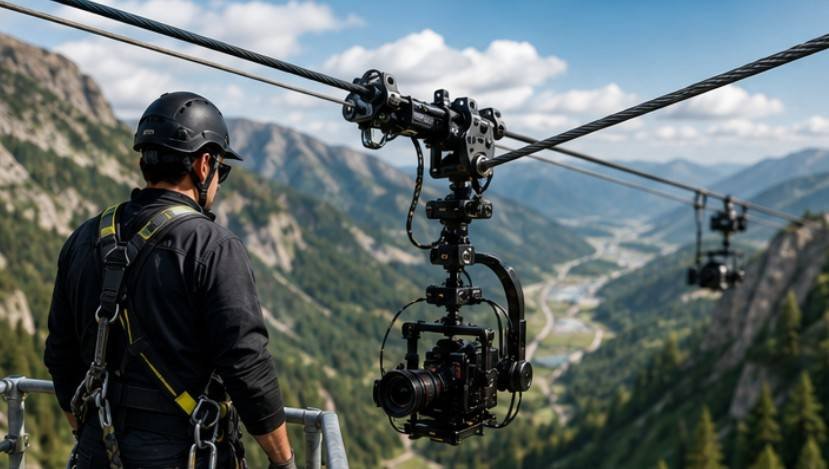
A cable camera can look safest when its line is pulled extremely tight, but tighter is not automatically safer. Line tension, support reactions, payload, operating geometry, and emergency braking all affect the forces traveling through the system. That is why cable camera system safety guidelines should begin with the entire load path, not simply the strength printed on the rope. PLASA guidance specifically requires designers to consider loads occurring during normal operation, emergency stops, failures, and fault conditions.
For US crews, applicable OSHA rigging and suspended-load rules, venue requirements, production procedures, manufacturer limits, and engineering review may all matter. Contract Services also offers dedicated Safe Rigging and Materials Handling and Camera Crane Safety training, reinforcing the importance of task-specific competency on motion-picture productions.
Safety Starts With the Full Load Path
A cable cam is a moving suspended load. Safety depends on every component from the camera and carriage through the line, connectors, winches, anchors, and supporting structure.
PLASA’s National Rigging Advisory Group says equipment should withstand forces that can occur during installation, operation, emergency stopping, failures, and fault conditions. Anchor points should be certified, validated by calculation, or verified as suitable by the structure’s designer or manufacturer.
A “rated” anchor is therefore not automatically a safe cable-cam anchor. Span, sag, payload, braking, wind, and cable direction can change support forces. For a new run, use a documented cable camera anchor point installation guide as a planning reference, then have the actual structure and load case checked by a competent rigger or engineer when required.
Be Careful With Simple Safety Multipliers
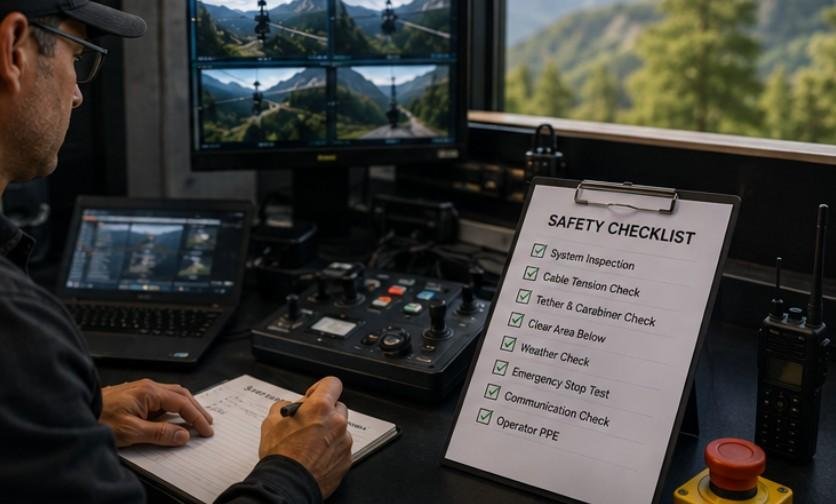
Some online guidance uses fixed figures such as a 5× anchor factor or keeping tension below 50% of an anchor rating. Those figures should not be treated as universal rules. PLASA instead states that safety factors and the need for redundancy can vary with the operating mode and should be identified in the Motion Plan.
The practical takeaway is straightforward: use manufacturer limits and calculations based on the actual installation geometry and credible worst-case forces. A generic percentage cannot replace an engineered load case.
Build a Motion Plan Before Tensioning
PLASA recommends a Motion Plan covering payload, flight path, rated speed, system and support loads, environmental conditions, controls, emergency procedures, studio and event rigging and crew responsibilities.
For a 1D cable cam, define its permitted path and stopping zones. Multi-line systems also need positions identified where tension or clearance becomes critical. These limits should be agreed upon before the creative team starts requesting faster, lower, or longer moves.
The International Code of Practice for Entertainment Rigging recommends operator override capability, risk-assessed emergency stops, visual monitoring, and logged pre-performance checks for computer-controlled effects.
Inspect the Parts That Carry or Control the Load
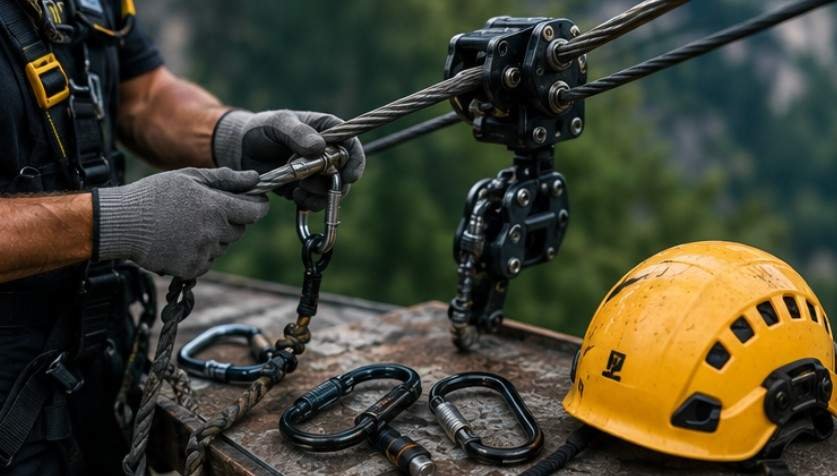
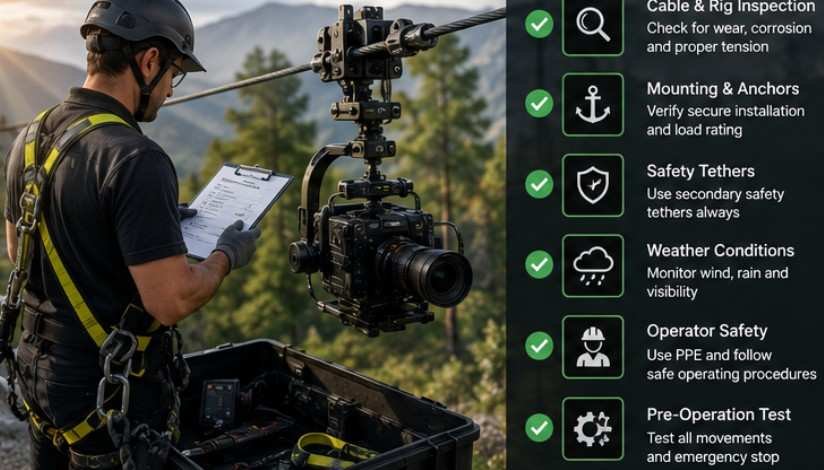
Before use, inspect the line for abrasion, cuts, glazing, pulled fibers, kinks, contamination, and damaged terminations. Check winches, carriage wheels, brakes, connectors, retaining devices, batteries, and controls at the same time.
OSHA’s construction rigging rule requires covered rigging equipment to be inspected before use on each shift, defective equipment to be removed from service, and identification markings showing recommended safe working load. Exact cable-camera applicability depends on the work situation, but these are sensible baseline practices.
Noxon also recommends maintaining documentation for ropes, carabiners, hand winches, and the cable-cam system. Some projects may additionally request proof testing or a secondary rope; any proof test should follow an approved manufacturer or engineering procedure rather than an improvised overload on location.
Camera accessories deserve the same attention. Batteries, transmitters, lens motors, monitors, and adapters need positive retention so they cannot become dropped objects. A clean camera cage accessories setup for filmmaking rigs is also considerably easier to inspect.
A Five-Stage Cable Cam Safety Check
| Stage | Verify | Stop if… |
| Before tensioning | Anchors, structure, rope path, calculations | Any load case is unverified |
| Before payload | Line, connectors, retention, brakes | Damage or uncertain rating appears |
| Before access | Limits, E-stop, radios, exclusion zone | Stop system or communication fails |
| During operation | Tension, wind, clearance, carriage behavior | Conditions exceed the plan |
| After an incident | Load path, brakes, anchors, terminations | Shock load, impact, or slip occurred |
Testing should progress from lower to higher consequence. Begin with a low-risk movement, verify braking and travel limits, and introduce the final payload only after controls behave as planned.
Exclusion Zones and Redundancy Solve Different Problems
An exclusion zone reduces human exposure, while redundancy reduces the probability that one failure becomes a falling load. One control cannot simply substitute for the other.
OSHA provisions addressing suspended loads emphasize keeping workers clear, while its sling standard states that employees should remain clear of suspended loads and prohibits shock loading. These provisions are not written specifically for cable-camera systems, but their underlying principle is highly relevant to a moving camera carriage overhead.
For operation over people, designers, qualified riggers, venues, production safety teams, or insurers may require independent retention or additional engineered redundancy. Noxon describes a second rope as common for crowd-overflight applications, while PLASA ties redundancy to operating mode and the documented safety plan.
Make Travel Limits and Emergency Stops Obvious
Software limits are useful, but visible references add another protection layer. Noxon describes a white tape marker used together with virtual limits on compatible cable-cam systems, helping operators recognize the end of permitted travel.
Before operation, test the emergency stop, brakes, direction controls, telemetry, and crew radios. Repeat critical checks after re-tensioning, battery replacement, mechanical adjustment, relocation, or control-system changes.
Camera controls should not distract the person controlling movement. A manual vs wireless follow focus for filmmaking choice should preserve clear communications and an unmistakable command structure.
Weather Can Change a Safe Setup
Wind, rain, temperature, moisture, and ground or floor conditions can affect stability, friction, and carriage behavior. PLASA specifically recommends documenting environmental limits, monitoring arrangements, and actions to take when conditions deteriorate.
Production changes deserve the same attention. A new lighting truss, lift, scenic element, special effect, or occupied audience area may alter clearances and consequences even though the cable itself has not moved. Significant changes should trigger reassessment rather than relying on yesterday’s approval.
Frequently Asked Questions
1. What is the first safety check for a cable camera?
Verify the entire load path: payload, carriage, rope, hardware, winches, anchors, and supporting structure. If a rating or structural assumption is unknown, stop before tensioning.
2. Should a cable cam always have a secondary safety line?
Not universally. Redundancy should follow the engineered design, manufacturer instructions, venue requirements, and risk assessment. Operations over people normally demand substantially greater protection.
3. How often should cable camera equipment be inspected?
Inspect during setup and before each use, plus after abnormal loading, weather changes, re-rigging, impacts, or adjustments. Always follow manufacturer inspection and retirement intervals.
4. Can a cable camera operate over a crowd?
Only when the system is specifically designed, reviewed, and authorized for that condition. Crowd overflight should never be treated like operation above a controlled exclusion zone.
A cable cam is a moving rigging system carrying stored energy and dynamic loads. Good cable camera system safety guidelines make the forces, limits, fall zone, and emergency response predictable before the carriage ever starts moving.