



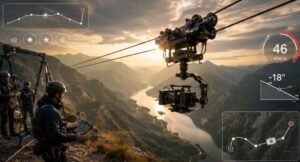
During a high-stakes NFL broadcast, a 30-pound camera rig glides smoothly just feet above the field at 30 miles per hour, tracking a receiver into the end zone. That cinematic, video-game perspective isn’t driven by a drone or an impossibly long crane arm.
Understanding how cable camera system works reveals a masterclass in structural engineering, real-time trigonometry, and high-speed motor synchronization. Suspended on ultra-strong lines pulled tight across massive venues, these systems convert precise cable tension into fluid 3D spatial movement.
The Mechanical Anatomy Behind the Glide
At first glance, an aerial cable camera looks like a simple pulley setup. In reality, it relies on a tightly integrated loop of mechanical and electronic components working in complete harmony.
Every suspended camera rig depends on four fundamental structural elements:
- Tensioned Cables: Instead of standard steel wire, modern systems rely on advanced synthetic ropes made from Kevlar or Ultra-High-Molecular-Weight Polyethylene (UHMWPE) like Dyneema. These fibers offer a higher strength-to-weight ratio than steel while remaining flexible enough to pass through high-speed pulleys.
- High-Torque Motorized Winches: Heavy-duty winches anchored at the corners of a venue supply the mechanical force. Driven by digital servo motors, these winches wind or unwind line at precise velocities to position the camera load.
- The Central Carriage (Dolly): The central hub suspended at the junction of the lines houses telemetry receivers, battery packs, and communication gear.
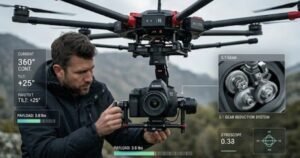
- Gyro-Stabilized Gimbal Head: Below the carriage sits a multi-axis motorized gimbal. Active gyroscopic sensors detect micro-vibrations and tilt changes hundreds of times per second, commanding brushless motors to instantly counter any unwanted movement.
1D Linear vs. 3D Spatial Systems
Not all aerial setups operate in three dimensions. Choosing between a simple single-axis line and a full spatial rig comes down to venue geometry and production goals. Look out for cable camera rigging safety
1D Point-to-Point Systems
A 1D cable cam operates along a single line stretched between two fixed anchor points, such as trees, light poles, or truss towers. A motorized trolley rides back and forth along this track.
Systems like the Wiral LITE or commercial linear rigs are popular for action sports, festival crowds, and film sets where the camera action stays along a predictable line.
3D Spatial Systems
Pioneered by inventor Garrett Brown with the creation of Skycam in 1984, 3D cable setups manipulate spatial coordinates across a open volume. Four winches sit at elevated points around a stadium perimeter.
By pulling and releasing all four lines simultaneously at varying speeds, the central camera rig floats anywhere within the enclosure with pinpoint spatial accuracy.
| System Feature | 1D Linear Cable Cam | 3D Spatial System |
| Movement Axes | Single line (Forward / Reverse) | Full 3D spatial (X, Y, Z axes) |
| Anchor Points | 2 points | 4 high-elevation corners |
| Top Speeds | 25–45 mph | Up to 35 mph |
| Rigging Time | 30–60 minutes | 4–8 hours |
| Typical Use Case | Action sports, music videos, track events | Stadium broadcasts, arenas, massive live events |
[Editor’s Note: A line chart tracking tension load relative to cable sag angle would best illustrate the structural mechanics governing anchor point stress.]
The Software Math Keeping the Rig Airborne
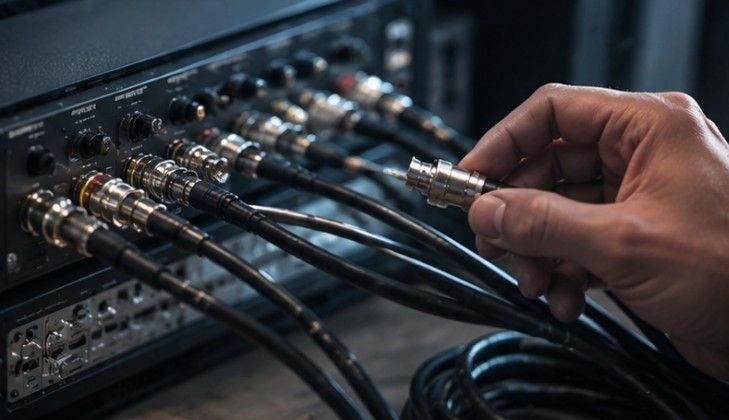
Moving a camera through 3D space on four variable lines requires constant vector calculations. A computer controller translates pilot joystick inputs into real-time winch commands.
When a pilot moves the joystick forward, the software calculates the exact distance each of the four cables must lengthen or shorten to keep the camera on a straight vector. If two winches spool off line slightly faster than the other two pull, the camera loses elevation or drifts off course.
To prevent catastrophe, control software relies on rigid safety boundaries:
- Keep-Out Zones: Software geofencing prevents the camera carriage from flying into scoreboards, goalposts, or stadium lighting trusses.
- Virtual Floor Limits: Programmed hard stops prevent the rig from dipping below a set height above players or spectators.
- Tension Telemetry: Load cells on each winch continuously monitor line force to prevent snapping cables or over-straining structural anchors.
Camera operators usually split responsibilities into two roles. One pilot manages spatial positioning across the venue while a separate camera operator controls pan, tilt, zoom, and focus on the gimbal head.
Physics and Environmental Limitations
Despite their impressive versatility, cable cameras operate under strict physical constraints that every broadcast engineer must respect. Look out for weather conditions for cable camera systems before final setup.

The Physics of Cable Sag
It is mathematically impossible to pull a suspended cable completely flat over a long span. Due to gravity acting on the cable’s own mass, attempting to eliminate sag entirely requires infinite tension force.
Riggers must calculate an acceptable sag angle (typically 3% to 5% of the total span length). This geometric curve requires winches to constantly adjust line lengths just to keep the camera flying at a uniform horizontal height.
Environmental Constraints
Wind introduces dynamic forces that can alter flight stability or threaten safety:
- Crosswinds: Strong gusts push against the camera housing and suspended lines, introducing lateral drag that forces winches to work harder.
- Operating Limits: Most commercial systems shut down operations when sustained winds exceed 25 to 30 mph.
- RF Spectrum Congestion: High-definition video signals must transmit wirelessly from the floating rig back to the control truck. Saturated wireless environments in packed arenas require robust channel-hopping technology to prevent signal dropouts.
Field Checklist: Essential Steps for Safe Deployment
Rigging an aerial system demands rigorous safety protocols. Professional crews follow a strict multi-step setup sequence before every flight.
- Structural Audit: Inspect all anchor points (stadium beams, truss systems, or rigging towers) to ensure they exceed minimum load-bearing requirements (often rated for several thousand pounds of force).
- Cable Inspection: Visually inspect synthetic lines along their full length for fraying, heat damage, or core degradation.
- Calibrate Winch Encoders: Run zero-point calibration routines so the flight computer knows the precise line length deployed from every reel.
- Define Geofences: Program soft and hard boundaries inside the control software to block access to hazard zones.
- Load and Tension Testing: Fly an equivalent dummy weight through the envelope at maximum acceleration to test system response and anchor deflection.
- RF Spectrum Sweep: Search local radio frequencies to lock in clear channels for control signals and zero-latency video transmission.
Frequently Asked Questions
1. How does a wired camera system work?
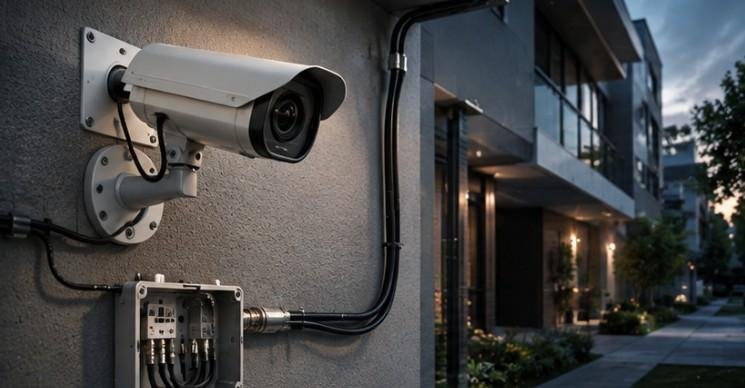
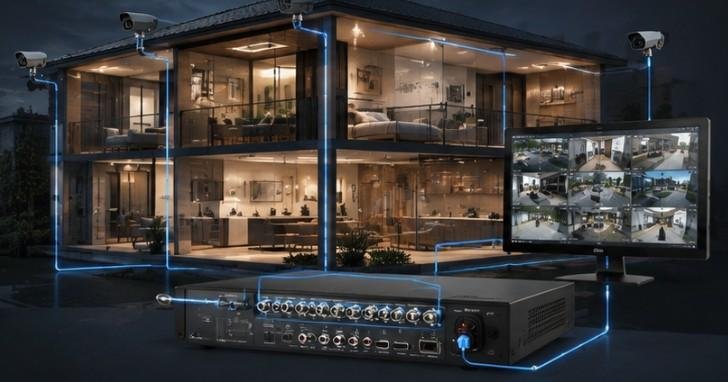
Wired camera systems use physical cables—like Ethernet or coaxial—to transmit video signals directly from the camera to a central recording device or monitor, ensuring a stable, interference-free connection.
2. Do wired cameras record all the time?
Yes, they can record continuously 24/7 if configured to do so. However, operators can also set them to record only on motion detection or specific time schedules to conserve storage space.
3. How do coax cameras get power?
Coaxial cameras get power via dual-wire Siamese cables with a dedicated power line attached, or through Power over Coax (PoC) technology, which transmits both video and DC power through the single coaxial line.
4. How far can you run a camera cable?
Standard Cat5e/Cat6 Ethernet cables for IP cameras max out at 328 feet (100 meters) without extenders. Coaxial cables (RG59) can carry HD video up to 500–800 feet before requiring signal boosters.
The Future of Aerial Cinematography
From early analog setups to today’s fully automated 3D tracking systems, choosing the right cable camera or aerial cable camera technology has fundamentally changed how we experience live sports and film. By combining high-tensile material science, precision servo control, and real-time flight mathematics, these systems deliver stabilized airborne perspective without the noise, battery limits, or safety hazards of traditional drones.
As automated object-tracking and computer-vision algorithms continue to evolve, future systems will fly even tighter lines—bringing viewers closer to the action than ever before.