





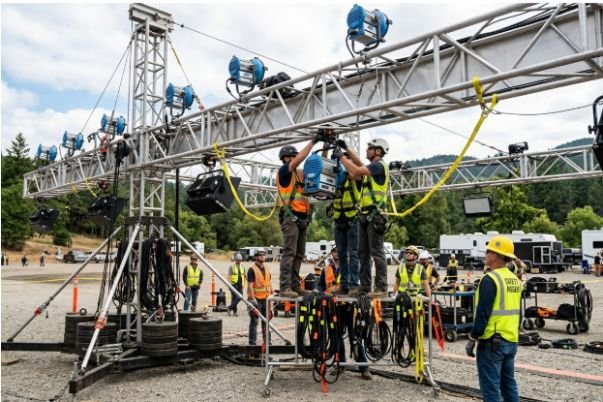
When I plan an overhead camera, lighting, truss, scenic, or cable-supported system, I treat safety as part of the creative process rather than a final inspection. OSHA compliance for film set rigging starts before equipment leaves the truck. The production must identify hazards, verify load capacities, assign experienced personnel, control access, and prepare for equipment or environmental changes.
Federal OSHA does not publish one standalone standard exclusively for entertainment rigging. Instead, productions may need to follow the General Duty Clause, general industry requirements, construction standards, manufacturer instructions, and recognized industry practices.
State Plans, including Cal/OSHA, may impose additional requirements. IATSE, SAG-AFTRA, studio policies, engineering specifications, and consensus standards can strengthen the production’s safety program, but they do not replace applicable law.
Which OSHA Standards Apply to Film Set Rigging?
The applicable standard depends on the work, not simply on whether the location is called a film set.
Routine soundstage activities may fall under OSHA’s general industry standards in 29 CFR 1910. Set construction, structural installation, material handling, scaffold erection, or covered crane operations may trigger construction standards in 29 CFR 1926.
Section 5(a)(1), known as the General Duty Clause, requires employers to protect workers from recognized serious hazards when a more specific OSHA rule does not fully address the condition.
For applicable construction material-handling operations, 29 CFR 1926.251 governs slings, hooks, shackles, wire rope, chains, and other rigging equipment. Subpart CC, beginning at 29 CFR 1926.1400, applies to covered cranes and derricks used in construction.
It includes requirements for assembly, load control, qualified riggers, signal persons, and keeping workers clear of loads. These crane rules do not automatically apply to every lighting grid, camera mount, or overhead scenic rig.
ASME B30.9 and B30.26 provide recognized guidance for slings and rigging hardware. Their provisions may support safe work practices, manufacturer requirements, or General Duty Clause evaluations, but not every ASME recommendation automatically becomes a federal OSHA rule.
Who Is Qualified to Perform Entertainment Rigging?
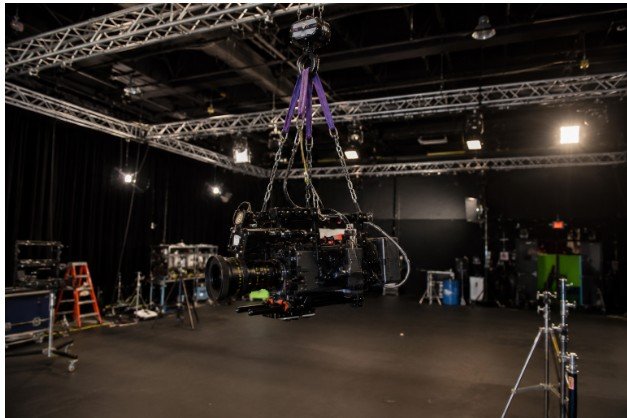
Productions should never assign overhead rigging to someone simply because that person can tighten a clamp or operate a hoist.
OSHA specifically requires qualified riggers during certain crane, derrick, steel-erection, assembly, disassembly, and fall-zone operations. A qualified rigger must demonstrate the knowledge, training, and experience needed for the assigned work. The necessary expertise changes with the rig’s complexity and site conditions.
Although federal rules do not universally require a formal certification card for every film rigger, I recommend documenting relevant training, certifications, experience, and assigned responsibilities. Covered signal-person duties may carry separate qualification and documentation requirements.
A designated supervisor should understand the complete load path and have authority to stop work. Where an OSHA standard requires a competent person, that person must identify hazards and possess authority to correct them promptly.
How Often Must Rigging Equipment Be Inspected?
For applicable work under 29 CFR 1926.251, rigging equipment must be inspected before use during each shift and as necessary while it remains in service. General industry sling rules also require inspections before use each day, with additional checks when service conditions demand them.
I would reinspect a film rig whenever the crew changes the camera package, lens, remote head, motor, monitor, fixture, truss configuration, cable tension, attachment point, travel path, or environmental exposure.
Every sling, shackle, hook, clamp, beam, wire rope, chain, and connector should carry the required legible identification. Equipment with a missing working load limit, unreadable tag, visible crack, deformation, severe corrosion, damaged stitching, broken wires, heat damage, deep gouge, or unauthorized repair should leave service immediately.
Periodic documented inspections should follow the applicable OSHA provision, manufacturer instructions, equipment type, severity of use, and relevant consensus standard. A single universal 12-month rule does not apply identically to every rigging component.
How Should Film Crews Calculate Rigging Loads?
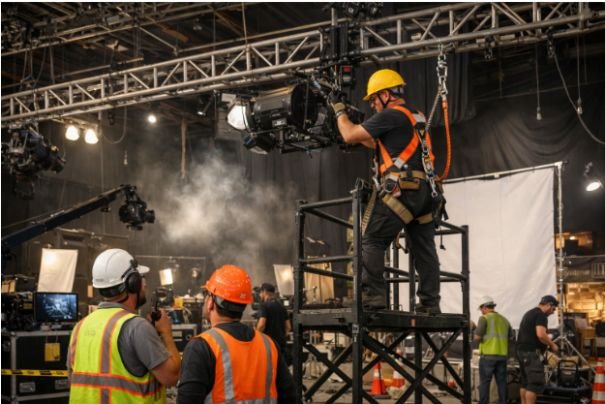
The production must calculate the entire suspended payload, not just the camera or light.
I include the lens, battery, media, gimbal, remote head, motors, matte box, monitor, transmitter, mounting plate, power supplies, cables, clamps, chain, hoists, truss, safety restraints, and scenic materials. Every component in the load path must remain within its rated working load, and the lowest-rated component limits the system.
Sling angles can dramatically increase tension. In a balanced two-leg arrangement, each nearly vertical leg may carry about half the load. At a 30-degree angle measured from horizontal, each leg may approach the weight of the entire load. Actual forces depend on geometry, hitch type, center of gravity, and load distribution.
Crews must also consider acceleration, abrupt stops, vibration, swinging, shock loading, side loading, and wind. Hardware-store eyebolts or unmarked connectors are not substitutes for forged, rated equipment designed for the intended direction of loading.
Custom-designed lifting beams, grabs, hooks, or clamps covered by 1926.251 must display their safe working load and be proof-tested before use as required by the standard.
How Do Productions Control Overhead and Fall Hazards?
I establish an exclusion zone beneath and around the rig during installation, testing, adjustment, operation, and strike. Only essential personnel should enter the fall zone, and no one should stand directly beneath a suspended load unless an applicable procedure specifically permits necessary access.
Tools, accessories, cables, and loose hardware must be secured. Primary connections and backup restraints should not share the same likely failure point. A secondary safety cable cannot make an overloaded clamp or unsuitable attachment safe.
Every crew should also understand Cable Camera Emergency Stop Procedures for Film Crews, ensuring operators know how to halt system movement immediately if equipment malfunctions, unexpected obstacles appear, or personnel enter restricted areas. Prompt use of emergency stop controls, followed by a full inspection before restarting operations, helps prevent injuries and further damage to the rig.
Rigging crews may also work from scaffolds, ladders, lifts, rooftops, grids, or temporary platforms. General industry typically requires fall protection at four feet, while construction commonly uses a six-foot threshold, although equipment-specific rules may differ.
I first try to eliminate elevated work or use guardrails and suitable platforms. When personal fall protection is necessary, the production must provide appropriate anchorage, equipment, training, clearance planning, and rescue procedures.
How Should Electrical Safety Be Integrated Into a Rig?
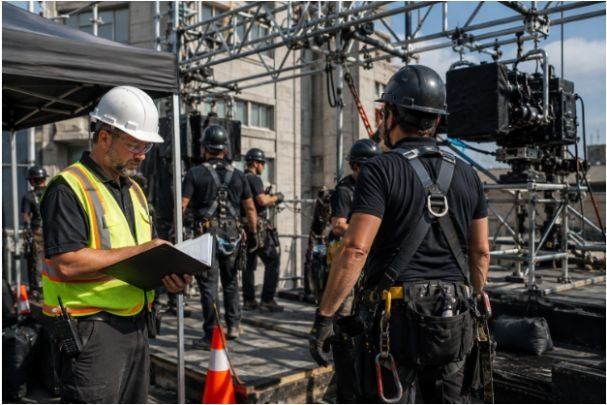
Film rigs often combine suspended hardware with temporary power, data, and control cables. That makes electrical safety inseparable from mechanical safety.
NFPA 70E may inform workplace electrical safety practices, including energized-work planning and arc-flash risk controls. Productions must also comply with applicable OSHA electrical requirements.
Cables should be rated for the connected load, environment, length, routing, temperature, and bundling. Improperly sized or overloaded cords can overheat and damage insulation. Wet-location connections require equipment and routing appropriate for the environment.
Where useful, a drip loop can help prevent water from tracking toward a connection, but it does not replace weather-rated connectors, GFCI (The ground-fault circuit interrupter) protection, or proper enclosure.
What Records Should a Film Production Keep?
A defensible safety file should include load calculations, equipment ratings, inspection records, manufacturer instructions, engineering approvals, training records, lift plans, weather limits, corrective actions, and removal-from-service reports.
Productions should also record major modifications and confirm that affected systems were reinspected before operation resumed. California productions must review Cal/OSHA requirements in addition to federal guidance because State Plans may adopt more protective rules.
Frequently Asked Questions (FAQs)
1. Does every film rig require a qualified rigger?
Not every rig triggers the same federal requirement. However, covered crane and construction operations may expressly require one, and any serious overhead rig should be assigned to personnel with demonstrated knowledge and experience.
2. Can a crew use rigging hardware with a missing tag?
Covered equipment should not remain in use when required identification or working load information is missing or illegible. Remove it until an authorized process confirms whether it can safely return.
3. Must rigging be checked before every lift?
OSHA commonly requires pre-shift or daily inspections for covered equipment, plus additional inspections as conditions require. Rechecking before a lift is prudent when the load, configuration, hardware, environment, or operating path has changed.
4. Does a safety cable make an unrated mount acceptable?
No. A backup restraint provides redundancy after a suitable primary connection has been installed. It cannot correct an overloaded, damaged, or unapproved attachment.
5. Do OSHA rules apply on private soundstages?
Yes. Private ownership does not exempt a production from workplace safety requirements. The applicable general industry or construction rule depends on the activity being performed.
Creating a Safer Rigging Culture
For me, effective OSHA compliance for film set rigging means planning for failure before it happens. I verify the structure, calculate the full payload, inspect every connection, manage electrical exposure, control the fall zone, and stop work whenever the rig or conditions change.
A well-managed system protects performers, crew members, equipment, and the production schedule. More importantly, it allows ambitious filmmaking without turning preventable hazards into an accepted part of the job.