



A film set may look controlled on camera while hiding serious hazards behind the frame. Camera operators, grips, gaffers, construction teams, and rigging technicians regularly work on ladders, scaffolds, rooftops, lighting grids, aerial lifts, and temporary platforms.
I treat fall protection for film production crews as part of production planning, not as equipment added after someone climbs. A strong system begins with eliminating unnecessary work at height, continues with engineered barriers and properly selected gear, and ends with a rescue plan that the crew can actually perform.
US productions must consider applicable federal OSHA requirements, state-plan regulations, employer policies, manufacturer instructions, and site-specific conditions. OSHA generally requires fall protection at four feet in general industry and six feet in construction, although different standards and exceptions may apply to scaffolds, lifts, roofs, ladders, and dangerous equipment.
What Is the Hierarchy of Fall Protection on a Film Set?
Productions should manage elevated work through a hierarchy of controls. The goal is to prevent exposure before depending on a system that catches someone after a fall.
Eliminate Work at Height Whenever Possible
The safest fall is the one that never happens. I first ask whether the crew can complete the task from ground level.
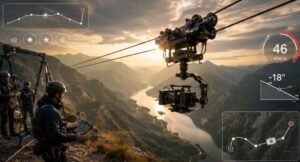
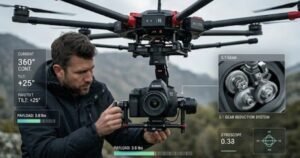
A lighting team may use an extension pole for a minor adjustment. A camera department may install a remote-controlled pan-and-tilt head rather than placing an operator on a difficult platform. Crews can also pre-rig fixtures, lower a truss, reposition equipment, or assemble scenic components before raising them.
Elimination reduces fall exposure, setup time, equipment demands, and rescue complications.
Use Guardrails and Collective Fall Protection
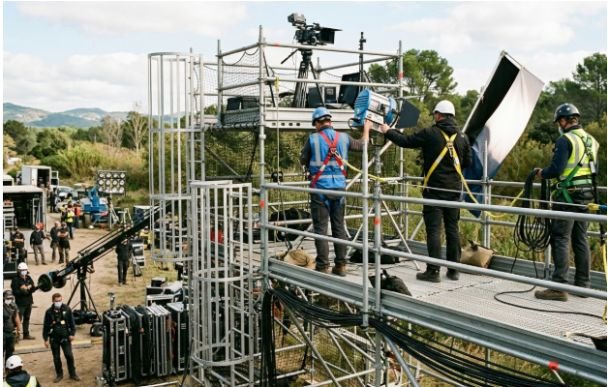
When elevated work cannot be eliminated, passive protection should usually come next. Properly designed guardrails, platform gates, secured covers, temporary barriers, and safety nets can protect several crew members without requiring each person to remain connected to an anchor.
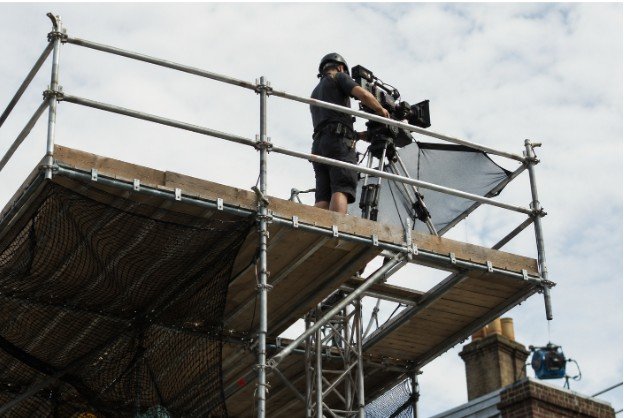
Camera platforms and professionally erected scaffolds may require compliant top rails, midrails, and toe boards. Toe boards help prevent tools, camera accessories, and materials from sliding over the edge.
Productions should never remove a guardrail to improve a camera angle without first implementing another approved protection method.
Use Travel Restraint to Prevent Edge Access
A travel-restraint system uses a full-body harness, connector, suitable anchorage, and a fixed or adjustable line that prevents the worker from reaching an exposed edge.
Restraint may be appropriate on rooftops, catwalks, set pieces, or elevated platforms where the crew can establish a controlled working area. Because the system prevents the fall rather than arresting it, it can reduce clearance and rescue complications.
Use Fall Arrest Only When Exposure Remains
A personal fall-arrest system does not prevent a fall. It catches the worker and limits the forces generated during the event.
The system may include a full-body harness, self-retracting lifeline, shock-absorbing lanyard, compatible connectors, and an approved anchorage. The plan must consider free-fall distance, deceleration, worker height, equipment stretch, available clearance, and swing-fall exposure.
A harness alone offers no protection when it is connected to an unsuitable structure or when the worker could strike the level below before the system stops the fall.
What Fall-Protection Equipment Do Film Crews Need?
Equipment selection should match the worker, task, structure, and movement path. US productions should use components that comply with applicable OSHA requirements and relevant recognized standards while following every manufacturer’s instruction.
Full-Body Safety Harnesses
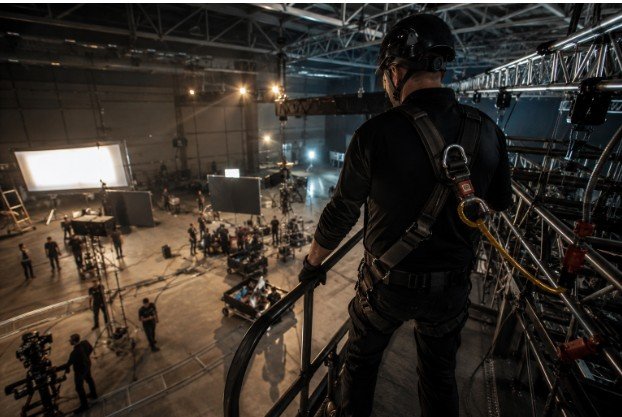
A full-body harness distributes arrest forces across the thighs, pelvis, chest, and shoulders. Camera operators may prefer lower-profile designs that allow controlled movement, while rigging grips may need padded models designed for positioning or extended wear.
Before use, crew members should inspect webbing, stitching, D-rings, buckles, labels, and adjustment points. The harness must fit snugly without restricting breathing or circulation.
Some crews use a two-finger fit check around chest and leg straps. However, the manufacturer’s fitting instructions should always take priority because harness designs differ.
Self-Retracting Lifelines and Shock-Absorbing Lanyards
A self-retracting lifeline pays out and retracts as the worker moves. It locks when it detects sudden acceleration, much like a vehicle seat belt. SRLs may improve mobility on grids, roofs, and scaffold systems, but crews must confirm that the selected model is approved for the intended orientation and edge condition.
A shock-absorbing lanyard contains energy-absorbing material designed to deploy during a fall and reduce the force transferred to the worker and anchorage.
Neither device should be chosen without calculating clearance and reviewing compatibility with the harness, connector, and anchor.
Certified Anchors and Anchor Connectors
Anchor connectors may include beam clamps, cross-arm straps, engineered anchor points, horizontal lifelines, or vertical lifelines.
Crew members must never assume that a lighting truss, handrail, scaffold rail, pipe, set wall, or roof fixture can safely serve as an anchor. A qualified person must evaluate and approve the anchorage for the intended system.
How Do Crews Maintain 100% Tie-Off?
When a task requires continuous connection, the worker should remain attached while moving between approved anchors.
A dual-leg lanyard can support 100% tie-off by allowing the worker to connect the second leg before disconnecting the first. This method may be used while moving across certain grids, structures, or rigging systems.
The crew should receive task-specific training before using this technique. Connecting both legs incorrectly, attaching them to unsuitable points, or clipping unused legs to an unapproved harness location may interfere with system performance.
How Should Crews Inspect Harnesses and Secure Tools?
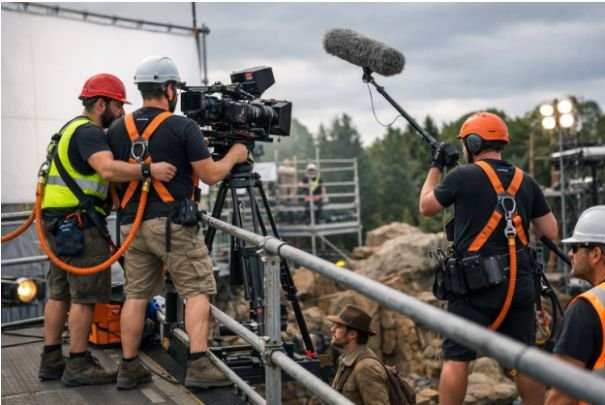
I recommend a buddy check before anyone enters an elevated work area. One crew member can confirm another worker’s buckle connections, strap routing, harness fit, lanyard attachment, and anchor selection.
Incorporating a Daily Film Rigging Inspection Checklist for Safer Film Sets into the pre-shoot routine helps ensure that harnesses, anchors, rigging hardware, camera mounts, and safety equipment are inspected consistently before work begins. A standardized checklist reduces the chance of overlooked hazards, promotes accountability among crew members, and supports a safer working environment throughout the production day.
Harnesses, SRLs, lanyards, and connectors should be removed from service when they show cuts, burns, fraying, broken stitching, corrosion, deformation, missing labels, damaged gates, deployed absorbers, or evidence of a previous fall.
Dropped-object protection is equally important. Cameras, lenses, lights, batteries, monitors, hand tools, and accessories should use suitable safety cables or rated tool-tethering systems. The crew should also establish a controlled area below the work whenever falling objects could endanger others.
What Are the Rules for Scissor Lifts and Boom Lifts?
Scissor lifts rely primarily on properly designed and maintained guardrail systems. Crew members should keep gates closed, stand on the platform floor, and never climb on rails or place ladders, crates, cases, or apple boxes inside the platform to gain height.
Boom-supported aerial platforms present different hazards, including ejection. Workers must follow applicable tie-off requirements and connect only to the manufacturer-designated anchorage inside the platform. They should not tie off to a nearby truss, pole, building, or scenic structure.
Only trained and authorized personnel should operate lifts. Pre-use planning should consider ground stability, wind, load capacity, overhead structures, electrical lines, vehicle traffic, and the movement of performers and crew members below.
Why Does Every Film Set Need a Rescue Plan?
A fall-arrest system may stop the fall but leave the worker suspended and unable to reach a platform.
Prolonged suspension can restrict circulation and lead to unconsciousness, suspension trauma, or death. NIOSH (The National Institute for Occupational Safety and Health) emphasizes the importance of prompt rescue planning whenever personal fall-arrest systems are used.
The plan should identify trained rescuers, available equipment, communication procedures, access routes, medical response, and control of the area below. Relying only on calling 911 may not provide a sufficiently prompt site-specific rescue, especially on remote locations, locked stages, rooftops, or complex grids.
Frequently Asked Questions (FAQs)
1. At what height does a film crew need fall protection?
The threshold depends on the activity and applicable OSHA standard. General-industry requirements often begin at four feet, while many construction requirements begin at six feet. Productions should evaluate the work classification and surrounding hazards rather than relying on one universal number.
2. Can a camera operator use a harness on an elevated platform?
Yes, when the platform exposes the operator to a fall hazard and passive protection or restraint cannot adequately control it. The full system must include a suitable anchor, compatible components, sufficient clearance, and a rescue plan.
3. Is a harness always required in a scissor lift?
A properly maintained guardrail system is generally the primary protection for a scissor lift. Additional equipment may be required by the manufacturer, employer policy, site rules, or specific exposure.
4. Can a grip attach a lanyard to a lighting truss?
Not without approval. A qualified person must determine whether the truss and connection method can support the intended fall-protection system.
Final Takeaway
Effective fall protection for film production crews depends on decisions made before the first rehearsal. I eliminate elevated work where possible, prioritize guardrails and restraint, select compatible equipment, maintain continuous tie-off when required, secure every tool, and prepare a workable rescue plan.
No production schedule or ambitious camera angle justifies an improvised anchor, incomplete guardrail, damaged harness, unstable ladder, or untrained lift operator. When safety planning becomes part of the creative workflow, crews can achieve complex shots without accepting unnecessary risk.