





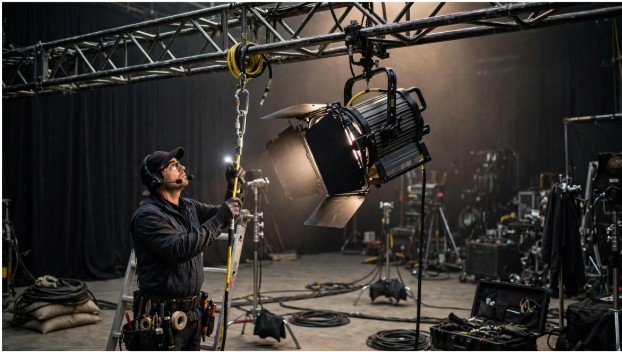
A fixture suspended above cast or crew should never rely on one connection. When I review secondary safety cables for overhead film equipment, I treat the cable as an independent last line of retention.
The cable must suit the fixture, connector, attachment point, and supporting structure. OSHA also requires applicable material-handling rigging to be inspected and carry legible safe-working-load identification. Defective rigging must be removed from service.
Why Secondary Retention Matters Above a Film Set
The primary support may be a clamp, junior receiver, spigot, yoke, truss connection, or engineered mounting point. The secondary system serves another purpose: restraining the fixture if that primary path fails.
Manufacturers reinforce this redundant approach. ETC specifies a safety cable for its ColorSource PAR and lists a 400-pound safe working load for that cable. ARRI also directs users to install safety cables on lampheads in modular SkyPanel configurations.
I never use secondary safety cables for overhead film equipment to excuse a questionable primary mount. Redundancy only works when both paths are properly configured.
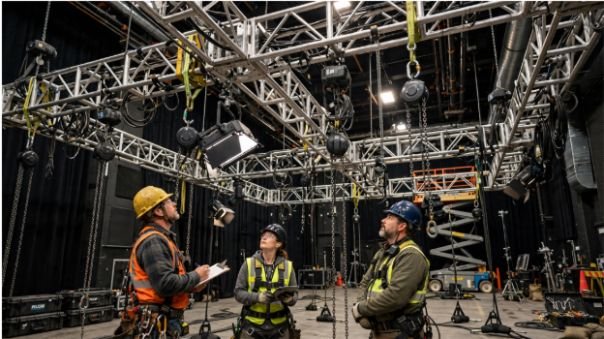
The same principle belongs within film set hoisting safety procedures. OSHA requires covered suspended loads to resist unintentional displacement and places restrictions on worker exposure within fall zones.
| Reference | Practical Takeaway |
| OSHA rigging requirements | Inspect gear and verify readable load identification |
| OSHA suspended-load rules | Control loads and limit fall-zone exposure |
| OSHA sling requirements | Avoid shock loading |
| Manufacturer documentation | Follow fixture-specific attachment instructions |
| ESTA standards | Apply structured entertainment-rigging inspection practices |
ESTA maintains standards addressing overhead entertainment rigging systems used with scenery, luminaires, and similar loads. Its inspection guidance specifically includes video and film studios.
How to Choose a Proper Safety Cable
Check Rated Capacity and Identification
For secondary safety cables for overhead film equipment, I begin with the fixture manufacturer’s documentation.
The instructions may specify the required cable, load rating, connector, or approved safety attachment point.
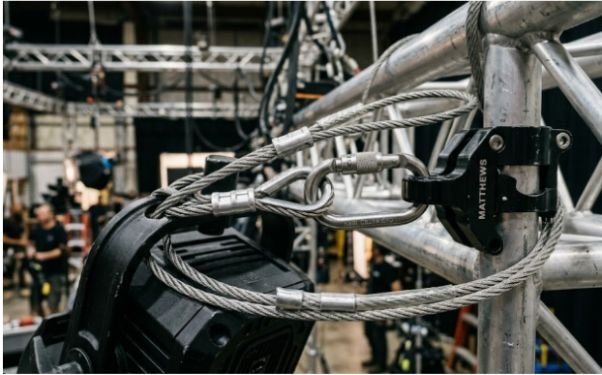
I avoid decorative wire rope, improvised loops, unmarked carabiners, and hardware without traceable ratings. OSHA requires applicable material-handling rigging equipment to carry identification showing its recommended safe working load.
A large breaking-strength figure alone does not prove suitability. The complete assembly matters. That includes the wire rope, terminations, ferrules, hooks, links, and intended application.
Control Shock Loading and Drop Distance
Static fixture weight is only part of the load problem.
If excessive cable slack lets a light fall several inches, it gains speed before the secondary system arrests it. The resulting force may be much greater than the fixture’s stationary weight.
OSHA’s sling requirements prohibit shock loading. The practical lesson for overhead film equipment is simple: avoid creating unnecessary fall distance.
I therefore keep the cable as short as its approved routing allows. It must permit any intended fixture movement without leaving excessive slack.
How I Rig Secondary Safety Cables Correctly
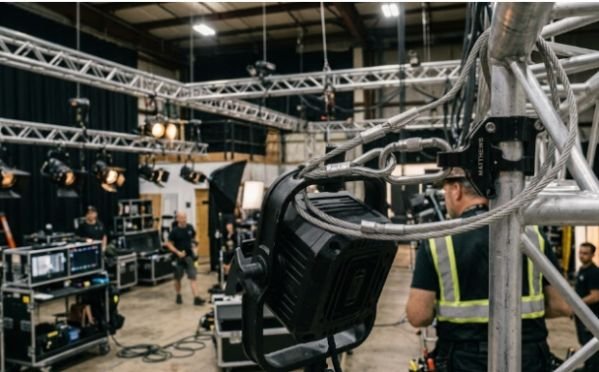
Attach to the Approved Fixture Point
I use a dedicated safety eye whenever the manufacturer provides one. If the instructions specify the yoke or another structural part, I follow that method.
I do not attach only to barn doors, accessory frames, power cords, removable handles, or similar detachable parts.
With secondary safety cables for overhead film equipment, the backup must stay connected to the main fixture after the failure it is intended to address.
Connect to Independent Structural Support
The opposite end should connect to a suitable pipe, truss, grid, beam, or approved rigging point.
I avoid making the primary and secondary connections depend on the same detachable component. Otherwise, one failure could defeat both systems.
Junior-pin installations deserve particular attention. If a pin can leave its receiver, the secondary arrangement should still capture the fixture through its manufacturer-approved attachment point.
This principle also strengthens safe lifting practices for film production crews. Load safety depends on attachment integrity, control, and worker positioning rather than lifting technique alone.
Lock the Connector and Check the Route
I confirm that snap hooks fully engage and screw links close as designed.
Then I follow the entire cable path. I look for crushed wire rope, sharp bends, interference, damaged terminations, or connectors being loaded incorrectly.
A properly rated cable can still be poorly installed. I inspect the complete retention path rather than stopping at its load-rating label.
The Two-Path Failure Test I Use Before Going Overhead
My most useful check for secondary safety cables for overhead film equipment is surprisingly simple: I mentally remove the primary support.
If the clamp disappeared, would the fixture remain captured?
If the junior pin pulled completely from its receiver, would the secondary connection remain attached to both fixture and structure?
If a removable accessory separated, would the main fixture remain restrained?
I call this the Two-Path Failure Test.
It catches a common problem: two apparent connections that actually depend on one vulnerable component.
Consider a fixture installed through a junior receiver. A secondary attached only to hardware that could leave with the pin may provide little useful redundancy.
A better arrangement uses the manufacturer’s approved fixture safety point and reaches suitable independent structural support.
Asking “what happens when the primary disappears?” tells me far more than simply checking whether a safety cable is present.
Inspection, Retirement, and Documentation
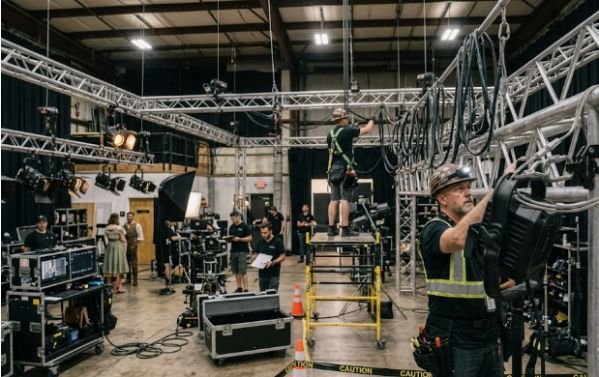
I inspect secondary safety cables for overhead film equipment before use.
I check the entire wire rope, loops, ferrules, thimbles, hooks, links, closures, and identification markings.
OSHA requires applicable rigging gear to be inspected before use during each shift and as necessary while being used. Defective equipment must be removed from service.
If a cable catches a falling fixture, I immediately remove it from normal service. I then follow the manufacturer’s retirement requirements or arrange the appropriate qualified inspection.
I would never return an arrested cable to overhead service merely because it looks undamaged.
On larger productions, simple documentation also helps. Recording cable identification, inspection dates, assigned fixtures, and retirement status prevents questionable gear from quietly returning to the rig.
Common Film-Set Safety Cable Mistakes
The errors I watch for most are surprisingly basic.
Excessive slack increases possible drop distance. Unrated connectors create uncertainty. Removable accessories make poor attachment points. A secondary path sharing the primary failure point defeats genuine redundancy.
Another mistake is treating fixture retention cable as lifting gear.
For example, ETC describes its fixture cable as a safety device with a specified safe working load. That does not mean every safety cable is designed or approved for hoisting equipment.
I also avoid assuming that “installed” means “verified.”
Before an overhead area becomes active, the setup should be checked according to Suspended Load Safety Rules for Film Sets, including fixture attachment, cable condition, connector closure, routing, clearance, and exposure beneath the suspended equipment.
No Drama Overhead: Make Redundancy Boring
I want overhead film rigging to be boring.
No mystery hardware. No questionable attachment points. No excessive cable loops. No secondary connection attached to the same component most likely to fail.
Used properly, secondary safety cables for overhead film equipment create another retention path if the primary mounting system fails. They work best alongside rated hardware, manufacturer instructions, inspection, limited drop distance, and controlled fall zones.
My final check takes only seconds: erase the primary mount in your mind.
If the fixture remains safely captured, you have meaningful redundancy. If it does not, correct the secondary path before anyone works underneath it.
Frequently Asked Questions
1. Are secondary safety cables for overhead film equipment legally required?
There is no single blanket federal OSHA rule stating that every film fixture must use one; applicable OSHA requirements, manufacturer instructions, venue rules, and production safety requirements must all be followed.
2. What size safety cable should I use for an overhead film light?
Use the manufacturer’s specified cable or a suitably rated retention assembly approved for that fixture and installation.
3. How much slack should a secondary safety cable have?
Use only enough slack for approved routing and normal fixture movement while keeping potential drop distance as short as practical.
4. Should I reuse a safety cable after it catches a falling light?
Remove it from service and follow the manufacturer’s inspection or retirement requirements before considering any reuse.