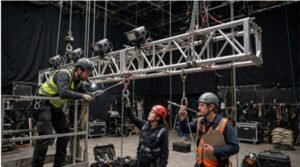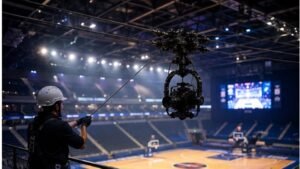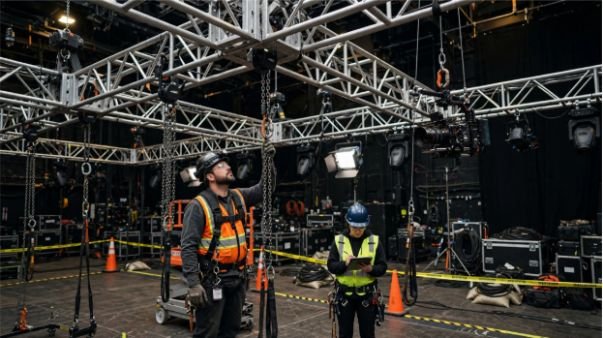




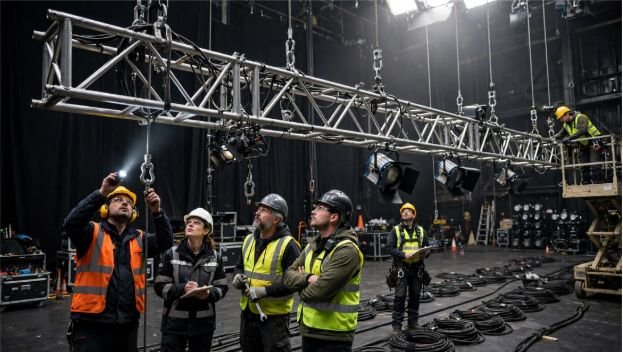
Overhead equipment can turn a controlled film set into a falling-object hazard in seconds. For me, overhead equipment safety for film production starts before a light, camera, speaker, or truss leaves the ground. I want every load rated, every secondary restraint independent, and every person outside the potential fall zone unless needed for the task.
The safest approach is not “add a cable and move on.” It is a layered system that prevents failure, catches failure, and limits exposure.
Why Overhead Rigging Needs More Than a Visual Check
Film crews work under time pressure, which makes shortcuts around clamps, shackles, safeties, and load records dangerous. That is why overhead equipment safety for film production needs a system, not a last-minute glance.
I use a three-layer test for overhead equipment safety for film production:
- Prevent the primary attachment from failing.
- Provide a properly rated secondary restraint where required.
- Keep people away from the possible consequence.
ESTA standards cover entertainment rigging areas such as powered hoists, statically suspended systems, aluminum truss, inspection, and maintenance.
Rated Hardware and Working Load Limits
A clamp that “looks strong enough” is not a rigging plan. For reliable overhead equipment safety for film production, I verify the intended use and rated capacity of every load-bearing part.
The load path includes more than fixture weight. A hypothetical 45-pound light with an 8-pound modifier and 5 pounds of attached hardware places at least 58 pounds into the assembly.
That figure alone does not determine clamp selection. Angle, movement, load distribution, structure capacity, and manufacturer limits still matter.
| Check | Verify | Red flag |
| Primary attachment | Correct rated hardware | Missing rating |
| Supporting structure | Approved load path and capacity | Unverified pipe or truss |
| Fasteners | Correct and secured | Loose or improvised parts |
| Accessories | Retained against detachment | Untethered accessories |
ANSI E1.2 addresses aluminum trusses and towers, while the E1.6 family covers powered entertainment rigging and electric chain hoists.
Secondary Safeties for Suspended Lights
When I consider to secure suspended equipment on a film set, I separate the primary mount from the backup. A secondary safety should not depend on the same weak point that could fail first.
Professional fixture makers provide dedicated safety attachment points on many products. CHAUVET Professional describes its SC-08 as a secondary safety cable and publishes a 165-pound safe working load for that specific product. That rating must not be assumed for other cables.
Keep unnecessary slack out of the secondary system. However, I would not treat a universal “20 cm maximum drop” as a US film-set rule.
Follow the product manual, venue requirements, engineered system, and applicable regulations.
Inspections and Documentation
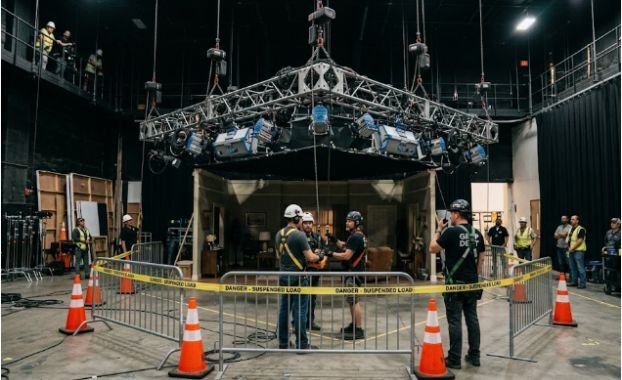
Consistent overhead equipment safety for film production depends on repeatable inspection, not memory.
Before use, I check clamps, wire rope, slings, shackles, pins, safety cables, hoists, truss connections, and attachment points. I look for deformation, corrosion, broken strands, cracking, missing retainers, or damaged threads.
CHAUVET also recommends visual safety-cable inspection before each use and removal of compromised cables.
A simple log should record equipment ID, date, condition, inspector, and anything removed from service. That traceability strengthens overhead equipment safety for film production as gear moves between locations.
Drop Zones and Suspended Load Control
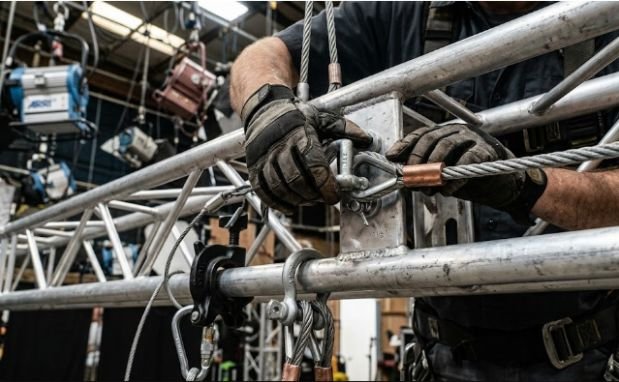
A strong rig is not permission to stand beneath it.
I treat suspended load safety rules for film sets as exposure control. During lifting, adjustment, or landing, unrelated people should stay outside the controlled zone.
OSHA’s construction crane rule requires hoisting routes that minimize worker exposure and restricts fall-zone access. Those provisions apply when that construction standard governs the work, so productions must confirm the federal, state-plan, venue, and contractual requirements covering their operation.
For practical overhead equipment safety for film production, mark the zone, assign control responsibility, announce movement, and stop unrelated traffic until the load is stable.
PPE and Fall Protection for Rigging Crews
PPE is the last barrier, not the first. I never use PPE to justify weak overhead equipment safety for film production controls higher in the hierarchy.
Where workers face potential head injury from falling or flying objects, OSHA requires suitable head protection. Protective footwear is also required where falling, rolling, piercing, or certain electrical hazards threaten the feet.
Height rules need context. OSHA generally identifies fall-protection thresholds of four feet in general industry and six feet in construction. Its entertainment-industry interpretation also confirms that entertainment workers must be protected from recognized fall hazards.
That distinction matters on productions because not every stage or location task automatically falls under OSHA construction rules.
Electrical and Outdoor Rigging Hazards
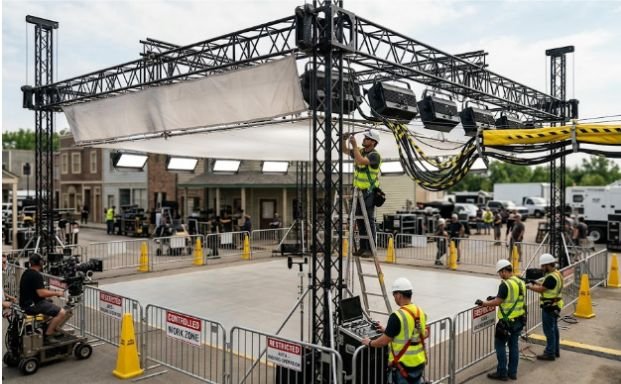
Electrical routing can undermine overhead equipment safety for film production even when the mechanical rig is sound.
I keep power and control cables away from pinch points, sharp edges, moving hoists, and crushing hazards. OSHA prohibits worn or frayed cords in construction and unsafe practices such as hanging extension cords from nails or wire.
Outdoor work adds wind, rain, uneven support, and overhead utility hazards.
Where covered cranes operate near energized lines, OSHA 1926.1408 includes specific clearance and planning requirements. Determine which rule actually applies before using any distance as a set-wide standard.
My Seven-Point Pre-Lift Check
A useful rigging risk assessment for film production happens before the lift.
| Stage | Question |
| Load | What is the complete suspended weight and configuration? |
| Hardware | Is every load-bearing component suitable and rated? |
| Backup | Is the required secondary restraint correctly attached? |
| Structure | Is the support capacity verified? |
| People | Can the fall zone stay clear? |
| Environment | Could wind, power, water, or movement alter risk? |
| Record | Who inspected the rig and documented it? |
I call this the “load-to-people” test. It makes overhead equipment safety for film production follow the whole failure path instead of focusing only on the clamp.
The value of this approach is simple. A rig can have an excellent clamp and still be unsafe because of a weak structure, unsecured accessory, damaged safety cable, uncontrolled drop zone, or changing outdoor conditions.
Frequently Asked Questions
1. What is the safest way to rig overhead film lights?
Use manufacturer-approved mounting points, rated hardware, required secondary safeties, verified structures, inspections, and controlled fall zones.
2. Are safety cables required for overhead film lighting?
Many professional fixture manufacturers require them for overhead mounting; follow the product manual, venue rules, engineered-system requirements, and applicable regulations.
3. How often should film rigging equipment be inspected?
Inspect before use and follow manufacturer, employer, venue, ANSI/ESTA, and regulatory intervals for periodic inspections.
4. Can crew members work under suspended equipment?
Good overhead equipment safety for film production avoids unnecessary exposure; where OSHA crane rules apply, only specified essential workers may enter defined fall zones during certain operations.
The Shot Is Never Worth the Drop
My standard for overhead equipment safety for film production is simple: no shot or schedule earns the right to bypass a rated load path or controlled work zone.
Before the next rig goes up, trace it from structure to fixture and then to the people below. Verify ratings, inspect components, secure accessories, install required secondary protection, and clear the exposure zone.
That final check takes overhead safety beyond compliance paperwork. It makes the crew think about what happens if the first control fails.
If one link in that chain is uncertain, the rig is not ready to fly.