




Standard HDMI and SDI cables hit a literal wall at roughly 300 feet. Push a uncompressed 4K or 8K cinema feed any farther over traditional copper, and signal degradation, frame drops, and severe latency take over.
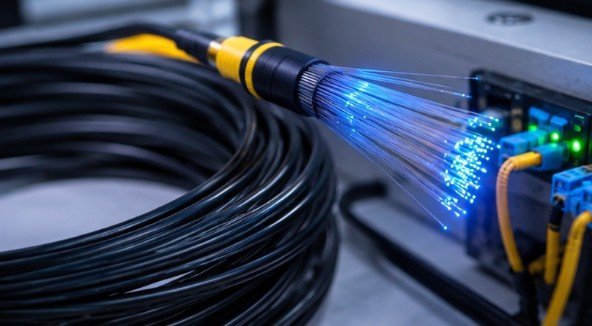
When long-range video transmission demands pristine quality, upgrading to an optical fiber cable for camera transmission is no longer just an alternative—it is mandatory. Optical fiber converts delicate electrical camera signals into light pulses, effortlessly streaming gigabytes of uncompressed visual data over miles without signal loss.
For live sports broadcasts, sprawling event coverage, and intricate cinema setups like a remote cable cam rig, glass strands are quietly replacing copper as the gold standard for high-bandwidth production.
The Physics of Video Signals: Why Copper Fails Where Glass Excels
Copper wire relies on electrical current to move video data. As cable length increases, copper acts as a resistor, weakening the voltage and rounding off the sharp digital square waves needed to decode high-definition video.
Worse yet, long copper runs act like massive antennas. They attract Electromagnetic Interference (EMI) and Radio Frequency Interference (RFI) from stadium lighting, power generators, and radio comms.
Optical fiber transmits data as photons moving through ultra-pure silica glass. Because light operates on an entirely different electromagnetic spectrum, fiber is 100% immune to electrical interference and ground loops.
| Feature | Copper Cables (HDMI / SDI) | Optical Fiber Cables |
| Max Distance (Uncompressed 4K) | ~30–300 feet | Up to 6 miles (30,000+ feet) |
| Interference Immunity | Vulnerable to EMI, RFI, Ground Loops | Fully Immune |
| Cable Weight & Bulk | Heavy, thick, cumbersome | Lightweight, ultra-thin |
| Bandwidth Ceiling | Bottlenecked at higher refresh rates | Practically unlimited headroom |
Editor’s Note: A grouped bar chart comparing signal loss (dB per 100m) between RG6 SDI coax and single-mode optical fiber would visually reinforce this performance gap.
Architectural Breakdown: Single-Mode, Multi-Mode, and SMPTE Hybrid Lines
Navigating optical fiber for video transmission requires matching your production distance with the correct glass profile and cable design.
[ Camera Output ]
│
(HDMI / SDI / Ethernet)
│
▼
[ Transceiver / SFP ]
(Converts Electricity ➔ Light)
│
┌────────────┴────────────┐
│ Choose Fiber Backbone │
└────────────┬────────────┘
│
┌─────────────┼─────────────┐
│ │ │
▼ ▼ ▼
Single-Mode Multi-Mode SMPTE Hybrid
(Long-run) (Studio/Short) (Data + Power)
│ │ │
└─────────────┬─────────────┘
│
▼
[ Receiving End SFP ]
(Converts Light ➔ Electricity)
│
▼
[ Switch / Monitor / NVR ]
Single-Mode Fiber (SMF)
Single-mode fiber features a tiny core (typically 9 microns in diameter) that allows light to travel in a single, straight path. This minimizes modal dispersion, allowing uncompressed video signals to travel miles without losing clarity. It is the premier choice for broad venue setups, cross-campus video links, and remote broadcast trucks.
Multi-Mode Fiber (MMF)
Multi-mode fiber utilizes a larger core (50 to 62.5 microns), allowing multiple light rays to bounce down the core simultaneously. While OM3 and OM4 multi-mode cables offer exceptional bandwidth, modal dispersion limits their effective range to a few hundred meters. MMF is ideal for compact indoor studios, temporary event stages, or localized control rooms.
SMPTE Hybrid Cables
In professional broadcast, running separate cables to power a camera defeats the purpose of long-distance optics. SMPTE 311M hybrid cables solve this by combining two single-mode optical fibers for bi-directional data/video alongside copper conductors that deliver high-voltage AC power directly to the camera rig.
Interfacing Hardware: Converters, SFPs, and Connectors
Connecting a camera to a fiber optic network requires dedicated conversion hardware to bridge the gap between electrical output and optical transmission.
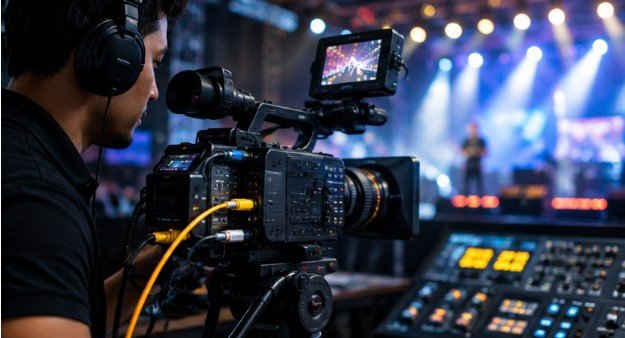
- Media Converters: Standalone hardware units that take an SDI, HDMI, or RJ45 Ethernet feed from a camera and convert it directly into an optical light stream.
- SFP Transceiver Modules: Small Form-factor Pluggable (SFP/SFP+) modules slide directly into network switches and optical camera backs. They allow crew members to swap wavelengths and connector types instantly depending on the distance required.
- Tactical Optical Connectors: While standard LC and SC connectors work well in static patch panels, harsh field conditions call for ruggedized connectors like Neutrik opticalCON or ST connectors designed to resist dirt, dust, and physical tension.
For specialized dynamic shots where weight and power delivery are critical, understanding how to power remote cable cam systems alongside optical transceivers ensures your rig stays light enough to move quickly while retaining infinite signal reach.
Real-World Production Impact: Live Events and Dynamic Rigs
The true value of an optical fiber camera setup becomes clear during complex real-world shoots.
When capturing sports, festivals, or multi-stage events, running hundreds of feet of heavy coaxial cable creates massive logistical hurdles. Fiber optic cables reduce cable weight by over 80%, drastically cutting down load-in times and strain on support equipment.
Furthermore, dynamic camera movement systems benefit significantly from fiber’s low weight. When evaluating when to use a cable cam over a drone, weight distribution is everything. Replacing bulky copper video lines with thin, flexible optical fiber allows aerial cable cams to move faster, draw less battery power, and carry heavier cinema camera payloads safely over crowds.
Field Inspection Checklist: Pre-Flight Optical Readiness
Unlike forgiving copper cables, a single microscopic specks of dust on a fiber core can completely block light transmission. Follow this field readiness routine before rolling camera:
- Inspect Ferrule Ends: Use a fiber inspection scope to check for dirt, oil, or physical scratches on the connector tip.
- Clean Before Every Mating: Use an optical cleaning pen or lint-free isopropyl wipe; never blow on a connector with your mouth.
- Verify Optical Power Levels: Use a handheld Optical Power Meter (OPM) to verify light output matches your transceiver specs (typically -3 dBm to -10 dBm).
- Enforce Minimum Bend Radius: Never kink fiber optic cable. Maintain a loop diameter of at least 20 times the cable’s outer thickness to prevent light leakage.
- Cap Unused Ports: Keep dust caps securely installed on all transceivers and cable connectors until the exact moment of connection.
Critical Limitations: When Fiber Is Not the Right Choice
Despite its overwhelming advantages, optical fiber is not a universal solution for every shooting scenario.
- Extreme Fragility: Glass fibers cannot survive sharp 90-degree bends, heavy foot traffic, or being pinched in metal doors unless wrapped in expensive armor.
- No Native Power (Non-Hybrid): Pure glass cables cannot transfer power. Unless you invest in heavy, high-cost SMPTE hybrid lines, your camera must rely on local batteries or onboard power solutions.
- Field Repair Complexity: Splicing a broken fiber optic cable requires specialized fusion splicers costing thousands of dollars. You cannot simply twist and solder a broken fiber line back together on set.
Frequently Asked Questions
1. Can optical fiber carry power to my camera?
Pure optical fiber carries light only and cannot transmit electrical power. To deliver power over the same cable run, you must use specialized SMPTE hybrid cables that house both copper power leads and glass fiber strands within a single jacket.
2. How far can an optical fiber cable run a 4K camera feed?
Single-mode fiber can seamlessly transport uncompressed 4K video up to 6 miles (10 kilometers) without signal degradation. Multi-mode fiber can carry 4K video up to roughly 1,000 feet (300 meters) depending on the transceiver classification.
3. What happens if you bend a fiber optic camera cable too sharply?
Bending a fiber cable past its minimum bend radius causes light to leak out of the glass core, leading to severe packet loss, dropped video frames, or a complete signal blackout. Extreme bends will permanently fracture the internal glass strand.
Final Thoughts
The shift toward 4K60, 8K, and high-frame-rate cinema feeds has pushed copper wiring past its physical limits. Adopting optical fiber cables for camera transmission guarantees zero latency, complete immunity to signal interference, and limitless bandwidth. By understanding the hardware ecosystem and keeping your connectors immaculately clean, glass lines will keep your video feeds crystal clear no matter how far away the action takes place.