



A stadium camera can move much faster than it looks on television. Beckhoff documented Spidercam speeds of up to 9 meters per second, about 20 mph, on one generation of the system. Yet the camera is not flying under its own power; coordinated winches and cables pull it through space. That is the key to understanding how spidercam works in stadium sports.
For U.S. viewers, one distinction matters: Spidercam is a specific cable-suspended camera system, while SkyCam is another well-known system commonly seen in NFL and college football coverage. Both belong to the same broad category of cable-driven aerial cameras.
The Four-Winch System Behind the “Flying” Camera
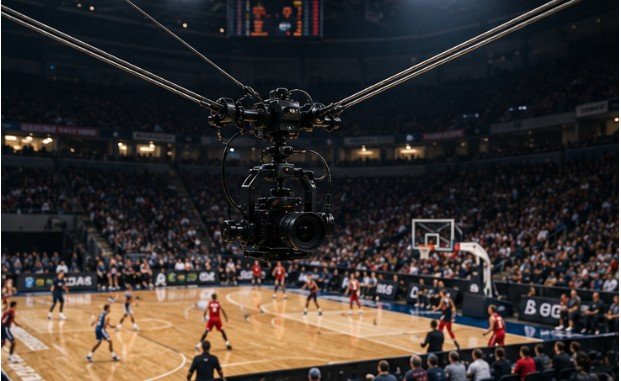
Spidercam uses four fixed rigging areas around a venue and motorized winches controlling the suspension cables. By shortening some cables while letting out others, the system moves the camera dolly along the field’s length, width, and height.
The critical part is synchronization. The winches do not behave like separate motors. A central motion-control system translates the pilot’s command into coordinated cable-length changes so the dolly follows a controlled path. Beckhoff describes a computer-based system using servo drives and networked control, while Ross Video describes Spidercam as a cable-driven robotic camera system built for stadiums and live productions.
What Happens After the Pilot Moves the Joystick
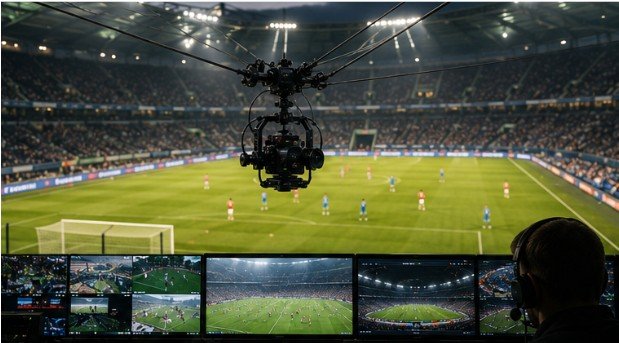
The pilot controls where the dolly moves, while the camera operator handles framing, pan, tilt, zoom, focus, and other lens functions.
Beckhoff has described a three-person operating setup: a pilot, a camera operator, and a technician monitoring system parameters.
The process is straightforward:
- The pilot commands a direction and speed.
- Control software converts that request into cable-length changes.
- The winches wind or unwind together.
- Position data is monitored.
- The stabilized camera head keeps the image usable during motion.
- Video and control signals return to the production system.
This is part of the broader workflow behind cable camera systems in live sports broadcasting, where movement, lens control, transmission, safety, and directing all have to work together.
Why the Picture Stays Smooth
A suspended camera naturally swings and vibrates, so stabilization is essential.
Ross Video says current Spidercam systems combine stabilized dollies with modern gimbals, helping isolate pan, tilt, and roll from unwanted carrier movement. Ross also says camera, lens, microphone, tally, and other signals can travel through fiber-optic connections, including 4K UHD video. Beckhoff has documented specialized Spidercam cables with fiber integrated for image transmission.
| System element | Main job |
| Motorized winches | Change cable lengths |
| Suspension cables | Position the dolly |
| Motion-control software | Coordinate 3D movement |
| Stabilized gimbal | Smooth the image |
| Fiber connection | Carry video and control |
| Operators | Separate flying from framing |
Why Broadcasters Use Cable Cameras Instead of Drones
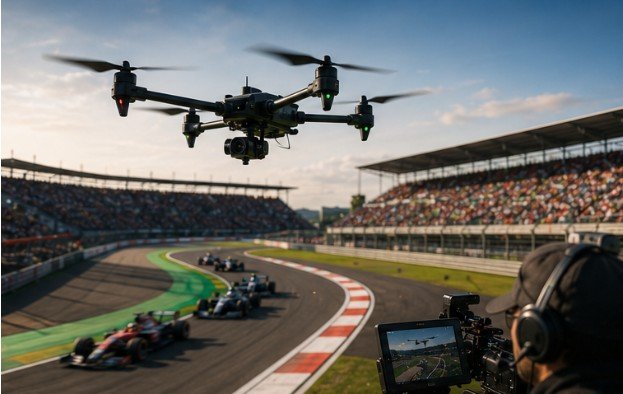
A drone may seem simpler, but live sports has different priorities from a one-off cinematic shoot.
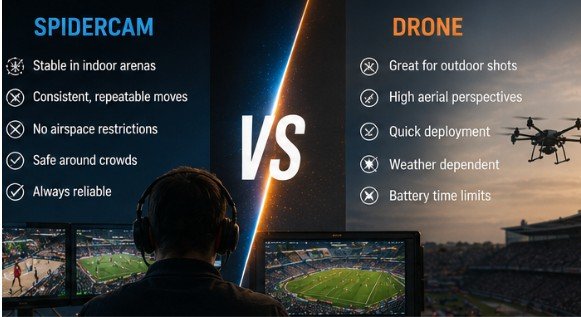
Ross notes that drones work well across large outdoor areas and are quick to deploy, while cable systems depend on fixed suspension points and available cable length. Cable systems, however, operate inside a defined flight volume and integrate closely with professional broadcast workflows.
That matters in crowded U.S. stadiums, where an aerial camera may operate above players, officials, crews, and spectators. For the creative trade-offs, see cable camera vs drone for cinematic shots.
Safety Is Part of the Camera Move
Understanding how spidercam works in stadium sports also means understanding what operators cannot do. They cannot simply chase the ball at maximum speed. The camera and cables occupy the same airspace through which punts, passes, kickoffs, and high-arcing shots may travel.
Operators work within movement limits, monitor position, and coordinate with production staff. Procedures vary by sport, venue, equipment, and governing rules.
U.S. football shows why that matters. In October 2025, a SkyCam interfered with a pass during an NFL game, drawing attention to the league’s treatment of overhead-camera interference. Current officiating analysis of the rule states that when a live loose ball strikes a SkyCam or similar object, the ball is dead and the down is replayed from the previous spot. The 2026 NFL rulebook places dead-ball provisions under Rule 7.
A useful sports broadcast production case study should therefore evaluate safety and positioning decisions, not just dramatic footage.
A Five-Point Test for Watching Spidercam Like an Operator
Use five cues to judge a flying stadium-camera shot:
1. Height
Low moves feel immersive but reduce clearance above athletes and the ball.
2. Acceleration
Smooth starts and stops suggest careful piloting and coordinated winch control.
3. Horizon
If the carrier moves aggressively while the frame remains level, stabilization is doing its job.
4. Route
A good shot follows the play without creating unnecessary interference risk.
5. Information
The best shot reveals spacing, formations, movement, or scale a sideline camera cannot show.
ESPN has offered dedicated SkyCam feeds for college football, showing the value of an elevated behind-the-play perspective for following formations and developing action.
Frequently Asked Questions
1. How does the Spidercam work?
Spidercam uses coordinated motorized winches and suspension cables to move a stabilized camera through 3D space. Software manages cable movement while separate operators control the flight path and camera framing.
2. How do stadium flying cameras work?
Cable-suspended stadium cameras change the length of multiple support cables with computer-controlled winches. A stabilized camera head records the action while broadcast connections carry video and control signals.
3. What is a Spidercam in football?
Spidercam is a cable-suspended robotic camera system that creates moving aerial views over a field. In U.S. football, viewers more often see a comparable system under the SkyCam name.
4. What happens if a ball hits a Spidercam?
Rules vary by sport. In the NFL, comparable SkyCam interference with a live loose ball can make the ball dead and require the down to be replayed.
The best way to understand how spidercam works in stadium sports is to see it as more than a camera hanging from wires. It is a motion-control system, stabilized robotic head, broadcast link, and trained crew working together in real time. The dramatic aerial shot is only the visible result.