




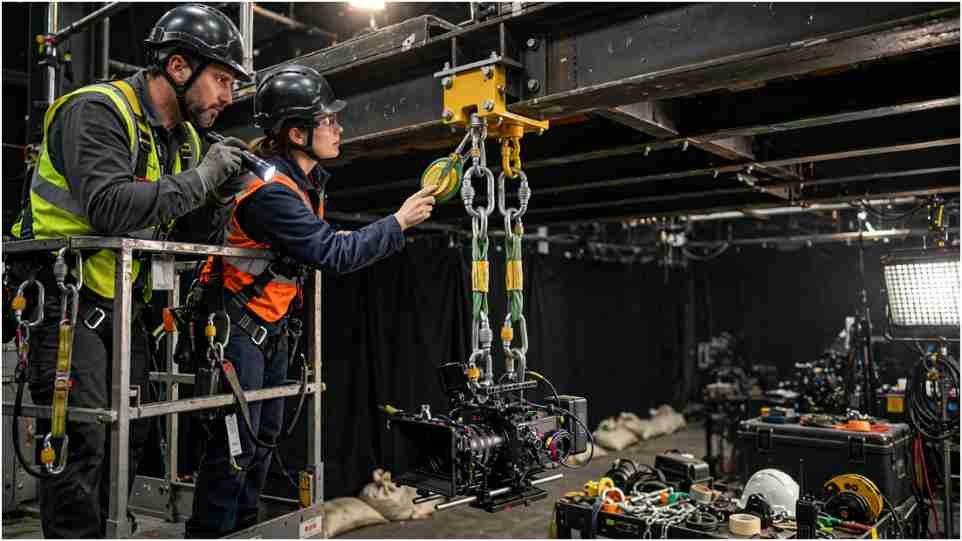
A camera can be replaced. A failed overhead point can change a production in seconds. When I assess safe rigging anchor points for film production, I use one rule: if the structure, rating, load direction, or connection is unverified, I do not treat the point as usable.
Film rigs combine expensive equipment, moving loads, tight schedules, and people working below. The anchor is not simply somewhere to clip a sling. It is the first structural link in the whole load path.
Start With the Structure, Not the Hardware
The strongest shackle cannot rescue a weak beam, unknown insert, decorative rail, or unverified ceiling member. Safe rigging anchor points for film production begin with a structure whose capacity and allowable loading direction are known.
Structural steel, engineered studio grids, and properly designed concrete connections may be suitable. That does not make every beam or slab an approved point. Connection strength and the surrounding structure still matter.
ANSI E1.56-2026 covers permanent stationary entertainment rigging support points attached to permanent facility structures. ESTA describes the current standard as establishing minimum requirements for design, fabrication, installation, inspection, and documentation. Its published scope is permanent points, so temporary production rigs should not simply be assumed to fall under the same requirements.
Ask More Than “Can It Hold the Weight?”
My next question is, “Can the complete structure carry this force in this direction?”
A point intended for vertical loading may react very differently to side loading. I therefore follow the force from the suspended camera or fixture through every connector and into the supporting structure.
Film Rigging Load Ratings: WLL Is the Starting Line
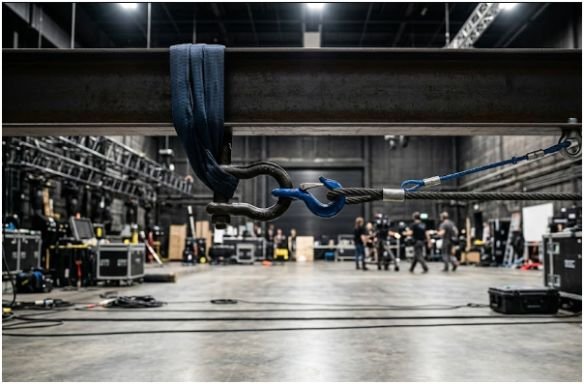
Working Load Limit, or WLL, tells me how much a component is rated to carry under specified conditions. Safe rigging anchor points for film production must be paired with correctly rated components used within their intended configurations.
Under OSHA’s general-industry sling rules, slings must not exceed their rated capacities. OSHA also requires appropriate identification markings and prohibits using damaged or defective slings.
I avoid treating a blanket safety-factor number as universal. Required design factors depend on the material, hardware, load case, system, and governing standard.
Movement changes the problem too. Acceleration, stopping, swinging, and shock can create forces beyond static equipment weight. For moving systems, safe rigging anchor points for film production need the expected dynamic loading considered rather than relying on scale weight alone.
For the arithmetic behind that decision, see how to calculate safe working load for film rigging before selecting the final components.
| Check | What I verify |
| Total load | Camera, head, cables, fixtures, accessories |
| WLL | Every component in the load path |
| Direction | Vertical, lateral, angled, or multi-axis |
| Dynamics | Starts, stops, travel, swing, shock |
| Weakest link | Lowest valid rating in the system |
Multi-Point Rigging Anchors Can Increase Force
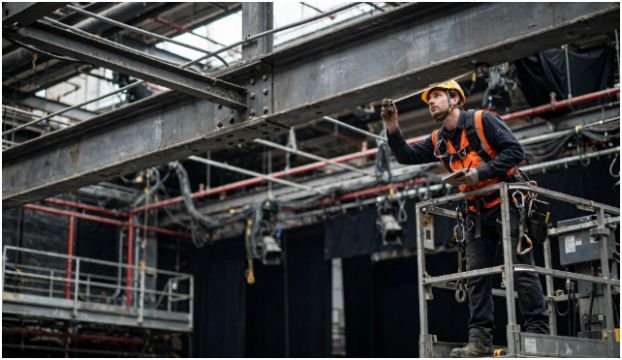
Two anchors do not automatically split a load 50/50. Bridle angle changes tension, which means safe rigging anchor points for film production must be assessed as one system.
Take an ideal symmetrical two-leg bridle carrying a 1,000-pound static load:
| Included angle | Approx. tension per leg |
| 0° | 500 lb |
| 60° | 577 lb |
| 90° | 707 lb |
| 120° | 1,000 lb |
| 150° | 1,932 lb |
At a 120-degree included angle, each leg carries roughly the entire suspended load. At 150 degrees, each leg approaches twice that load.
That is the counterintuitive part. Adding anchor points does not guarantee more capacity.
This is a simplified physics example, not a rigging plan. Actual loads can become unequal because of geometry, center of gravity, movement, stretch, and imperfect load sharing.
Overhead Rigging Safety Needs Real Redundancy
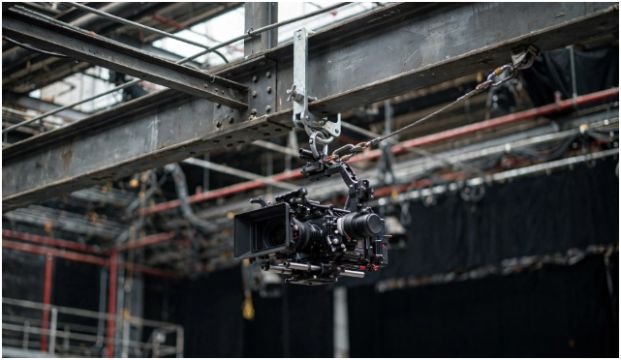
A backup should protect against an identified failure. It should not be extra hardware added because the primary system feels questionable.
For suspended equipment, secondary retention should follow the fixture manufacturer’s instructions, venue requirements, and approved production design. Both primary and secondary systems need legitimate load paths.
Worker fall protection is different.
OSHA requires personal fall-protection anchorages to be independent of anchorages used to suspend employees or their work platforms. An anchorage must support at least 5,000 pounds, or 22.2 kN, for each attached employee unless a qualified person designs, installs, and supervises a complete system maintaining at least a two-times safety factor.
That distinction matters when evaluating safe rigging anchor points for film production. I would never copy an equipment-suspension rating into a worker fall-protection calculation.
Rigging Hardware and Connections: Rated Beats Familiar
Safe rigging anchor points for film production are only as dependable as the hardware between the structure and load.
I look for traceable manufacturer information, a readable WLL or rated capacity, compatible connection geometry, and the correct loading orientation. A component that “looks strong” tells me almost nothing useful.
For personal fall protection for film production crews, OSHA requires D-rings, snaphooks, and carabiners to withstand a minimum 5,000-pound tensile load. Snaphooks and carabiners must also use an automatic-locking design requiring two separate consecutive movements to open.
For slings, loading conditions matter just as much as the tag. OSHA requires slings to be protected from sharp load edges and prohibits shock loading under its general-industry sling requirements.
The practical lesson is simple: never solve a connection problem with improvised hardware.
The Pre-Shift Anchor Check
Safe rigging anchor points for film production are not “approved once, safe forever.”
Gear gets dropped. Slings abrade. Connections move. Sets change. A component that passed yesterday’s inspection may not be acceptable today.
Before use, I want the point identification, WLL, sling condition, connector condition, loading direction, and any secondary retention checked. The space below the suspended load also needs control before lifting or movement begins.
OSHA requires slings and their attachments to be inspected for defects before daily use by a competent person. Defective equipment must be removed from service. Personal fall-protection systems require inspection during each workshift, while impact-loaded components must remain out of service until they are inspected and determined safe.
A red tag only works if damaged gear actually stays quarantined.
Who Should Approve the Anchor?
Depending on the system, safe rigging anchor points for film production may require review by a qualified entertainment rigger, competent person, structural engineer, or another appropriately qualified specialist.
I draw a firm line around structural uncertainty.
If nobody can establish what a beam can carry, what lies behind the ceiling, how an embedded point was installed, or how the force transfers through the building, I consider that point unavailable.
A larger shackle does not make an unknown structure stronger.
FAQs
1. What structures are safest for film rigging anchor points?
Engineered and documented structural members are the right starting point, but capacity, connection method, and permitted loading direction still require verification.
2. Can two anchor points double the rigging capacity?
No. Bridle angles and unequal load sharing can substantially increase individual anchor forces, so multi-point systems require calculation.
3. What OSHA rating applies to a fall-protection anchor?
OSHA generally requires 5,000 pounds per attached employee or a qualified-person-designed system maintaining at least a two-times safety factor.
4. How often should safe rigging anchor points for film production be inspected?
Inspect applicable hardware before use as required, then follow manufacturer instructions, engineering requirements, venue procedures, and applicable standards.
If the Point Is a Guess, the Shot Can Wait
The best safe rigging anchor points for film production look boring on paper: documented structure, known ratings, controlled angles, compatible hardware, and disciplined daily film rigging inspections.
That is exactly what I want. A spectacular camera move should come from creative planning, not structural guesswork.
Verify the point. Calculate the complete load path. Inspect the hardware. Then put the rig in the air.