





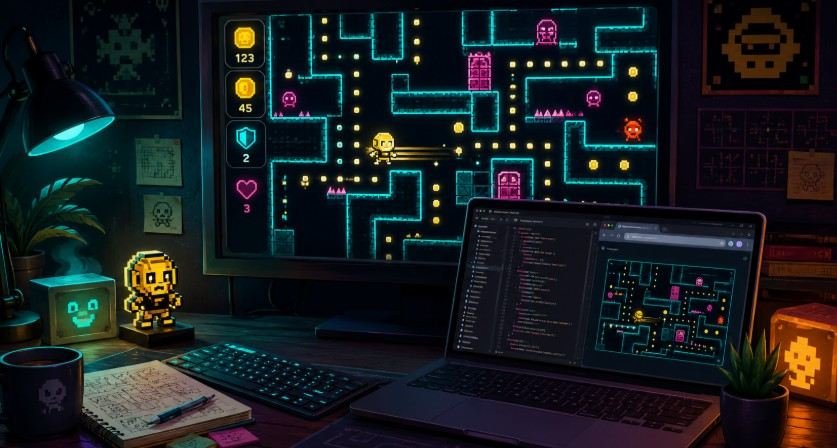
One search can lead to several completely different games. That is the most important thing to understand about tombofthemask github: there is no single, official open-source edition of Tomb of the Mask sitting in one definitive repository.
Instead, GitHub contains browser ports, programming-class projects, small recreations, engine experiments, and fan-made clones inspired by the fast-moving maze game. Some are useful if you simply want to play; others are far more interesting if you want to understand game loops, procedural maze generation, collision detection, or movement systems.
The original Tomb of the Mask was developed by Happymagenta and is currently distributed by Playgendary. The current App Store listing identifies Playgendary Limited as the developer account offering the commercial game. Community GitHub projects should therefore be viewed as separate implementations rather than official source releases.
Table of Contents
ToggleWhat Does Tombofthemask GitHub Actually Refer To?
The phrase usually describes a collection of independently maintained projects inspired by the same arcade concept.
One of the most visible is water-logger/totm, whose repository describes itself simply as “Tomb of the Mask on the web.” Its files include Unity loader components, WebAssembly resources, an HTML page, CSS, and packaged game data. The repository currently shows 32 forks, suggesting that other users have copied or experimented with the web build.
Other developers approached the idea very differently. nhoffmann created a Rust version using the Bevy engine, while a student project from kc12341 uses Python and includes maze-generation code based around Kruskal-style techniques. Separate Java and small clone projects also exist.
That variety is exactly why searching by repository name matters more than assuming every result contains the same game.
Which Tomb of the Mask Repositories Are Worth Exploring?
Here is a practical comparison of several public projects currently available.
| Project | Technology | Best Reason to Explore It |
| water-logger/totm | Unity web build/WebAssembly | Playing or studying how a Unity build is deployed on the web |
| nhoffmann/rusty-tomb-of-the-mask | Rust + Bevy | Learning engine-based movement and game-state development |
| kc12341/Tomb-of-the-Mask-Term-Project | Python | Studying maze generation, movement, enemies, and student game architecture |
| iliya-shenavar/Tomb-of-the-mask | Java | Reviewing a compact Java arcade implementation |
| Pixel-Man360/Tomb-of-The-Mask-Clone | Game project | Inspecting a small completed five-level recreation |
The five-level clone explicitly identifies itself as a completed small recreation, while the Rust repository documents planned mechanics such as four-direction movement, walls, exit tiles, spikes, coins, and additional levels.
The Python project is particularly useful for students because its repository includes source files, design material, a storyboard, and user-study notes rather than merely a compiled game. Its README describes moving with arrow keys, avoiding monsters and traps, and reaching an exit to advance.
What Can You Learn From the Gameplay Code?
Tomb of the Mask looks simple because the player generally chooses only a direction. Implementing that behavior cleanly is less simple.
Movement and collision create the real challenge
In a typical recreation, pressing a direction does not move the character one tiny step. The player continues traveling along an axis until a wall or another rule stops the movement.
That means the program must coordinate keyboard input, position updates, collision detection, walls, hazardous tiles, enemies, exits, and game state. The Rust project specifically describes directional movement continuing until an obstacle is reached.
For a learner, this makes the game a useful exercise in separating input from movement logic instead of attaching every behavior directly to a key press.
Maze generation can become a computer-science lesson
The Python term project goes further by including files associated with Kruskal’s algorithm and depth-first search. That turns an arcade clone into an approachable example of how graph algorithms can influence playable spaces.
Developers can also experiment with object-oriented classes for tiles, enemies, player states, scores, or hazards. Patterns such as factories, commands, or Model-View-Controller can be useful, but they should not automatically be attributed to every Tomb of the Mask repository without inspecting its actual source.
How Should You Check a Repository Before Running It?
A GitHub page being public does not automatically make every downloadable file safe. A five-minute review can eliminate many unnecessary risks.
- Read the README and determine whether the project provides source code, a compiled executable, a browser build, or all three. Check the repository history and whether the development instructions make sense.
- Look for a license. Public visibility and permission to copy, modify, or redistribute software are not the same thing.
- Prefer reviewing source and building it yourself when practical rather than immediately launching an unfamiliar EXE, JAR, script, or binary.
- Inspect dependencies and build files. OWASP recommends understanding software dependencies and verifying software provenance because compromised or vulnerable components can affect an otherwise legitimate project.
- Scan unfamiliar downloads and keep your operating system and security software updated. CISA guidance on safeguarding your data specifically warns that even apparently legitimate free software can carry hidden risks.
This matters for some Tomb of the Mask repositories because downloadable executables are present alongside source files. For example, the maxhu08 Java class project includes both an EXE and JAR in its repository.
Can You Play Tomb of the Mask Through GitHub Pages?
Sometimes, yes.
Web ports can package a playable build into HTML, JavaScript, WebAssembly, or Unity web assets and publish it through GitHub Pages. The water-logger project, for example, contains the files needed for a Unity-style browser deployment.
Browser access is convenient because you do not necessarily need to install a desktop program. It should not, however, be confused with the official commercial version or treated as automatically trustworthy simply because the host name contains github.io.
Controls may also differ between ports. A keyboard-based recreation might use arrow keys or WASD, while the original mobile experience is designed around touch interactions.
For developers building accessible browser versions, the W3C’s WCAG 2.2 guidance says functionality should be operable using a keyboard and should avoid trapping keyboard focus.
Is It Legal to Make a Tomb of the Mask Clone?
This question has more nuance than “GitHub allows it.” U.S. Copyright Office guidance for games explains that the idea of a game and its methods of play are not themselves protected by copyright, while expressive material such as artwork, text, software, and other original creative elements can receive protection.
That distinction matters. A developer can study a sliding-maze mechanic and create an original game around the concept, but directly copying protected graphics, audio, code, level artwork, or other expressive assets creates a different legal question.
Cornell LII explanation of derivative works also notes that copyright owners generally hold rights concerning derivative works based on copyrighted material. For U.S. developers planning to publish or monetize a remake, originality is safer than attempting to reproduce the commercial game as closely as possible.
How Could Developers Build a Better Version?
The most interesting tombofthemask github project would not be the clone that copies the most features. It would be the one that learns the mechanic and then adds something technically or creatively new.
A developer could introduce procedural levels with reproducible seeds, configurable difficulty, enemy pathfinding, replay recording, speed-running timers, accessibility settings, controller support, original visual themes, or a level editor.
The code should also be documented well enough that another developer can understand how movement, collision, rendering, and game state interact. A clear license, dependency list, build instructions, and source-first release are valuable additions that many small learning repositories overlook.
Frequently Asked Questions
1. Is tombofthemask github the official Tomb of the Mask?
No. The term generally refers to community ports and recreations hosted on GitHub. The commercial Tomb of the Mask is distributed separately by Playgendary.
2. Can I play a Tomb of the Mask GitHub project without downloading it?
Some projects provide browser-compatible builds through GitHub Pages. Others require you to clone, compile, or download files, so check each repository’s README before attempting to run it.
3. Which repository is best for learning programming?
The Python term project is useful for studying algorithms and maze logic, while the Rust/Bevy project is more relevant for developers interested in modern engine architecture and entity-based game development.
4. Are GitHub Tomb of the Mask clones safe?
Not automatically. Review source code, repository history, dependencies, build instructions, license information, and downloadable binaries before running unfamiliar software.
The Real Value Is Behind the Game Screen
The surprising part of tombofthemask github is not that someone made Tomb of the Mask playable in another environment. It is how differently programmers can interpret one deceptively simple movement mechanic.
A web port teaches deployment. A Python version can turn maze generation into an algorithms lesson. A Rust recreation exposes game-engine architecture, while Java projects show how the same ideas translate into another programming model.
Play a browser build if entertainment is your goal. If you want to learn, open the source first. The most valuable part of these repositories is often not reaching the next maze—it is understanding what makes the maze work.