





Imagine walking through a factory that exists thousands of miles away, trying on digital clothing from your living room, or attending a class where historical places surround you in three dimensions. These experiences may feel futuristic, but their foundations already exist.
When I examine the technologies powering the metaverse, I see much more than VR headsets: I see AI-generated worlds, responsive digital twins, spatial computing, high-speed networks, and connected sensors working as one system. Together, these innovations are turning the metaverse from an ambitious concept into a practical environment for how Americans may work, learn, shop, create, and connect.
Table of Contents
ToggleWhat Technologies Are Powering the Metaverse?
The metaverse relies on extended reality, artificial intelligence, spatial computing, 3D modeling, digital twins, blockchain, cloud and edge computing, 5G connectivity, IoT sensors, and advanced human interfaces.
Some of these technologies already support American businesses, schools, manufacturers, healthcare organizations, and entertainment companies. Others, including consumer haptic suits, 6G networks, and brain-computer interfaces, remain experimental or limited in availability.
How Do XR and Wearable Devices Create Immersion?
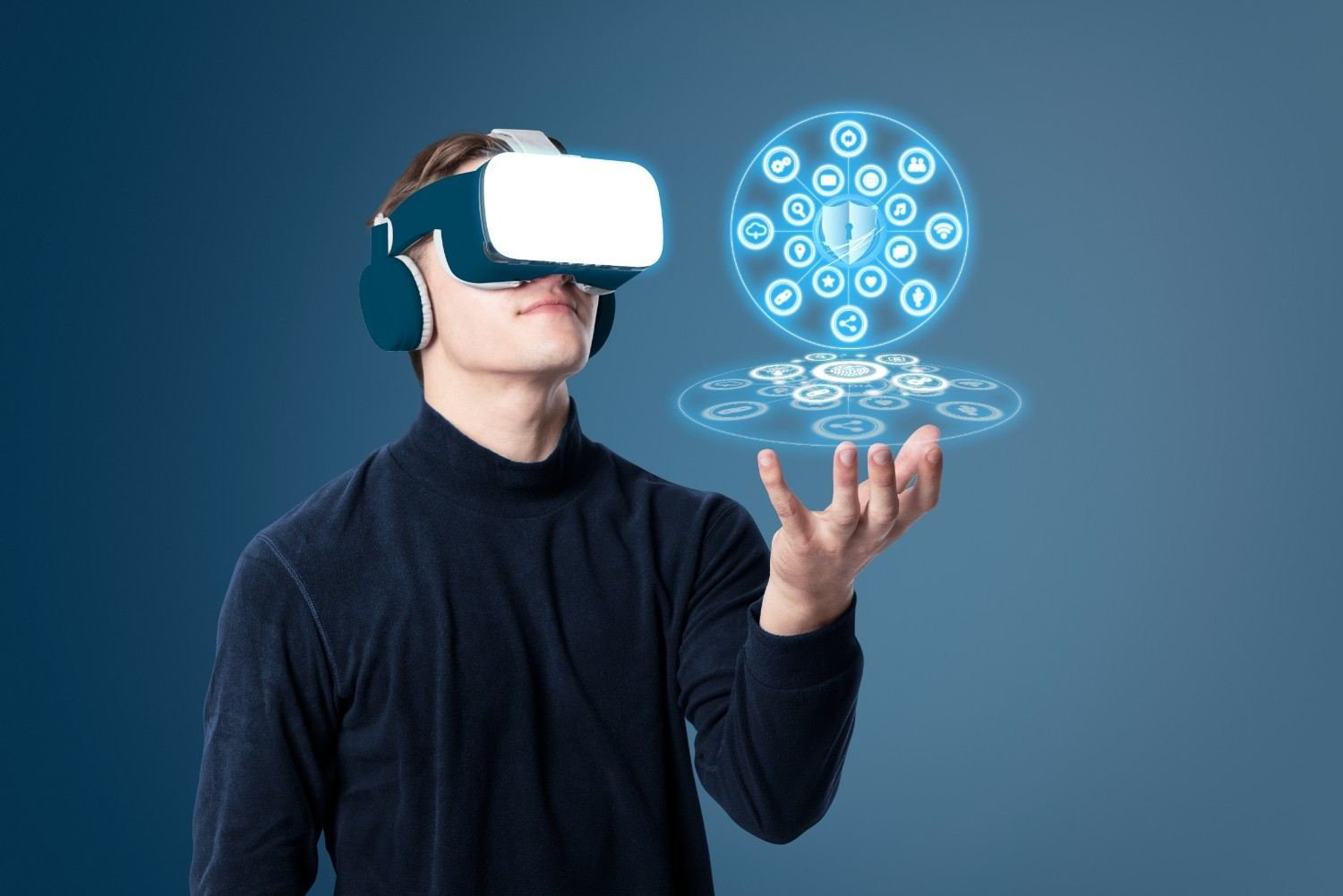
Extended reality, commonly called XR, includes virtual reality, augmented reality, and mixed reality. These interfaces provide the primary bridge between users and three-dimensional digital content.
Virtual-reality headsets replace a user’s physical field of view with a computer-generated environment. Augmented-reality devices place digital information over physical surroundings, while mixed reality allows virtual objects to interact with real surfaces and spaces.
Wearable technology can deepen that experience. Motion controllers, eye-tracking cameras, body sensors, and spatial audio help platforms understand how users move and where they focus. Haptic gloves and suits attempt to reproduce sensations such as pressure, texture, resistance, and weight. However, cost, battery life, comfort, motion sickness, and accessibility continue to affect widespread adoption.
Why Is Artificial Intelligence Essential to Virtual Worlds?
Artificial intelligence makes virtual environments responsive instead of static. It can analyze movement, recognize objects, interpret speech, personalize experiences, and control intelligent non-player characters.
Natural language processing allows users to hold realistic conversations with digital assistants and virtual characters. AI can also produce customized avatars from photographs or simple user inputs. Generative AI expands these capabilities by converting text instructions into 3D objects, dialogue, landscapes, music, and interactive experiences.
For US businesses, these tools can accelerate virtual training, product design, customer service, and content creation. Developers must still address bias, inaccurate AI-generated information, copyright concerns, harmful content, and the collection of sensitive behavioral data.
How Do Spatial Computing and 3D Engines Build the Metaverse?
Spatial computing allows software to understand physical dimensions, surfaces, movements, and locations. Cameras, sensors, computer vision, and mapping systems work together to determine where users and objects exist in three-dimensional space.
Real-time 3D engines such as Unity and Unreal Engine create lighting, physics, animation, and environmental behavior. Unlike a traditional video, these engines render scenes as users interact with them. This makes virtual meetings, games, simulations, stores, and events feel responsive.
Three-dimensional reconstruction adds physical objects to digital environments. Specialized cameras, scanners, and photogrammetry software capture an object or location and convert it into an optimized digital model. These tools can recreate everything from a small retail product to an entire building.
How Do Digital Twins Connect Real and Virtual Spaces?
A digital twin is a data-connected virtual representation of a real object, facility, or process. It differs from a standard 3D model because it can update as conditions change in the physical world.
A manufacturer could create a virtual version of a factory and use sensor data to monitor machinery. City planners could simulate traffic and infrastructure changes, while stadium operators could test crowd movement. Architects could invite clients into digital buildings before construction begins.
This technology gives the industrial metaverse practical value. American companies can use digital twins to improve training, predict maintenance needs, test expensive changes, and manage operations remotely.
Why Do Cloud, Edge Computing, and GPUs Matter?
Metaverse platforms must render detailed environments, process AI requests, track movement, and synchronize large numbers of users. Consumer devices cannot always handle these workloads independently.
Cloud computing supplies scalable storage and processing resources. Edge computing processes information closer to the user, reducing the time required for data to travel to distant servers. Graphics processing units handle complex visual rendering and support many AI workloads.
Moving intensive calculations away from a headset could eventually produce lighter, less expensive devices. The challenge is maintaining smooth performance when millions of concurrent users enter the same platform.
How Do 5G, 6G, and IoT Support Real-Time Experiences?
Low latency is essential to immersion. If an avatar responds late or a virtual scene freezes, the experience immediately feels artificial and may contribute to discomfort.
Fiber broadband, Wi-Fi, and 5G currently support high-bandwidth digital experiences. Edge servers can reduce delays further by handling calculations locally. Future 6G networks may support more connected devices and complex spatial services, although 6G is not yet a broadly available consumer technology.
The Internet of Things connects physical sensors to virtual environments. Temperature monitors, cameras, industrial equipment, wearables, and location sensors can continuously update a digital twin. Because IoT can influence real-world systems, developers need encryption, strong authentication, access controls, and regular security updates.
Does an Open Metaverse Require Blockchain and Web3?
Blockchain can provide an economic and ownership layer for virtual environments. NFTs may represent virtual land, clothing, collectibles, event passes, or other unique digital assets. Decentralized finance can support peer-to-peer payments, while smart contracts can automate transactions.
However, blockchain is not mandatory for every metaverse application. A private workplace simulation or hospital training platform may operate more efficiently with a conventional database.
Blockchain also cannot make assets automatically portable. True interoperability requires compatible 3D formats, identity standards, rendering systems, intellectual-property permissions, and platform agreements. An item purchased in one virtual world will not necessarily function correctly in another merely because its ownership appears on a blockchain.
What Could Prevent Widespread Metaverse Adoption?
Privacy and security present major obstacles. Immersive devices can collect eye movements, body gestures, voice data, room maps, and behavioral patterns. US developers must consider biometric privacy, consumer protection, workplace monitoring, child safety, identity theft, and data ownership.
Affordability also matters. The metaverse cannot become a universal digital space if participation requires premium headsets and expensive broadband. Accessible interfaces, mobile options, open standards, responsible moderation, and meaningful real-world applications will determine whether these platforms achieve lasting adoption.
Frequently Asked Questions (FAQs)
1. What are the main technologies powering metaverse platforms?
The main technologies include XR, AI, spatial computing, real-time 3D engines, digital twins, cloud and edge computing, 5G, IoT, blockchain, haptics, cybersecurity, and digital identity.
2. Can people enter the metaverse without a VR headset?
Yes. Users can access many virtual environments through smartphones, tablets, and computers. VR headsets provide deeper immersion, but they are not required for every platform or activity.
3. How does AI help build metaverse environments?
AI creates avatars, generates 3D assets, powers virtual characters, translates conversations, recognizes gestures, personalizes experiences, and helps developers moderate large digital communities.
4. Are metaverse technologies already available?
Many foundational technologies are already available, including VR, AR, AI, IoT, cloud computing, game engines, and digital twins. A fully interoperable metaverse connecting independent platforms is still developing.
The Bigger Picture
I see the metaverse as an evolution of digital interaction rather than one destination. Its most valuable applications may emerge in American manufacturing, healthcare, education, design, entertainment, and remote collaboration before a universal virtual world appears.
The technology alone will not guarantee success. Developers must combine capable hardware and software with privacy, security, affordability, accessibility, and interoperability. When those pieces work together, immersive environments can become a practical extension of the internet rather than another passing trend.