



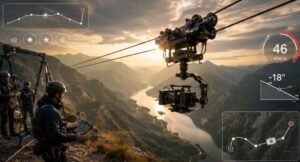
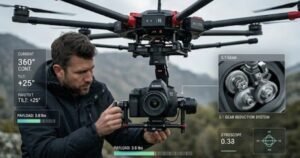
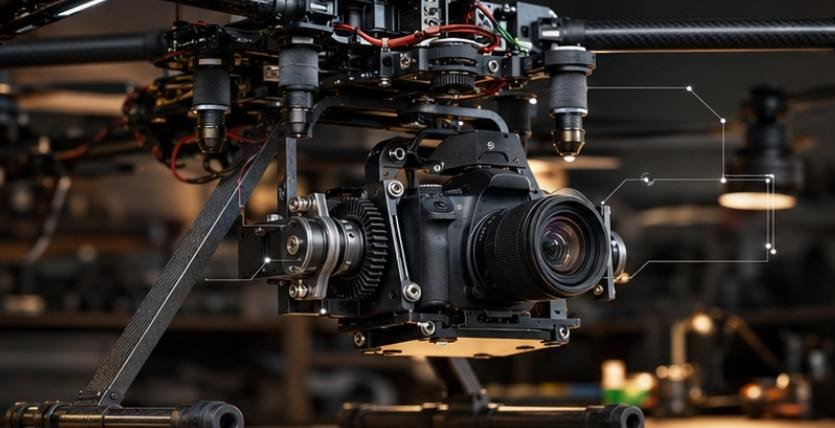
Search “mkTR” today and you may see a palm-oil company, a proposed Nasdaq ticker, a marketing agency, or a university course prefix. Yet in early multirotor aerial-imaging circles, mkTR meant something very different: a purpose-built two-axis camera tray for MikroKopter Hexakopter and Octokopter aircraft.
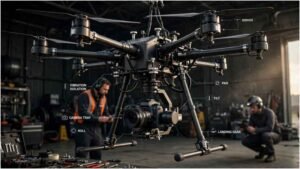
The older product is worth understanding because it shows how drone filmmakers tackled stabilization before compact brushless gimbals became standard. Its design combined geared tilt control, proportional feedback, mechanical roll correction, and vibration isolation.
What Was the Original mkTR?
The historical mkTR was an unassembled camera-gimbal kit designed to bolt directly onto MikroKopter multirotor frames. Its tray could accommodate cameras in the Canon T2i/550D class, while the complete assembly weighed about 340 grams.
The tilt axis used a 4:1 gear reduction plus an external potentiometer that supplied position feedback. Instead of merely commanding a servo, the stabilization system could determine where the camera tray actually was and correct its position more smoothly.
The roll axis used a direct-drive servo arrangement and offered 36 degrees of total movement—18 degrees on either side of level. Eight flange ball bearings supported the tray to reduce friction during correction.
Why Was the Design Technically Interesting?
Proportional Control Made Stabilization More Predictable
Older gear-driven camera mounts could move a camera without necessarily supporting accurate closed-loop control. The mkTR’s external position feedback helped the flight system compare commanded and actual tray position.
Modern gimbals use faster inertial sensors, brushless motors, and sophisticated controllers, but the engineering principle is similar: measure movement, compare it with the desired camera attitude, and correct quickly.
Vibration Isolation Targeted Rolling-Shutter Distortion
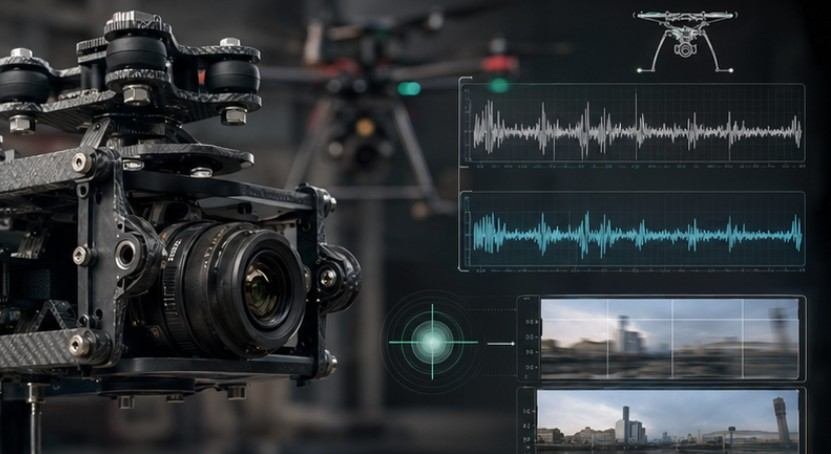
Multirotors create vibration from motors, propellers, frame resonance, and shifting loads. The mkTR used neoprene ball isolators between the aircraft and camera mount, with rubber grommets around its carbon-fiber support tubes.
The original maker reported a 95% reduction in vibration measured at the camera tray versus the airframe during hover. That figure should be treated as a manufacturer-reported test rather than an independently validated benchmark.
The underlying engineering problem is well established. Rolling-shutter CMOS sensors expose rows at slightly different times, so vibration can produce row-dependent distortion, wobbling geometry, and reduced image sharpness. A 2023 peer-reviewed investigation indexed by the U.S. National Library of Medicine examined how vibration degrades rolling-shutter imagery and demonstrated that different image rows can experience different vibration effects. Read the rolling-shutter vibration research at NLM
Key Historical mkTR Specifications
| Specification | Historical figure |
| Complete weight | 340 g |
| Width at skids | 300 mm |
| Height | 200 mm |
| Camera tray | 134 mm × 100 mm |
| Roll travel | 36° total |
| Tilt travel | 110° total |
| Tilt reduction | 4:1 |
| Maximum camera weight | 1 kg |
| Servo type | Hyperion DS16 digital |
The mounting plates also served as battery supports. Two batteries could be installed in parallel, while a single-battery setup allowed the entire gimbal to slide forward or backward by as much as 50 mm for center-of-gravity adjustment.
That balancing feature mattered. A gimbal may stabilize the picture while still making an aircraft harder to control if the camera sits too far forward or backward.
For anyone examining an old aerial-camera system, balance should therefore be checked before servo tuning or stabilization adjustments. Install the intended camera and battery first, then position the payload so the aircraft is as naturally balanced as possible.
Why “MKTR” Means Something Else in Search Results Now
The biggest challenge for modern researchers is entity confusion. Search engines do not treat MKTR as one universal product name.

One prominent result is PT Menthobi Karyatama Raya Tbk, an Indonesian public company involved in oil-palm plantations, processing, logistics, agricultural services, and related activities. The company is listed on the Indonesia Stock Exchange using MKTR as its ticker.
In US securities searches, MKTR also appears alongside Monkey Tree Investment Limited, a Hong Kong education business. U.S. Securities and Exchange Commission filings described a proposed offering of 1.65 million Class A ordinary shares, with $4 per share used as the low end of the proposed IPO price range. Later filing material stated that the proposed Nasdaq listing remained dependent on exchange approval.
The term appears outside finance as well. MKTR Agency operates in sports, video games, esports, communications, and public relations.
There is even an academic meaning. Sul Ross State University uses MKTR as a marketing-course prefix. Its catalog includes courses such as MKTR 5306 Brand Management, alongside other marketing classes carrying the same prefix.
Context therefore matters more than capitalization. A page mentioning servos, MikroKopter, Canon cameras, vibration mounts, or a camera tray is discussing the aerial-imaging product. “IDX: MKTR” points toward the Indonesian company. SEC references to Monkey Tree indicate a securities context.
A Five-Point Test for Identifying the Right mkTR
Use this quick check before relying on a search result:
- Check the publication date. Camera-gimbal material is normally archival or historical.
- Scan nearby terminology. “Servo,” “tilt,” “Hexakopter,” and “camera tray” strongly indicate the gimbal.
- Look for an exchange. “IDX: MKTR” identifies PT Menthobi Karyatama Raya.
- Look for a regulator. SEC filings connect the proposed US symbol with Monkey Tree Investment.
- Look for a course number. MKTR followed by four digits may indicate a university marketing course.
This simple process prevents an increasingly common research mistake: assuming that identical four-letter terms belong to the same organization, security, or product.
Is the Old mkTR Still Practical for US Drone Operators?
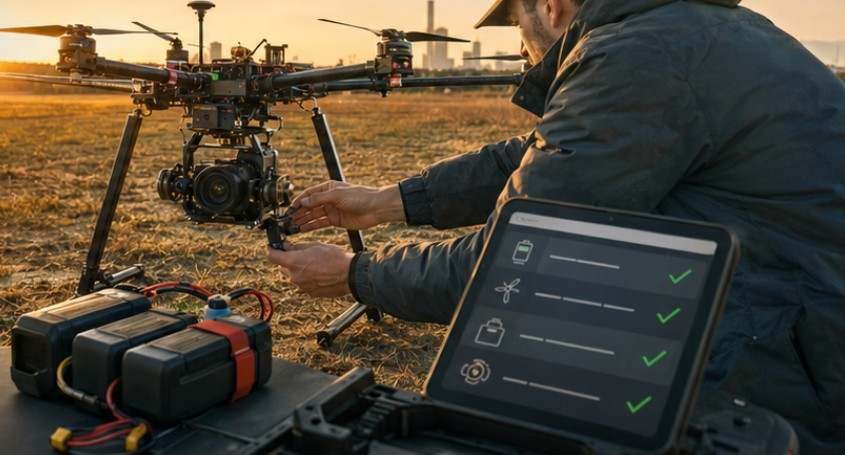
As a piece of aerial-imaging hardware, an original mkTR can still be interesting for restoration projects. Practical use depends on the aircraft, replacement-part availability, servo condition, vibration mounts, and whether the original MikroKopter platform remains serviceable.
Commercial operation in the United States introduces another consideration: the entire aircraft configuration must satisfy applicable aviation rules.
The Federal Aviation Administration’s Part 107 framework covers many commercial small-drone operations under 55 pounds. Among other requirements, operators must consider pilot certification, visual line of sight, operating limits, airspace authorization, preflight safety, and whether an external load affects aircraft controllability. Review FAA Part 107 small-UAS requirements
Before flying a restored mount, inspect neoprene isolators for hardening or cracks, confirm servo travel cannot hit the frame, keep wiring away from propellers, balance the aircraft with its actual camera and batteries installed, and verify that the payload does not compromise controllability.
An old gimbal that moves smoothly on a workbench is not automatically flight-ready.
Frequently Asked Questions
1. What does mkTR mean in drone photography?
Historically, mkTR referred to a two-axis camera tray and stabilization mount designed for MikroKopter Hexakopter and Octokopter aircraft.
2. Was mkTR a brushless gimbal?
No. It used digital servos, a geared tilt axis, position feedback, and a direct-drive roll mechanism rather than the brushless motors common in modern gimbals.
3. What cameras could the mkTR carry?
Archived specifications listed a maximum camera weight of 1 kg and a tray suitable for cameras around the Canon T2i/550D size class.
4. Is MKTR also a stock symbol?
Yes. MKTR identifies PT Menthobi Karyatama Raya on the Indonesia Stock Exchange and has also appeared as Monkey Tree Investment’s proposed US ticker.
Final Takeaway
The most useful fact about mkTR is the context behind the name. In aerial imaging, the historical mkTR was an inventive response to three persistent problems: camera leveling, vibration, and payload balance.
Those same concerns still shape drone cinematography, even though newer hardware solves them with smaller motors, faster sensors, and smarter controllers. If you find mkTR in an old build log, read the surrounding clues before assuming it refers to a company or stock. And if you restore one, treat vibration isolation and center-of-gravity setup as seriously as the camera itself.