How far can a cable cam system safely span, and what cable rating do I need?

Home » How far can a cable cam system safely span, and what cable rating do I need?

Planning a shot across a longer gap than my usual setup. What’s a realistic max span for a cable cam, and how do I figure out the right cable breaking strength?

4 Editorial Answers

These answers are written and fact-checked by PhotoShipOne's editorial team to represent genuinely different perspectives — they are not user comments or crowd-sourced discussion.

Editorial Perspective

Technical / Rigging Math

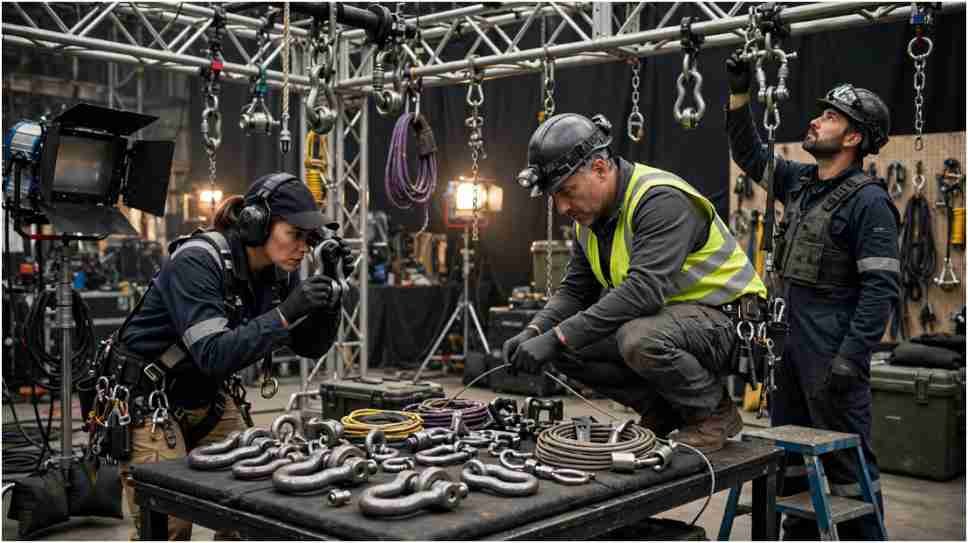
Start from your total payload (camera + gimbal mount + trolley, typically 2–15 lbs for consumer-to-mid systems), then apply a 10:1 safety margin on the cable's rated breaking strength as the baseline — the same working-load-limit principle used in grip and rigging generally. A 1/8” (3mm) galvanized aircraft cable rated around 1,700–2,000 lbs breaking strength comfortably covers most consumer cable-cam payloads with large margin to spare; heavier professional payloads (RED/ARRI packages) need thicker cable and a system rated for it, like the ones used on Speed Line-class rigs.

Span itself is less about the cable's strength and more about sag: a longer span with the same tension sags more in the middle, which changes your framing and the trolley's speed on an unpowered system. Commercial systems publish realistic max spans (often 100–300m); DIY setups should be tested empirically at a short span before committing to a long one.

Editorial Perspective

Field Experience / What Actually Happens

In practice, the limiting factor on longer spans usually isn't the cable rating — it's finding two anchor points rated for the tension a long span needs to stay taut. As one widely shared DIY build log put it, trees don't grow where you need them for a 50m span, and 100m of cable gives you more flexibility in anchor placement even if you don't use the full length. Longer spans also amplify wind effect on the trolley and camera, which matters more for image stability than the math on paper suggests.

If you're scaling up from your usual setup, test the new span a day before the shoot, not on the day itself — sag, wind behavior, and trolley speed all shift non-linearly as span increases.

Editorial Perspective

Safety-First Perspective

Never rely on cable breaking strength alone — it assumes a static load, and a cable cam trolley in motion introduces dynamic shock loading, especially at the start/stop of travel or if the brake grabs hard. Build in redundancy: a secondary safety line independent of the main cable path, rated separately, so a primary-cable failure doesn't send the payload to the ground or into anything below the span.

Also inspect the cable itself before every use for broken strands, kinks, or corrosion — a visibly damaged cable's rated strength no longer applies. This is the same discipline grip departments apply to any suspended load: if you wouldn't trust the anchor and cable over a person's head, don't trust it over your camera either, since a failure over cast or crew is a far bigger problem than a failure over empty ground.

Editorial Perspective

Gear / Commercial-System Comparison

If your projects are starting to need longer, repeatable spans regularly, this is usually the point where DIY stops being worth it — commercial systems like Speed Line are engineered specifically around span, sag compensation, and motor torque for distances DIY rigs struggle with, and they publish tested max-span figures you can plan a shoot around instead of guessing. A point-to-point motorized system can also run self-powered at a wide speed range (from near-static to 45kph-class speeds on some rigs), which an unpowered DIY pulley cam can't match without significant modification.

partners@mybacklinks.co

http://photoshipone.com

Leave a Reply

Your email address will not be published. Required fields are marked *