




I’ve always thought inventory management sounds deceptively simple. You count what comes in, track what goes out, and reorder before the shelves look embarrassingly empty. In reality, multiple suppliers, warehouses, logistics companies, spreadsheets, scanners, ERP systems, and human errors can turn that simple job into a daily puzzle.
That is where info blockchain based inventory management systems become interesting. Instead of every company maintaining a separate version of what happened to a product, blockchain can create a shared, tamper-evident history of important inventory events. The goal is not to make warehouses trendy with blockchain jargon. It is to make inventory data easier to trust, trace, and act on.
Table of Contents
ToggleWhat Are info blockchain based inventory management systems and Why Are Businesses Paying Attention?
A blockchain inventory system records agreed inventory transactions on a distributed ledger. Depending on the design, those records might include manufacturing dates, batch numbers, warehouse receipts, transfers, shipment events, ownership changes, and product conditions.
Instead of Supplier A, Distributor B, and Retailer C constantly reconciling separate records, authorized participants can work from synchronized data. Oracle describes blockchain-based inventory approaches as providing a shared ledger with tamper-evident transaction history and near-real-time visibility. You can explore Oracle’s explanation of blockchain and inventory visibility.
That difference matters most when inventory crosses organizational boundaries. Traditional warehouse software can be excellent inside one company. Blockchain becomes more compelling when several businesses need to verify the same events without relying completely on one participant’s database.
As technology continues to evolve alongside blockchain, exploring the Top 10 Generative AI Trends can provide useful context on how emerging technologies are shaping modern digital systems.
| Traditional Inventory Setup | Blockchain-Enabled Setup |
| Separate company databases | Shared transaction record |
| Frequent reconciliation | Synchronized verified events |
| Historical records may be editable | Tamper-evident history |
| Trust often depends on intermediaries | Transactions can be independently verified |
| Automation inside individual systems | Smart contracts can coordinate parties |
How Do info blockchain based inventory management systems Actually Work?
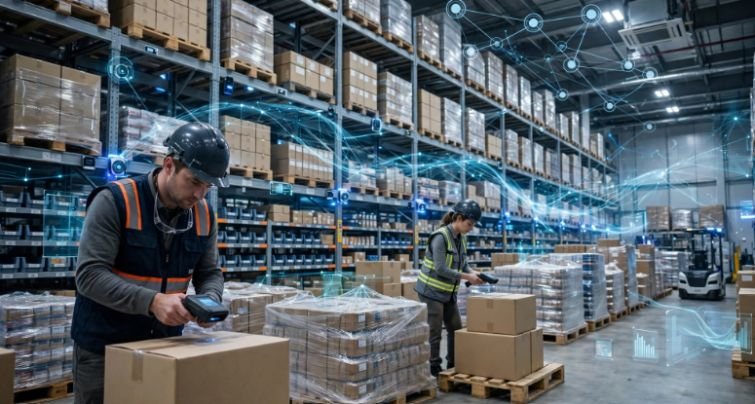
Think of the blockchain as the trusted history layer rather than the entire warehouse management system. A barcode scan, RFID reader, ERP transaction, warehouse application, or IoT sensor produces an event. Approved events can then be validated and recorded on the ledger.
Each new transaction becomes connected to the existing history. Authorized participants can therefore check when goods were produced, transferred, received, inspected, or shipped without repeatedly emailing spreadsheets around like it is still 2007.
The technology can also connect with AI and IoT. IBM notes that IoT can capture information from physical operations while blockchain helps establish trusted data across partners, with analytics turning that data into useful operational insight. For additional context, see IBM’s supply chain optimization overview.
Why Can info blockchain based inventory management systems Improve Inventory Accuracy?
Inventory discrepancies often start with ordinary mistakes. Somebody enters the wrong quantity, a shipment gets recorded twice, paperwork arrives late, or two systems update at different times.
Blockchain does not magically stop people from entering bad information. What it can do is give participants a traceable record showing what was submitted, when it happened, and which authorized party submitted it. That can make discrepancies easier to investigate.
It can also reduce repetitive reconciliation. When agreed transactions are visible across the network, purchasing, logistics, finance, and warehouse teams spend less time arguing about whose spreadsheet deserves custody of the truth.
Where Can Blockchain Inventory Management Create the Most Value?
Traceability is one of the strongest use cases. A manufacturer can potentially follow components from suppliers through production, warehousing, transportation, and delivery. That history becomes especially useful when investigating recalls, counterfeit products, warranty issues, or damaged shipments.
The National Institute of Standards and Technology has examined blockchain and related technologies specifically for manufacturing supply-chain traceability, highlighting their potential role as product origins and supply chains become harder to track. The full overview is available through NIST’s blockchain supply-chain traceability research.
Businesses dealing with pharmaceuticals, food, automotive components, luxury goods, electronics, and tightly regulated products may find this particularly relevant because provenance can matter almost as much as quantity.
As blockchain technology continues to expand beyond supply chain applications, Blockchain Hyperverse Blockchain offers readers another example of how blockchain concepts are being explored across digital ecosystems.
What Problems Should You Expect Before Adopting Blockchain Inventory?
Blockchain cannot repair poor operational processes by itself. If your item IDs are inconsistent, warehouse teams skip scans, suppliers submit unreliable information, or ERP data is already messy, permanently recording that mess simply gives you beautifully preserved bad data.
Integration is another hurdle. Your blockchain layer may need to communicate with ERP software, warehouse management systems, transportation platforms, APIs, RFID readers, supplier portals, and analytics software.
Privacy also deserves serious attention. Suppliers rarely want competitors seeing pricing, volumes, customers, or production details. That is one reason enterprise inventory applications generally favor permissioned blockchain networks where identities and access rights can be controlled.
How Do You Implement Info Blockchain Based Inventory Management Systems Step by Step?
Step 1: Start with one painful business problem. Do not begin with “we need blockchain.” Begin with something measurable, such as unexplained inventory discrepancies, slow recalls, supplier reconciliation delays, counterfeit risk, or poor batch visibility.
Step 2: Map every important inventory event. Identify when goods are manufactured, packed, transferred, shipped, inspected, received, sold, returned, or discarded. Decide which events genuinely need shared verification.
Step 3: Decide who can participate. Manufacturers, distributors, logistics providers, warehouses, retailers, auditors, and regulators may require different permissions.
Step 4: Connect the blockchain to existing systems rather than replacing everything overnight. Your ERP, WMS, barcode scanners, RFID infrastructure, and IoT devices can continue doing their normal jobs while selected events feed the shared ledger.
Step 5: Run a limited pilot. Choose one product family, supplier group, or distribution route. Measure accuracy, reconciliation time, traceability speed, and operating effort before expanding the network.
What Should You Measure After the System Goes Live?
The most useful metrics are operational, not technological. I would watch inventory accuracy, stockout frequency, reconciliation time, order discrepancies, recall tracing speed, shrinkage, supplier disputes, and manual data-entry hours.
You should also track participation quality. A shared ledger becomes dramatically less valuable when important partners update data late or avoid the system completely.
Finally, compare benefits against integration and governance costs. Blockchain deserves to stay only when it solves a real coordination or trust problem better than a simpler centralized database.
What Are the Key Takeaways About info Blockchain based inventory management systems?
The big takeaway is that blockchain is not really about making inventory decentralized for the sake of it. Its practical value comes from allowing several authorized organizations to rely on a common, verifiable history of inventory events.
The strongest deployments combine blockchain with existing inventory software, ERP platforms, RFID, IoT sensors, APIs, and analytics. Start with traceability or reconciliation problems where multiple organizations genuinely need shared trust rather than forcing blockchain into every warehouse process.
Frequently Asked Questions
1. What are info blockchain based inventory management systems?
They are inventory solutions that use distributed-ledger technology to create shared, traceable records of inventory transactions between authorized participants such as suppliers, manufacturers, warehouses, distributors, and retailers.
2. Can blockchain automatically reorder inventory?
Yes, smart contracts can trigger predefined workflows when agreed conditions occur. However, companies normally combine blockchain with ERP, forecasting, inventory, or procurement software rather than allowing the blockchain to make every decision independently.
3. Does blockchain replace warehouse management software?
Usually not. A blockchain often acts as an additional trusted data and coordination layer while a WMS continues handling picking, storage, receiving, packing, labor, and other warehouse operations.
4. Are blockchain inventory systems secure?
They can offer strong tamper resistance and cryptographic verification, but overall security still depends on identity management, access permissions, integrations, endpoint security, governance, and the quality of information entering the system.
Ready to Make Inventory Less Chaotic With info blockchain based inventory management systems?
Blockchain will not suddenly stop someone from scanning the wrong pallet at 4:55 p.m. on a Friday. What it can provide is a clearer record of what happened afterward, who recorded it, and how that event affected everyone else.
My favorite way to approach info blockchain based inventory management systems is simple: forget the buzzword for a moment and find the trust problem. If suppliers, warehouses, distributors, and retailers repeatedly disagree about the same inventory events, blockchain may finally give everyone one version of the story.