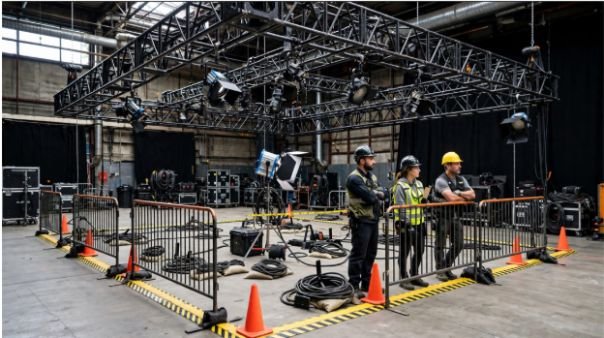




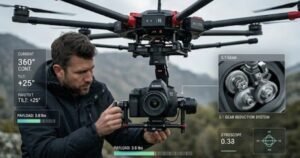
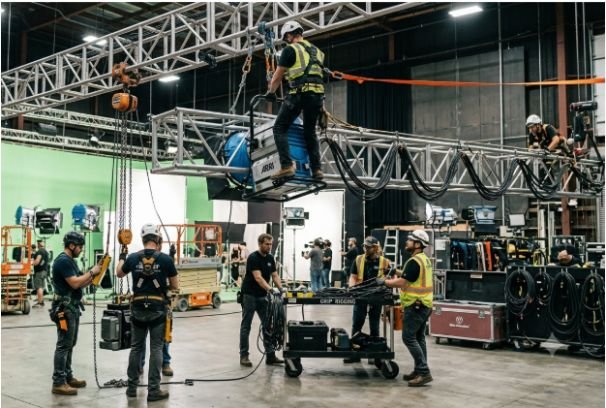
Whenever I plan a suspended camera, overhead lighting grid, temporary truss, flying set piece, or performer wire sequence, I treat the complete setup as one engineered system. Every anchor, connection, motor, sling, control, and operator can affect its safety.
Understanding ANSI rigging standards for film production helps US producers, key grips, rigging crews, studio managers, and safety coordinators select equipment, verify load paths, conduct inspections, and document approvals. These standards matter on soundstages and location shoots, where temporary installations and last-minute creative changes can quickly introduce new risks.
Most entertainment-specific standards are developed through ESTA’s Technical Standards Program and approved through the ANSI process. However, productions must also consider OSHA requirements, state-plan rules, local codes, engineering specifications, contracts, and manufacturer instructions.
Following OSHA Compliance for Film Set Rigging means integrating these requirements into every stage of production, from planning and equipment inspections to load calculations, worker training, fall protection, and emergency procedures. A comprehensive compliance approach helps reduce workplace hazards while promoting safer and more efficient film set operations.
ANSI standards are generally consensus standards rather than automatically enforceable federal laws, although contracts, codes, regulations, and workplace policies may make particular provisions binding.
Which ANSI Standards Apply to Film Production Rigging?
No single standard covers every film rig. The correct standard depends on whether the production uses trusses, permanent support points, temporary outdoor structures, powered hoists, static suspension, manual systems, or performer-flying equipment.
What Does ANSI E1.2 Require for Aluminum Trusses?
ANSI E1.2 covers the design, manufacture, and use of aluminum trusses and towers. Film productions commonly use these structures to support lights, LED walls, cameras, remote heads, speakers, diffusion frames, and scenic components.
I never determine truss capacity by appearance alone. Span length, support configuration, load position, orientation, connection type, and dynamic forces affect performance. Crews must follow manufacturer load data and reject trusses with cracked welds, bent chords, damaged connectors, missing hardware, or unauthorized modifications. ESTA lists E1.2 among its published entertainment-rigging standards.
How Does ANSI E1.21 Apply to Outdoor Film Sets?
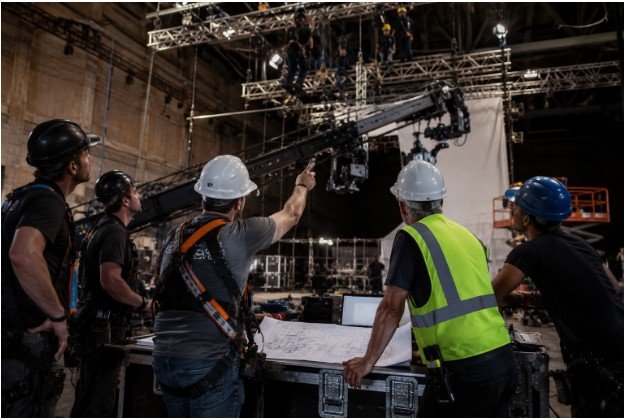
ANSI E1.21 addresses temporary structures used for technical production at outdoor entertainment events. It can be relevant to outdoor sets, production towers, temporary roofs, and other structures supporting equipment during location filming.
An exterior rig requires more than a load calculation. The production may need to assess soil conditions, anchorage, ballast, wind, rain, lightning, weather monitoring, and evacuation thresholds. ESTA describes E1.21 as establishing minimum design and performance parameters for temporary structures.
What Does ANSI E1.56 Cover on Soundstages?
ANSI E1.56 applies to stationary rigging support points attached to permanent facility structures. It addresses their design, fabrication, installation, inspection, and documentation. A newer edition published in March 2026 superseded the 2018 document.
This standard matters when a crew connects loads to a soundstage grid, beam, embedded anchor, or another permanent point. I verify the working load limit, approved loading direction, identification, inspection history, and supporting documentation before authorizing use. A beam that looks substantial is not automatically an approved rigging point.
Which Standards Govern Hoists and Suspended Systems?
How Does the ANSI E1.6 Series Apply to Powered Hoists?
The ANSI E1.6 series covers powered entertainment hoist systems and related chain-hoist selection, design, inspection, maintenance, and controls. E1.6-1 addresses powered hoist systems, while E1.6-2 covers serially manufactured electric chain hoists used in entertainment.
On a film set, these systems may raise lighting grids, green screens, scenic pieces, camera platforms, or other production loads. I check the hoist rating, duty cycle, operating orientation, controls, supporting structure, attachment hardware, and load distribution. A motor’s stated capacity does not prove that the complete load path is safe.
When Does ANSI E1.4-2 Apply?
ANSI E1.4-2 addresses permanently installed, statically suspended rigging systems, including dead-hung battens and grids in entertainment spaces.
Static equipment still presents a serious overhead hazard. Cameras, scenic panels, fixtures, and diffusion frames can fall when an anchor, connection, component, or secondary restraint fails. Every part must have an appropriate working load limit and remain compatible with its loading direction.
What Does ANSI E1.4-3 Cover?
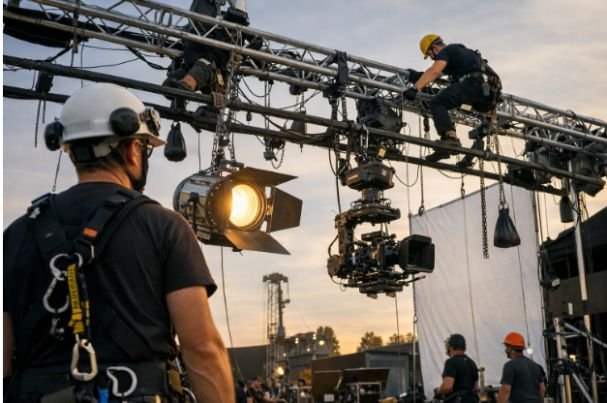
ANSI E1.4-3 applies to permanently installed, human-powered manual hoist rigging systems. It should not be confused with powered-hoist requirements or treated as a general standard for every hand-operated temporary device.
Which Standard Covers Performer Flying and Stunt Rigging?
ANSI E1.43 establishes requirements for performer-flying systems used for wirework, aerial effects, and stunt sequences. I separate performer flying from ordinary equipment suspension because a failure can directly injure the performer.
Qualified specialists should design, install, test, inspect, operate, and maintain these systems. Productions also need controlled rehearsals, clear commands, emergency stops, rescue procedures, performer training, and medical planning. ESTA identifies E1.43 as its performer-flying system standard.
How Does ANSI ES1.18 Support Production Rigging Safety?
ANSI ES1.18-2022 addresses event rigging from a management perspective. It covers responsibilities and general requirements for planning, design, installation, setup, operation, and removal rather than setting detailed hardware specifications.
That lifecycle approach suits film production because a rig must remain controlled from preproduction through strike. Responsibilities should be assigned before installation begins, especially when production departments, outside vendors, venue representatives, and engineers share authority.
What Standards Apply to Slings, Shackles, and Hooks?
Entertainment standards do not replace broader lifting-equipment requirements. The ASME B30 series covers many hoists, slings, hooks, shackles, and below-the-hook devices used in load handling.
ASME B30.9 addresses the fabrication, use, inspection, testing, and maintenance of slings. ASME B30.26 covers detachable rigging hardware such as shackles, eyebolts, swivels, turnbuckles, wire-rope clips, and rigging blocks.
Crews should inspect this equipment for deformation, cracks, corrosion, heat damage, illegible identification, damaged threads, stretching, excessive wear, and other removal-from-service conditions.
Who Is Qualified to Design or Inspect a Film Rig?
ANSI/ASSP A10.42 establishes safety requirements for rigging qualifications and responsibilities in construction-related operations. It is not an ESTA film standard, but it can provide relevant guidance when construction activity forms part of a production.
A job title alone does not prove qualification. The person must possess knowledge and experience appropriate to the system, equipment, calculations, and hazards involved. ETCP (The Entertainment Technician Certification Program) certification can demonstrate entertainment-rigging competence, but a structural engineer or manufacturer may still need to review unusual anchors, dynamic systems, heavy loads, or custom components.
What Should a Film-Set Rigging Inspection Include?
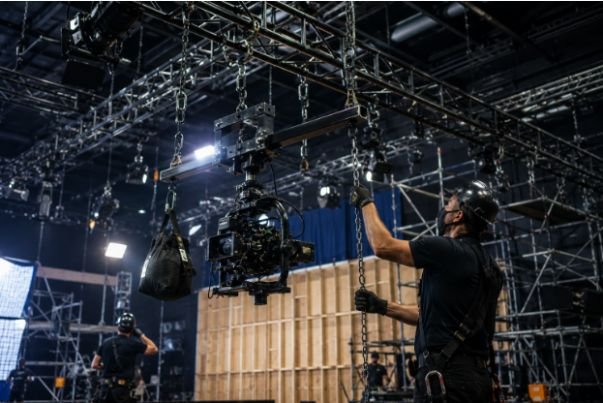
ANSI E1.47 provides recommended guidelines for entertainment rigging inspections. ESTA’s current records show that the 2020 edition is undergoing revision, so productions should confirm the latest published version before relying on it.
I inspect the structure, support points, trusses, hoists, slings, wire rope, shackles, hooks, clamps, pins, controls, electrical connections, secondary restraints, and load position. I also require reinspection after an overload, impact, emergency stop, equipment substitution, anchor change, payload increase, travel-path alteration, or exposure to damaging weather.
How Should Film Crews Calculate and Control Suspended Loads?
A load calculation must include the entire suspended system. For a camera rig, that means the body, lens, battery, media, remote head, mounting plate, motors, transmitter, cables, brackets, adapters, truss, hoists, and hardware.
Crews must also consider unequal distribution, movement, acceleration, deceleration, vibration, side loading, and environmental forces. The production should establish an exclusion zone below the rig and keep unnecessary personnel outside the potential fall or movement path.
What Records Should a US Production Keep?
The production file should include engineering drawings, load calculations, equipment specifications, inspection reports, maintenance records, crew qualifications, permits, manufacturer manuals, emergency procedures, and approval documents.
Clear records prevent a crew from following an outdated design after the director changes the shot. They also identify who approved the system and what operating limits apply.
Frequently Asked Questions (FAQs)
1. Are ANSI entertainment-rigging standards federal law?
Not automatically. However, they may become enforceable through adopted codes, contracts, regulations, permits, studio policies, or manufacturer requirements.
2. Does every film rig require an engineer?
No, but unusual support points, heavy or dynamic loads, outdoor structures, performer systems, and custom configurations often require engineering review.
3. Must a temporary rig be inspected every day?
Inspection frequency depends on the system and applicable requirements, but crews should complete appropriate pre-use checks and reinspect after changes or unusual events.
4. Can a key grip approve an overhead camera rig?
A key grip may approve work within their demonstrated qualifications and authority, but complex structural or mechanical systems may need a qualified rigger or engineer.
Creating a Safer Rigging Culture on US Film Sets
I view ANSI rigging standards for film production as a practical framework for making safer decisions, not as paperwork completed after the rig is built. They help crews choose suitable equipment, verify support points, inspect the complete load path, define responsibilities, and respond safely when creative requirements change.
A successful production never allows speed or budget pressure to replace qualified judgment. By applying ANSI rigging standards for film production, current ESTA guidance, ASME hardware requirements, applicable OSHA rules, and manufacturer instructions, film crews can protect people while still achieving ambitious shots.