





An overhead camera, lighting truss, scenic element, or audio array does not care how tight the production schedule is. If the rigging system fails, gravity takes over instantly. That is why I treat safe use of slings in film production rigging as a load-control process, not a box to check before cameras roll.
The basic rule is simple: know the load, know the sling, inspect every connection, control the lift, and keep people outside the hazard area.
OSHA requires slings to have legible identification and prohibits loading them beyond their rated working capacity. Its sling guidance also covers selection, use, maintenance, inspection, and hazard recognition.
Why Sling Safety Needs Special Attention on Film Sets
Film rigging creates conditions that can change hour by hour. A truss may move between stages. A lighting package may gain fixtures. Camera hardware may be added after the original lift calculation.
Temporary production environments also create unusual contact points. Slings can touch truss corners, steel brackets, scenic structures, vehicle rigs, or other equipment.
I therefore treat the sling as part of a complete load path. Its capacity alone does not make the lift safe. Shackles, hooks, attachment points, hoists, sling angles, and support structures must all be suitable.
That is also why shackle and sling safety for film rigging should be reviewed together rather than as separate equipment issues.
Entertainment-specific standards matter too. ESTA’s Technical Standards Program publishes standards addressing rigging inspections, support points, trusses, hoists, and other entertainment technology systems.
Choose the Right Sling Before the Load Leaves the Ground
The correct sling depends on the load, hitch, environment, contact surface, temperature, and required movement.
| Sling type | Common production application | Main concern |
| Synthetic web/round sling | Truss, painted equipment, delicate surfaces | Cuts, heat, chemicals, UV, abrasion |
| Wire rope sling | Heavy loads and demanding environments | Broken wires, kinks, corrosion, crushing |
| Multi-leg assembly | Balanced equipment or structural loads | Sling angles and unequal leg loading |
Synthetic Web and Round Slings
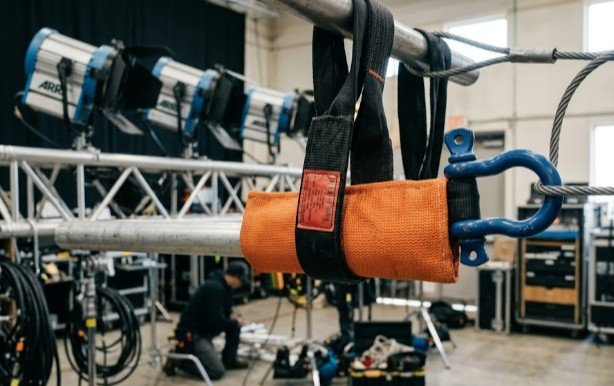
Synthetic slings can work well around production equipment because they are flexible and less likely to damage finished surfaces.
Their flexibility does not make them cut-proof.
OSHA guidance says sharp edges contacting synthetic web slings must be protected with material strong enough to protect the sling. It also lists holes, tears, cuts, snags, melting, charring, chemical burns, knots, and damaged fittings among conditions requiring attention.
I never treat a folded rag or improvised scrap as automatically adequate edge protection. Protection must suit the actual contact point and expected force.
Wire Rope Slings
Wire rope handles many demanding lifting applications, but its condition can be harder to judge casually.
I look for broken wires, crushing, bird-caging, kinks, corrosion, heat damage, and deformed end fittings. OSHA identifies these defects as reasons for removing affected wire rope slings from service.
Wire rope should also never be shortened with knots or improvised modifications.
Sling Inspection Before a Film Rigging Lift
I prefer a deliberate inspection before each production use rather than assuming yesterday’s safe sling remains safe today.
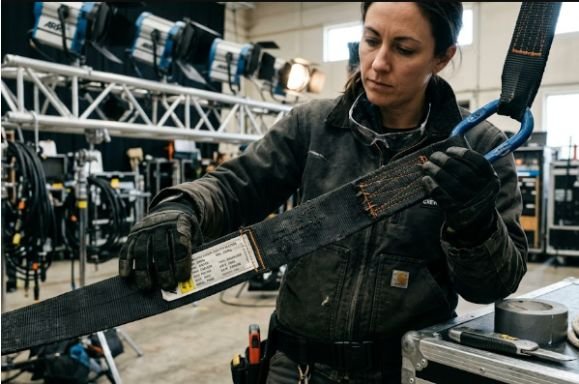
Check the identification first. If the capacity information cannot be read, stop there. OSHA prohibits using slings without required legible identification markings.
Then inspect the complete body and fittings.
For synthetic slings, check for cuts, abrasion, melted areas, chemical damage, damaged stitching, knots, stiff sections, and distorted hardware. For wire rope, inspect for broken wires, severe abrasion, kinking, crushing, bird-caging, corrosion, heat damage, and damaged end attachments.
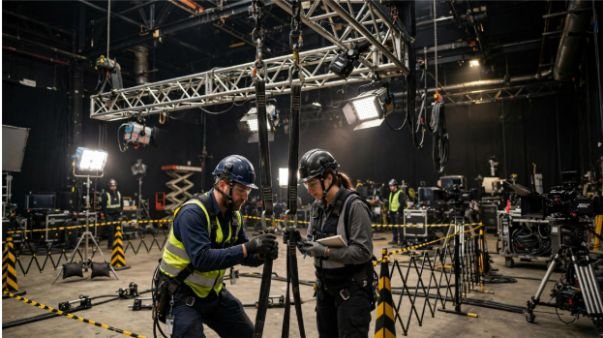
A production’s inspection process should also coordinate with its broader film set hoisting safety procedures, especially when multiple departments work beneath or beside the same rig.
Sling Angles, Hitch Types, and Load Control
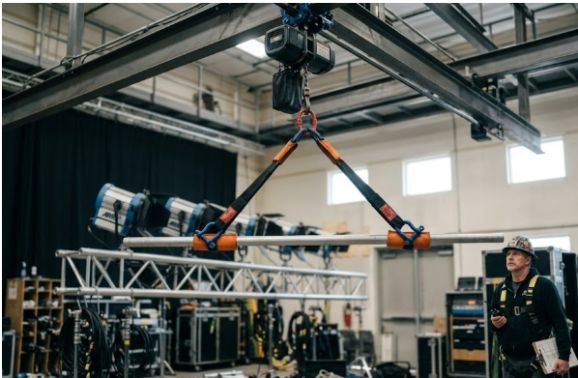
A sling tag cannot be read without considering how the sling will actually be used.
Vertical, basket, choker, and multi-leg configurations behave differently. OSHA guidance directs users to select slings according to the hitch and applicable angle. Multiple-leg systems carrying nonsymmetrical loads may require analysis by a qualified person.
Why Sling Angle Changes the Load
One mistake I watch for is assuming that two sling legs automatically divide the load equally with little consequence.
Consider an idealized 800-pound load suspended by two identical sling legs.
| Sling angle from horizontal | Approx. tension per leg* |
| 90° | 400 lb |
| 60° | 462 lb |
| 45° | 566 lb |
| 30° | 800 lb |
*Simplified symmetrical example only. Real rigging must use manufacturer ratings and qualified-person calculations where required.
As the legs become flatter, leg tension climbs sharply. At 30 degrees, each leg in this simplified example carries tension equal to the entire 800-pound load.
That is why safe use of slings in film production rigging cannot rely on load weight alone.
OSHA also notes that choker hitches below a 120-degree choke angle require a reduced rated load based on manufacturer or qualified-person guidance.
Protect Slings From Film-Set Damage
A perfectly rated sling can still become the weak point if the set damages it.
Sharp truss edges need suitable protection. Slings should not drag across abrasive floors. They should not become pinched between fittings or squeezed into hardware that does not fit correctly. Shock loading should also be avoided.
Storage matters after wrap. OSHA recommends protecting synthetic slings from mechanical, chemical, ultraviolet, and extreme-temperature damage. Wire rope should be protected from moisture, corrosion, mechanical damage, extreme temperatures, and kinking.
For permanently or temporarily suspended fixtures, sling planning should also complement secondary safety cables for overhead film equipment rather than treating the primary suspension and secondary restraint as interchangeable.
Keep People Away From Suspended Loads
No camera angle justifies putting a crew member beneath an uncontrolled suspended load.
OSHA guidance states that personnel should not stand or pass beneath suspended loads. It also warns against standing alongside sling legs under tension because a failure can release stored energy unexpectedly.
I want the exclusion area established before tension begins, not after the load reaches head height.
Production communication matters here. One person should control the lifting instruction. Crew members should understand the stop command. Nonessential personnel should stay outside the operating area.
My Tag–Touchpoints–Test Tension Method
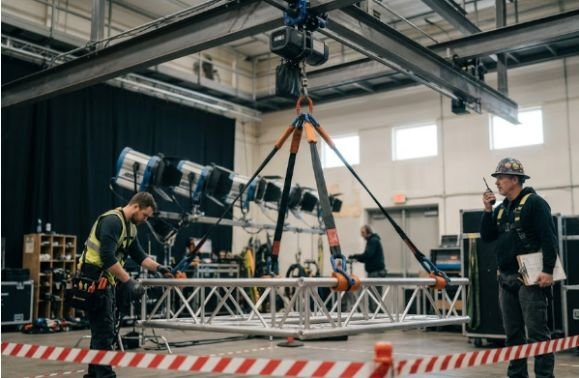
For safe use of slings in film production rigging, I reduce the final pre-lift check to three words:
Tag: Confirm sling identification, configuration, capacity, and compatibility.
Touchpoints: Inspect every place where the sling contacts the load, hardware, hook, edge protection, or attachment point.
Test Tension: Apply controlled initial tension before committing to the full lift. Confirm seating, balance, sling position, and load behavior.
The last stage is not a substitute for engineering or inspection. It is a final opportunity to spot a sling migrating toward an edge, a badly seated fitting, or an unstable load before elevation increases the consequences.
What to Do With a Damaged Sling
Do not create an on-set repair because replacement equipment is inconvenient.
OSHA says damaged synthetic web slings should be removed from service when specified defects or deterioration appear. Temporary repairs to synthetic webbing or fittings are not permitted under its guidance. Qualified repair and required proof testing apply where repair is allowed.
Wire rope slings with qualifying defects should also leave service immediately. OSHA guidance restricts repairs and states that the wire rope itself should not be repaired.
Tag questionable gear so another crew member cannot accidentally return it to the active rigging inventory.
If the Sling Looks Questionable, the Shot Can Wait
The safest rigging decision is often the least dramatic one.
I would rather replace one suspect sling, recalculate one awkward bridle, or delay one lift than discover the mistake with equipment overhead.
The practical standard for safe use of slings in film production rigging is straightforward: use identifiable rated equipment, inspect it carefully, respect sling angles, protect every contact point, avoid shock loading, control the load, and keep people clear.
For U.S. productions, OSHA provides the regulatory baseline, while applicable state-plan requirements and entertainment-industry standards may add further obligations.
When something about the load path creates doubt, stop and have a qualified person resolve it before the lift continues.
Frequently Asked Questions
1. How often should film production slings be inspected?
Inspect slings before use and follow the manufacturer’s, qualified person’s, OSHA, and applicable periodic inspection requirements for the service conditions.
2. Can a film crew shorten a sling with a knot?
No. OSHA guidance says slings should not be shortened or lengthened by knotting or twisting.
3. Why do sling angles matter in film rigging?
Lower sling angles can substantially increase tension in each leg, potentially exceeding the sling or connection’s rated capacity.
4. What is the main rule for safe use of slings in film production rigging?
Use correctly rated, inspected equipment and never suspend a load until its load path, sling configuration, hardware, and personnel-clearance plan are verified.