




A suspended truss, camera platform, lighting array, or set piece can turn a routine setup into a falling-object hazard in seconds. I treat film set hoisting safety procedures as a controlled sequence: calculate the load, verify every component, isolate the fall zone, test the system, and only then authorize movement.
For U.S. productions, requirements vary by activity, equipment, and jurisdiction. OSHA requires covered construction rigging to be inspected before use on each shift and defective gear removed from service. Its construction crane standard also has a defined scope, so productions must identify which regulations apply to their specific work.
That makes film set hoisting safety procedures a planning discipline, not a last-minute task.
Start With a Rigging Risk Assessment Before the Lift
The hoist is only one link in the load path. The load also passes through slings, shackles, hooks, attachment points, and the supporting structure. One weak connection can compromise the system.
A rigging risk assessment for film production should identify total weight, center of gravity, attachment points, lift route, landing area, fall zone, electrical hazards, weather, and emergency-stop procedures.
Calculate the Entire Suspended Load
Count the set piece plus attached lighting, camera gear, cable, slings, shackles, spreader hardware, and other below-the-hook items. OSHA has clarified in the crane context that load-attaching equipment can form part of the total suspended load.
For example, imagine a 600-pound scenic assembly with 90 pounds of attached equipment and 35 pounds of rigging hardware. Planning starts at 725 pounds, not 600. Sling angles, dynamic forces, configuration, and support-point limits still require evaluation.
Do not invent a universal “double the load” safety rule. Film set hoisting safety procedures should rely on marked working load limits, manufacturer data, applicable standards, and calculations by qualified personnel. OSHA prohibits covered rigging equipment from exceeding its recommended safe working load.
Hoist Inspection and Rigging Hardware Checks
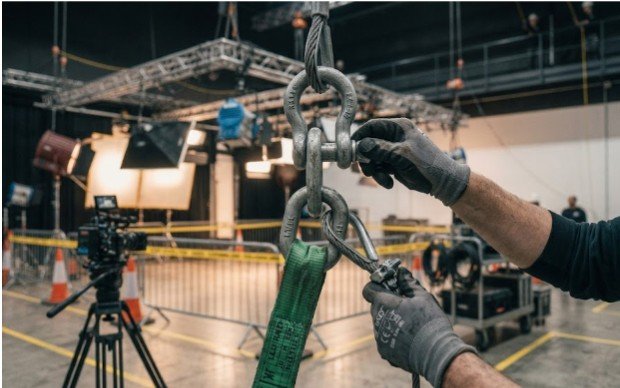
Before any lift, inspect each component for condition, identification, and correct installation. OSHA requires identification markings on covered rigging and requires defective equipment to be removed from service. Its sling requirements also address rated-capacity markings and damage criteria.
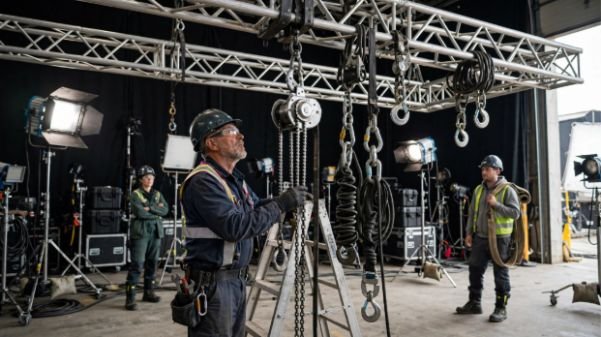
Inspect wire rope for broken strands, kinks, crushing, corrosion, and damaged terminations. Check chains and synthetic slings for wear, cuts, distortion, heat damage, or missing tags. Check hooks, shackles, pins, latches, brakes, controls, emergency stops, and electrical connections.
ESTA currently lists ANSI E1.6-1 for powered entertainment hoist systems, E1.6-2 for electric chain-hoist design, inspection, and maintenance, and E1.6-3 for chain-hoist selection and use. These standards make film set hoisting safety procedures more specific to entertainment work than a generic lifting checklist.
Where a fixture requires an independent secondary restraint, use a correctly rated safety cable or chain. A secondary restraint never makes damaged primary rigging acceptable.
These checks complement safe lifting practices for film production crews while truss sections, counterweights, cameras, and other heavy components are assembled or struck.
Control the Fall Zone Before the Load Moves
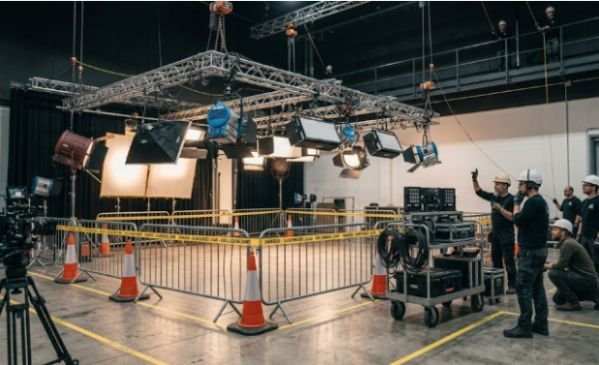
Keeping unnecessary people away from suspended loads is a core control. OSHA’s crane provisions call for hoisting routes that minimize employee exposure where available and restrict access within fall zones during covered operations.
Film-industry guidance reaches a similar conclusion. The Industry-Wide Labor-Management Safety Committee recommends exclusion zones around camera-crane construction, striking, and movement.
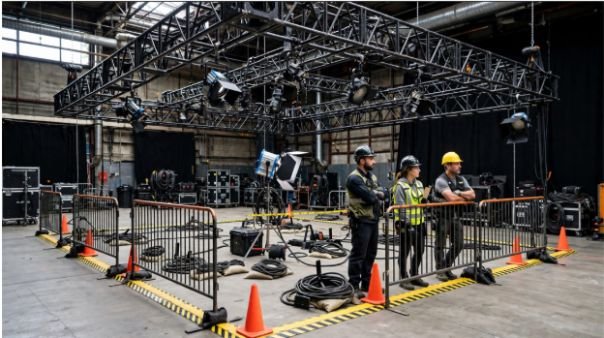
Good film set hoisting safety procedures establish that zone before the load leaves the floor. Use barriers or clear markings, control access, and assign someone to keep the travel path clear.
Remove cable coils, cases, loose tools, and carts from the landing area first. Crews should never improvise a landing zone while a load is hanging. This is where film set rigging exclusion zone safety becomes operational rather than theoretical.
Perform a Controlled Test Lift
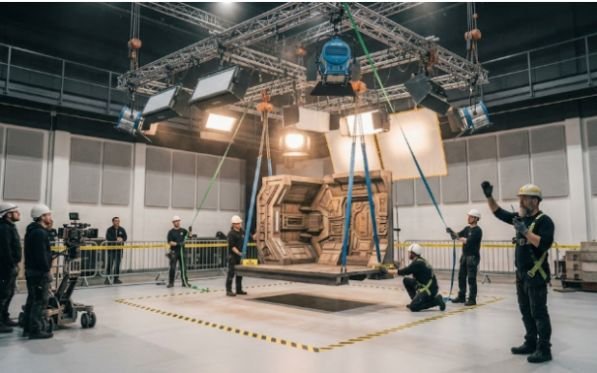
Raise the load only enough to confirm balance, attachment security, brake holding, and expected movement. A short test lift can expose twisting, load shift, or an incorrect center of gravity before full travel.
If anything looks wrong, lower the load and correct it. Film set hoisting safety procedures should prevent shock loading, abrupt acceleration, sudden stopping, and uncontrolled swinging.
OSHA requires a tag or restraint line when necessary to prevent hazardous rotation in covered crane operations. Tag lines can also help guide awkward scenic pieces, but their placement should never pull a crew member into a fall or pinch zone.
Make Communication Part of the Hoisting System
I treat communication as another safety component. Assign one lift leader or signal person and agree on commands before movement.
“Load coming up,” “stop,” and “all clear” should have one meaning across the crew. Anyone who sees an immediate hazard should also understand the stop-work method.
PPE should follow the production’s hazard assessment and applicable requirements. Depending on the operation, that may include protective footwear, head protection, gloves, eye protection, or high-visibility garments.
The Three-Gate Pre-Lift Release Check
My final film set hoisting safety procedures check uses three gates:
| Gate | Ask | Stop the lift when |
| Capacity | Is every load-path component properly rated? | Weight, angle, rating, or support capacity is uncertain |
| Connection | Is everything installed and inspected? | A sling, pin, latch, brake, or attachment is questionable |
| Exposure | Is the fall zone controlled? | People or obstacles remain in the hazard area |
This is a practical barrier against schedule pressure, not a substitute for a formal lift plan. If one gate fails, the load stays down.
Watch Weather and Changing Set Conditions
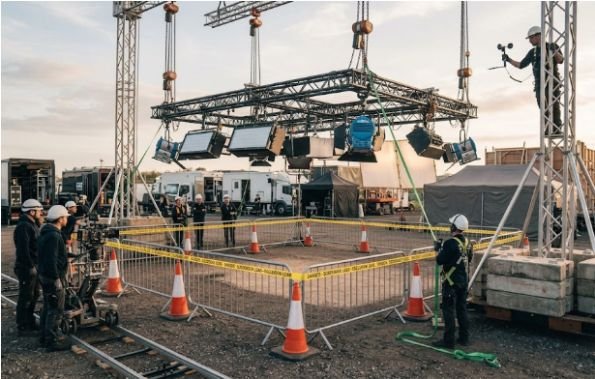
Outdoor lifts need defined stop-work criteria. Wind can make broad scenic pieces harder to control, while rain can affect footing and electrical conditions.
The Industry-Wide Labor-Management Safety Committee’s camera-crane guidance tells productions to consider wind, rain, extreme temperatures, and other atmospheric conditions that can affect safe operation.
Film set hoisting safety procedures should also be reviewed whenever the setup changes. Moving a hoist point, adding fixtures, changing the camera package, or rerouting equipment can alter the load or risk profile.
A lift approved at call time is not automatically approved after the rig changes.
The Load Does Not Care About the Call Sheet
Production pressure is exactly when film set hoisting safety procedures need to stay predictable. I would rather hold a setup than send uncertainty overhead.
The best lift is not defined by the biggest hoist. It comes from a known load, verified ratings, inspected hardware, a controlled exclusion zone, and trained personnel with authority to stop unsafe movement. Industry camera-crane guidance likewise emphasizes trained personnel, manufacturer instructions, inspection, testing, and controlled exclusion zones.
Before the next overhead move, run the three gates: capacity, connection, exposure. If one answer is unclear, keep the load on the ground.
Frequently Asked Questions
1. What are the basic film set hoisting safety procedures?
Calculate the full load, verify ratings, inspect rigging, control the fall zone, test the lift, communicate clearly, and stop when conditions become unsafe.
2. Who should operate a film-set hoist?
Only properly trained and authorized personnel should operate or supervise hoisting equipment according to applicable requirements and manufacturer instructions.
3. Can crew members stand under a suspended load?
Crew exposure beneath suspended loads should be eliminated or strictly controlled according to the applicable OSHA requirements and site-specific lift plan.
4. How often should film rigging equipment be inspected?
Follow the applicable regulation, manufacturer instructions, and entertainment standard; OSHA requires some covered rigging equipment to be inspected before use on each shift.