




Anyone running cable, wire rope, or safety tethers across a camera rig eventually faces the same question: how much tension is actually in that line, and is it safe to pull harder. A cable tension calculator answers that question in seconds, provided you feed it honest inputs and understand which physics it is solving.
This guide covers how the tool works, what the underlying tension formula looks like, and where a calculator will quietly give you the wrong number if you let it. The crews I have worked alongside treat cable tension as plumbing work with a side of applied math, and the tolerance for sloppy numbers is close to zero.
What a Cable Tension Calculator Actually Solves
A cable tension calculator is not a magic box. It is an arithmetic shortcut for one of two problems: direct tension in a straight or angled cable, or tension in a system involving supports, span, sag, and load. Cheap online calculators usually handle the first. The second set, which is what matters for suspended cable runs and overhead rigging, requires input about cable span, weight per unit length, and the sag you will allow. Feed the wrong units and the result is fiction, which is exactly how a checkout-lane algebra error turns into a bad afternoon on a roof.
The term “cable tension calculator” gets used loosely to describe anything from a phone app that returns a single number to spreadsheet templates built by engineers who also happen to be gaffers. What matters is that the tool you use exposes the tension equation it is applying, because otherwise you have no way to sanity-check the output. If the calculator will not tell you what formula it is running, assume it is the direct-tension shortcut and do not trust it for anything involving sag or deflection.
The Tension Formula Behind the Numbers
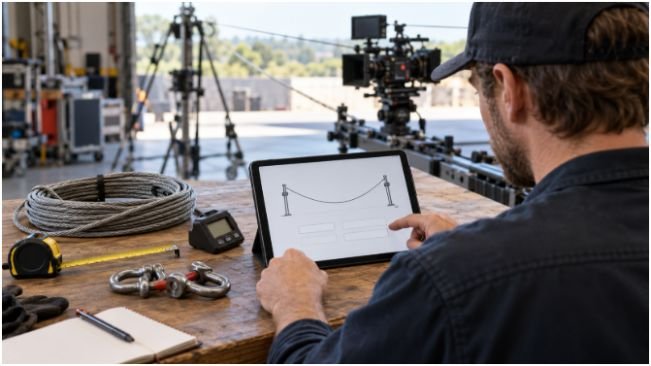
The tension formula for a straight, loaded cable resolves to a clean force balance. For a cable hanging vertically with a load at rest, the tension force formula is simply T = m times g, where m is the total mass the cable supports and g is the acceleration due to gravity, roughly 9.81 meters per second squared.
When the cable is at an angle, the vertical component of the tension must still equal the weight, so the tension equation becomes T = (m times g) divided by the sine of the angle the cable makes with the horizontal. That one sine term is where most field errors hide, because a nearly horizontal cable carries an enormous tension for a modest load, which is why plumbness of a stand matters far more than the weight on top of it.
For a suspended span, the classical catenary tension equation returns a horizontal component H = (w times L squared) divided by (8 times d), where w is the weight per unit length, L is the span, and d is the sag. Total tension at the support is the vector sum of horizontal and vertical components.
That is the formula for tension most rigging calculators quietly implement, and it is also the one most likely to be misused because sag values get estimated by eye. The math for suspended cables and the boundary assumptions behind it are documented in the standard reference for engineering structures maintained by NIST, whose measurement standards sit behind most civil and rigging equipment tolerances in the United States.
A calculator is only as good as the sag value you typed into it. A digit of sag changes tension by pounds you will absolutely feel in the hardware.
Inputs That Decide Whether a Cable Tension Calculator Is Useful
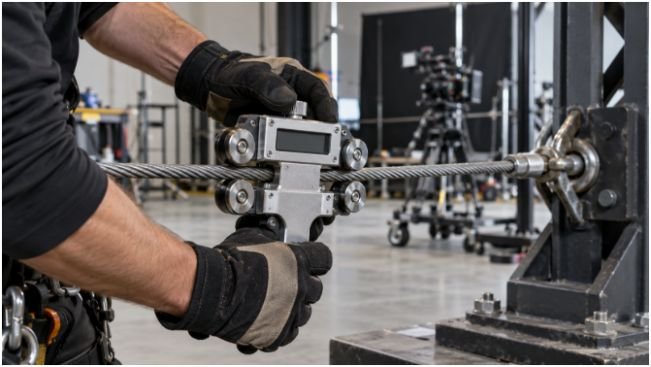
Enter data in consistent units. Mixing pounds and kilograms is the single most common reason a cable tension calculator returns a nonsensical answer. The workflow that keeps crews out of trouble has four steps.
- Measure the span or the unsupported length to the nearest inch, because tiny errors in the span get squared by the formula.
- Weigh the load and the cable together, since cable weight per foot is not trivial past a few dozen feet.
- Record the angle at each attachment point using an inclinometer, not a guess from a photograph.
- Run the calculator, then multiply the result by a safety factor set by the hardware manufacturers and the site rules.
For overhead rigging, the inspection requirements that dictate how often hardware and wire rope must be checked are covered in the OSHA standard for cranes and derricks in construction, which the agency publishes at osha.gov. The tension numbers coming out of a calculator feed directly into decisions about whether hardware is within its working load limit, and that government standard is where the inspection cadence comes from.
Worked Example: A Camera Rig Cable
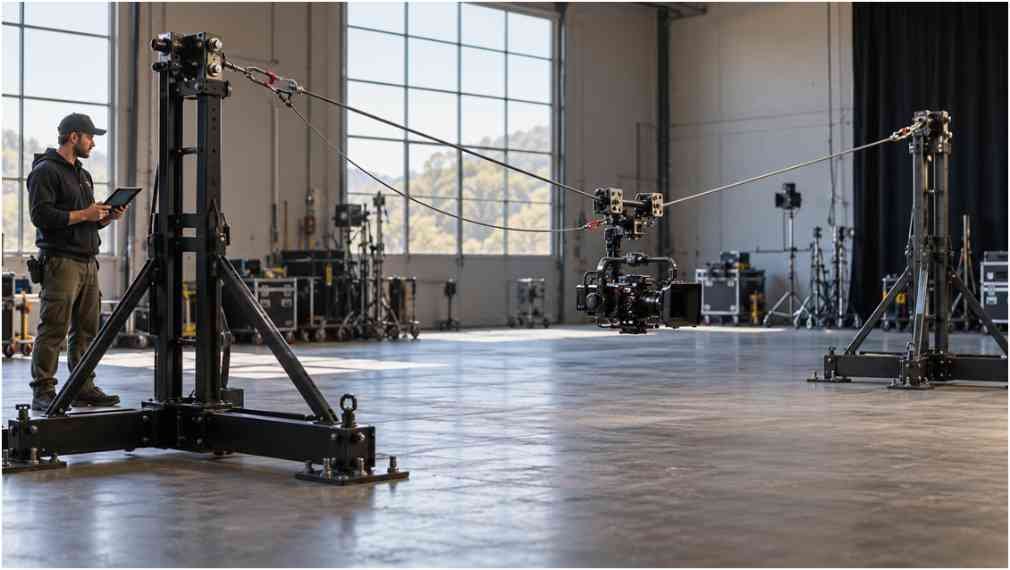
Suppose you have a camera dolly on a 30 foot span with a 50 pound load and a 2 foot allowable sag. Using the standard tension formula for a suspended span, the horizontal tension comes out near 880 pounds before any safety factor, which is a strikingly large number for a 50 pound camera.
The math shows why gaffers distrust people who tension long spans by feel. Now consider the alternative rig, a single angled support cable holding a camera at a shooting angle of 45 degrees with a 20 pound load.
That tension equation resolves to T = (20 times 9.81) divided by the sine of 45 degrees, which gives about 277 newtons, or roughly 62 pounds. Same camera weight, wildly different tension values, depending on geometry.
Any cable tension calculator that returns one number without exposing the geometry assumptions is not useful in a working environment. The best of them show you each step so you can verify the answer against the numbers you recorded on a notepad, and the tension force formula is short enough to do on the back of a call sheet if the phone battery dies.
Comparing Cable Tension Calculator Options
The table below captures the practical differences between common calculator categories without pretending any of them is universally best. Use it as a keel to choose what to keep loaded on your phone.
| Calculator Type | Handles Sag | Handles Angles | Shows Formula | Best For
|
|---|---|---|---|---|
| Phone app, straight tension | No | Yes | Sometimes | Quick estimates for single cables |
| Spreadsheet template | Yes | Yes | Yes, if built right | Repeat rigging jobs with reference numbers |
| Engineering calculator toolbox | Yes | Yes | Yes | Span and sag with traceable math |
| Manufacturer branded calculator | Often | Often | No | Checking a specific product’s limits |
| Paper and pencil | Yes | Yes | Yes | When nothing else is charged |
None of these is a substitute for a structural engineer’s sealed calculation when a shoot involves a rig over people. The calculator is a first-pass tool, not a sign-off.
Where the Formula for Tension Goes Wrong in the Field
When evaluating common film rigging safety mistakes to avoid, three mistakes show up over and over. The first is using the load weight rather than the total weight of load plus rig, which understates the tension equation by 10 to 15 percent on long cable runs. The second is ignoring the horizontal component in a nearly level line, where tension is dominated by preload rather than by any vertical load. The third is assuming a shared load between two cables when the geometry does not actually distribute it evenly, which is the sort of thing a good calculator will warn you about and a bad one will hide.
The formula for tension has a nasty property: it is nonlinear with respect to sag and angle. Halving the sag quadruples the horizontal tension in a suspended span. That property alone justifies using a cable tension calculator every time rather than trusting a rule of thumb, because the interior of the curve is where hardware fails and where the numbers on the load tester read back higher than anyone expected.
Setting Up a Repeatable Tensiometer Workflow
Once the cable tension calculator confirms the target number, the actual measurement gets done with a tensiometer, a load cell, or a calibrated pull gauge. Measure the tension on each cable at the attachment point and log the reading with a timestamp.
Compare the reading to the calculated value. If the measured number is within 10 percent of the calculated one, the rig is behaving as expected. If it is off by more than that, the geometry assumptions were wrong, and the calculator needs better inputs. The loop is straightforward and it catches rigging errors before the first shot.
Keep the calculator’s inputs saved with each rig. Over a season of jobs, the reference numbers become an asset, and the tension formula becomes second nature. New crew members inherit the numbers, not the tribal knowledge of who actually knows what a pound of tension feels like. That is how a shop stops being one unreliable memory wide.
Units, Rounding, and the Safety Factor
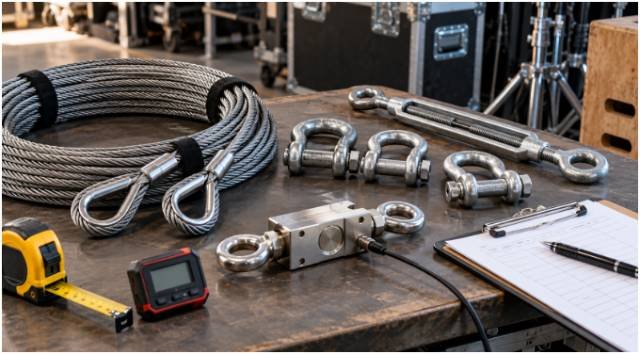
Every cable tension calculator will happily accept a number you typed in millimeters and treat it as inches. Discipline at the input stage is more valuable than any feature on the calculator itself. Round conservatively, always upward when the result feeds a safety decision, and log the safety factor separately from the calculated tension so the number is traceable. A
4:1 safety factor on the calculated tension is a common floor for motion picture overhead rigging, though the working load limit on the specific hardware, or a qualified engineer’s specification, always wins if the two disagree.
The formula for tension produces a working figure. The safety factor is the operational judgement layered on top of it, and it depends on the rig location, the number of people underneath, and the inspection history of the hardware in the bag. A good cable tension calculator leaves the safety factor to the operator, and a bad one hides it inside a black box.
What to Keep on the Truck
The crews I trust most never leave the shop without three things: a printed copy of the standard span tension formula, a phone with a calculator that shows its steps, and a calibrated tensiometer whose certificate is still in date. The cable tension calculator is the second of those three, not a replacement for the other two. Treat the calculator as a disciplined check on what you already know, and the tension numbers on the rig will hold up under inspection and under the load that actually matters.