






If a single network packet misses its physical arrival window by a fraction of a microsecond on a half-duplex line, the entire data frame collapses into noise. That critical, split-second boundary is known in network architecture as two times propagation time—or 2XPT.
Yet, if you mention the string 2X & 2XPT to an automation engineer, a drone cinematographer, or an apparel buyer, you will get three entirely different explanations. Technical jargon frequently collides across industries, creating a alphabet soup of acronyms that mean radically different things depending on your job description.
Whether you are configuring early-stage Ethernet protocols, wiring fail-safe industrial RTDs, mounting payload gimbals to an uncrewed aircraft, or picking out big-and-tall workwear, understanding the precise context of 2X and 2XPT prevents costly deployment mistakes.
1. Computer Networking: The CSMA/CD Collision Boundary
In local area networking, the acronyms 2X and 2XPT root back to the foundational mechanisms of half-duplex Ethernet under the Carrier Sense Multiple Access with Collision Detection (CSMA/CD) protocol standardized by IEEE.
To coordinate multiple devices sharing a single copper wire, CSMA/CD relies on strict timing constraints governed by physical propagation speed:
- Propagation Time (1X PT): The absolute duration required for an electrical pulse to travel from one end of a cable segment to the furthest receiving node.
- Two Times Propagation Time (2XPT): The maximum worst-case time window required for a transmitting station to detect a collision. It accounts for a signal traveling all the way to the far end of the cable, colliding with another transmission at the last microsecond, and returning the resulting voltage spike back to the original sender.
If a device streams data for the full duration of 2XPT without detecting a voltage irregularity, it has officially “captured” the channel. Any station attempting to send after that point will sense the busy line and defer.
Because half-duplex links depend on this round-trip timing, the physical length of a network segment and the minimum frame size (512 bits in classic 10Mbps Ethernet) are mathematically locked together. If the frame ends before 2XPT elapses, a transmitting node might assume its packet arrived safely—unaware that a late collision destroyed the data at the far end of the wire.
2. Industrial Automation: Redundant Platinum Temperature Sensors
Step out of the server room and onto a manufacturing floor, and 2X & 2XPT take on a physical hardware identity. Here, engineers use these terms as shorthand for industrial resistance temperature detectors (RTDs).
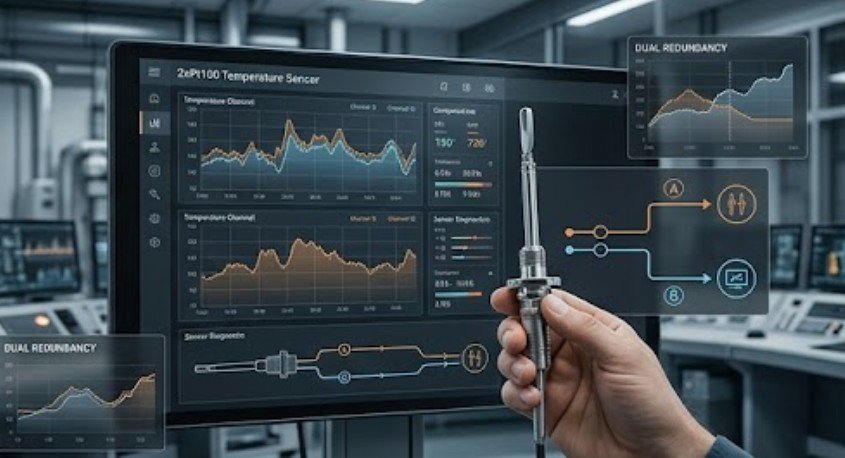
In chemical processing, power plants, and pharmaceutical production, temperature monitoring cannot afford a single point of failure. Sensor manufacturers solve this by packaging two independent platinum measuring coils inside a single protective stainless steel sheath:
- 2X (Dual Circuit Short-Hand): Signifies a dual-element probe containing two distinct, isolated sensing circuits.
- 2xPt (or 2xPt100 / 2xPt1000): Specifies dual-element platinum sensors calibrated to standard resistance profiles. A 2xPt100 sensor, for instance, houses two platinum elements that each measure 100 ohms at 0°C (32°F), built in accordance with international standards verified by organizations like the National Institute of Standards and Technology.
This dual-element construction offers two distinct practical advantages:
- Hardware Redundancy: If Element A burns out or drifts due to severe vibration, Element B provides an instant fallback without requiring process shutdown or instrument unthreading.
- Dual Output System Monitoring: One internal element feeds continuous real-time data to an operator interface, while the secondary element routes directly to an independent emergency shut-off relay.
3. Precision Aerial Imaging: The PhotoShip One Camera Gimbal
Within remote-control aviation and early uncrewed aerial vehicle (UAV) survey industries, the 2X and 2XPT designations reference a historic line of light-payload camera stabilization mounts engineered by PhotoShip One.
Designed prior to the total dominance of direct-drive brushless motors, these mechanical gimbals relied on custom gear reduction and high-speed radio control (RC) servos to isolate camera shake for high-resolution aerial photography.
The 2X Standalone Gimbal
The base PhotoShip One 2X was constructed primarily from high-strength G10-FR4 fiberglass composite plates and CNC-machined aluminum standoffs to keep overall weight minimal.
Key technical characteristics of the 2X include:
- Payload Capacity: Rated to balance mirrorless and DSLR cameras weighing up to 4 pounds (including models like the Canon 5D/7D series), provided the camera’s center of gravity was dialed into the tilt axis.
- 5:1 Gear Reduction: Both pan and tilt axes used 5:1 gear sets. This allowed standard pulse-width modulation (PWM) servos operating between 900–2100 microseconds to generate five times their native torque while dampening micro-jitter.
- 360-Degree Continuous Motion: Fitted with specialized slip rings or continuous-rotation setups, allowing unrestricted rotation along both axes.
- Gyroscopic Integration: Native compatibility with single-axis RC helicopter rate gyros to active-stabilize camera movement against wind buffeting.
The 2XPT Complete System
The 2XPT configuration combined the core 2X gimbal with a dedicated Front Mount Tube System (FMTS).
Instead of hanging directly under the belly of an aircraft where landing gear could obstruct the lens, the 2XPT bolted directly to the nose framework of heavy-lift RC helicopters (such as the Trex 700E, Logo 600, or Maxi Joker 3). This front-slung arrangement gave aerial photographers an unobstructed view forward and straight down.
When mounted in reverse using specialized mast adapters, technicians could also invert the 2X gimbal and bolt it atop telescoping ground booms to inspect elevated infrastructure without flying.
4. Retail & Apparel: Extended Sizing Nomenclature
In consumer retail, 2X and 2XPT define physical garment patterns, particularly within men’s big-and-tall lines and specialized workwear.
While a standard “2XL” focuses strictly on scaling out body width (chest, waist, and hip circumference), specialized sizing tags separate width from vertical length:
- 2X: Represents standard plus-size proportions, widening the body envelope by approximately 4 to 6 inches over a standard XL without increasing garment length.
- 2XPT (or 2XLT): Combines the extended 2X width envelope with a “Tall” or “Petite/Tall” pattern adjustment. In workwear coats, tall variants typically add 2 inches of torso length and 1.5 inches to sleeve lengths, ensuring lower-back coverage when reaching or bending.
Technical Comparison Matrix
To quickly pinpoint which version of 2X & 2XPT applies to your project, consult the functional breakdown below:
| Field / Industry | Primary Function | Core Components | Operational Benchmark |
| Networking | Channel acquisition & collision detection | Half-duplex media, CSMA/CD timing | Must transmit for 2XPT duration without error to secure line. |
| Automation & Sensors | Fail-safe thermal monitoring | Dual Pt100/Pt1000 platinum RTD elements | Dual 100Ω elements at 0°C inside a single protective probe sheath. |
| Aerial Cinematography | Camera payload stabilization | G10-FR4 composite, 5:1 reduction gear, PWM servos | Handles up to 4 lb payload with full 360-degree pan/tilt rotation. |
| Apparel & Workwear | Extended garment proportioning | High-durability textiles, tall-cut patterning | Combines a 2X chest width with extended sleeve and torso length. |
Step-by-Step Diagnostic: Determining Your Industry Context
If you are reviewing architectural documentation, equipment spec sheets, or legacy inventories that list 2X & 2XPT, follow this elimination workflow to identify the correct application:

- Check the Units of Measurement: If the documentation references microseconds ($\mu s$), slot time, or cable distance, you are dealing with networking protocols. If it references ohms ($\Omega$), DIN standards, or temperature limits, it is an industrial RTD sensor.
- Inspect the Physical Construction: If you have hardware in hand, look for moving mechanical joints, gear trains, and servo wires (aerial gimbal) versus a sealed stainless-steel probe with four to six lead wires (dual-element RTD).
- Verify Sizing Codes: If looking at protective outer-wear or flight suits, cross-reference shoulder-to-hem length against sleeve length.
Frequently Asked Questions
1. What does 2XPT stand for in network protocols?
In CSMA/CD networking, 2XPT stands for Two Times Propagation Time. It is the minimum time a node must transmit data to guarantee that a collision has not occurred anywhere along the shared physical medium.
2. Why use a 2xPt100 sensor instead of a standard single Pt100?
A 2xPt100 sensor houses two independent platinum RTD elements inside a single probe casing. This provides instant hardware redundancy and allows separate control systems to read the same process point simultaneously.
3. Can the PhotoShip One 2X gimbal carry modern mirrorless cameras?
Yes. The 2X gimbal handles payloads up to 4 pounds. As long as the camera’s center of gravity aligns precisely with the tilt axis, modern mirrorless systems fit easily within its adjustment frame.
4. What is the difference between 2X and 2XPT in clothing sizes?
A standard 2X increases the garment’s overall chest and waist circumference. A 2XPT (or 2XLT) retains that expanded chest width while adding critical length to the torso and sleeves for taller individuals.
Choosing the Right Standard for Your Project
Technical codes rarely exist in a vacuum, and mistaking a networking interval for an industrial sensor probe or a legacy camera mount can stall an entire engineering project.
Whether you are calculating half-duplex slot times to prevent packet loss, wiring high-accuracy 2xPt100 temperature sensors into a safety loop, or balancing payload distribution on a specialized aerial rig, isolating the specific industry context upfront keeps your systems running predictably. Always verify equipment datasheets, governing standards (like IEEE 802.3 or IEC 60751), and physical specs before making deployment decisions.