



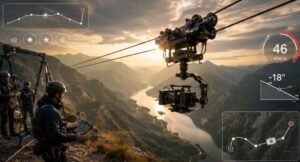
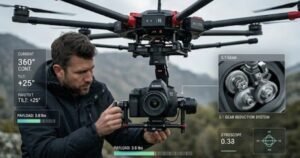
A camera rises above a character and suddenly reveals an entire city block. Another shot begins high over a crowd, then glides down until one face fills the frame. That is what makes camera boom movement in film so effective. A boom shot physically changes the camera’s height, perspective, and relationship to the scene.
What Is a Boom Shot in Filmmaking?
A boom shot is a continuous vertical camera movement in which the entire camera travels up or down through space. Crews usually create it with a jib arm, camera crane, boom arm, hydraulic dolly, or telescoping crane.
Traditional rigs use a mechanical arm with the camera on one end and counterweights on the other. The arm pivots around a central point, helping the camera operator create smooth, controlled movement.
Boom shot, crane shot, and jib shot are related terms, but they are not identical. “Boom” describes the movement, while “jib” and “crane” usually describe the filmmaking equipment used to achieve it.
Boom Up vs. Boom Down: What Changes on Screen?
What Does a Boom-Up Shot Do?
A boom up raises the camera to reveal a larger environment, transition toward a high-angle shot, or make a character appear smaller inside a city, crowd, battlefield, or landscape.
The move can suggest freedom, triumph, discovery, or vastness, but it can also communicate isolation or powerlessness.
Booming upward can increase perceived production value too. A sweeping reveal of a large set, location, or group of extras can give a scene the epic visual scale audiences often associate with major Hollywood productions.
What Does a Boom-Down Shot Do?

A boom down lowers the camera toward the ground or subject. It can move the audience from a broad high-angle view to eye level, turning an establishing shot into a more intimate character moment.
A slow descent can create focus, suspense, or emotional pressure.
Boom Shot vs. Tilt Shot: What Is the Difference?
A tilt keeps the camera in the same physical position while the lens pivots up or down. A boom moves the entire camera vertically through space.
I think of a tilt as standing still and looking from the floor to the ceiling. A boom feels more like riding an elevator while continuing to look forward.
Because the camera travels through space, camera boom movement in film changes perspective, foreground-background relationships, and visual depth in a way a simple tilt cannot.
Why Do Filmmakers Use Boom Shots?
A boom shot can reveal important information without requiring an edit. A director might start tightly on a character, then boom upward to expose a hidden threat, enormous crowd, building, landscape, or sudden change in context.
It is also excellent for communicating scale or isolation. As the camera moves higher and farther from a character, that person can appear increasingly small, emphasizing vulnerability, loneliness, or insignificance.
Boom movement is also useful in live production, where operators may need to cover performers, crowds, stages, or large venues from changing heights. A production breakdown of a multi-camera live event can help show how crane and boom shots fit alongside fixed, handheld, and roaming cameras without disrupting coverage.
Boom movement also creates fluid perspective transitions. A shot can travel from eye-level framing toward a bird’s-eye or God’s-eye view, shifting from an intimate human perspective to a broad, objective one within a single continuous take.
Filmmakers can also use vertical camera movement to follow action, such as someone climbing stairs, standing, descending through a structure, or moving between different levels of a set.
What Equipment Is Used for Boom Camera Movement?

A jib arm is a compact, portable crane system suited to independent films, television productions, music videos, commercials, and smaller U.S. sets. Its mobility makes it useful when filmmakers need smooth vertical movement without the footprint of a full-size production crane.
Production cranes provide much more height and reach and can support heavier camera packages. Some systems use remotely controlled camera heads, while larger configurations may include platforms for operators.
Technocranes take crane movement further. Their telescoping arms can electronically extend and retract during a take, allowing the camera to travel through tight spaces, push toward a subject, and then rise dramatically above the action.
Hydraulic dollies can create shorter vertical shifts, while remote heads allow operators to pan or tilt the lens while the boom itself rises or falls.
How Do You Film a Smooth Boom Shot?
I start by choosing the exact opening and ending composition. The movement should reveal information, follow action, or change perspective for a clear storytelling reason.
Then I rehearse the move with the performers. Camera height, actor blocking, focus, timing, and movement speed must work together. Abrupt starts, poor rig balance, missed focus, and weak final framing can make even expensive crane equipment look amateurish.
Preparing for overcoming difficult weather during an outdoor production helps crews protect the rig, maintain control, and know when conditions make a planned camera move unsafe or impractical.
Focus becomes especially important when the camera-to-subject distance changes. On larger professional productions, a focus puller may adjust focus throughout the shot.
Can You Combine a Boom With Other Camera Movements?
Yes. Filmmakers can combine booming with panning, tilting, dollying, tracking, or zooming. The camera might boom upward while panning to follow an actor or descend while dollying forward.
These combinations become especially valuable in long uninterrupted shots. Studying a production breakdown of complex one-take sequence can show how boom movement, actor blocking, focus pulls, timing, and other camera moves must work together without relying on an edit.
These combinations can create sophisticated cinematic camera movements, but more movement does not automatically create a better shot. Every change should serve the story.
What Are the Most Common Boom Shot Mistakes?
The biggest mistake is moving the camera simply because a crane is available. Camera movement should always have motivation.
Other common problems include confusing a boom with a tilt, incorrectly balancing the crane or jib, using inconsistent movement speed, missing focus, ending on a weak composition, or failing to rehearse with performers.
A successful boom shot should feel intentional from its opening frame to its final position.
When Should You Use a Boom Shot?
I recommend using a boom when changing camera height adds information, emotion, scale, or perspective that a static shot cannot provide.
Environmental reveals, large crowd scenes, landscapes, dramatic architecture, vertical action, hidden dangers, and moments of character isolation are all strong opportunities.
Boom and jib moves can also add polish to commercials, especially when camera movement for product videos needs to reveal tall packaging, appliances, vehicles, or hero products from a more dramatic vertical perspective.
Before planning the move, I ask one simple question: What should the audience understand or feel differently when the camera stops?
If there is a clear answer, the boom movement has a reason to exist.
Frequently Asked Questions
1. Is a boom shot the same as a crane shot?
Not exactly. A boom shot describes vertical camera movement, while a crane is a piece of equipment that can create it. A crane can also perform other sweeping movements.
2. Is a jib shot the same as a boom shot?
A jib is a compact crane-like camera support. Raising or lowering a camera on a jib creates a boom movement.
3. Why do directors use boom shots?
Directors use boom shots to reveal information, establish scale, follow vertical action, shift perspective, create spectacle, and strengthen visual storytelling.
4. What is a Technocrane used for in filmmaking?
A Technocrane uses a telescoping arm that extends or retracts during a take, allowing filmmakers to combine vertical, forward, backward, and sweeping movement within a continuous shot.
Final Thoughts
The best camera boom movement in film does not make viewers wonder how the crane worked. It makes them experience the scene differently. A boom up can turn an intimate character shot into a massive environmental reveal, while a boom down can pull viewers from a distant perspective into an emotionally focused moment.
Equipment matters, but motivation matters more. When vertical movement reveals information, follows action, demonstrates scale, or changes our relationship with a character, the boom shot stops being visual decoration and becomes genuine cinematic storytelling.